Episode Details
Back to Episodes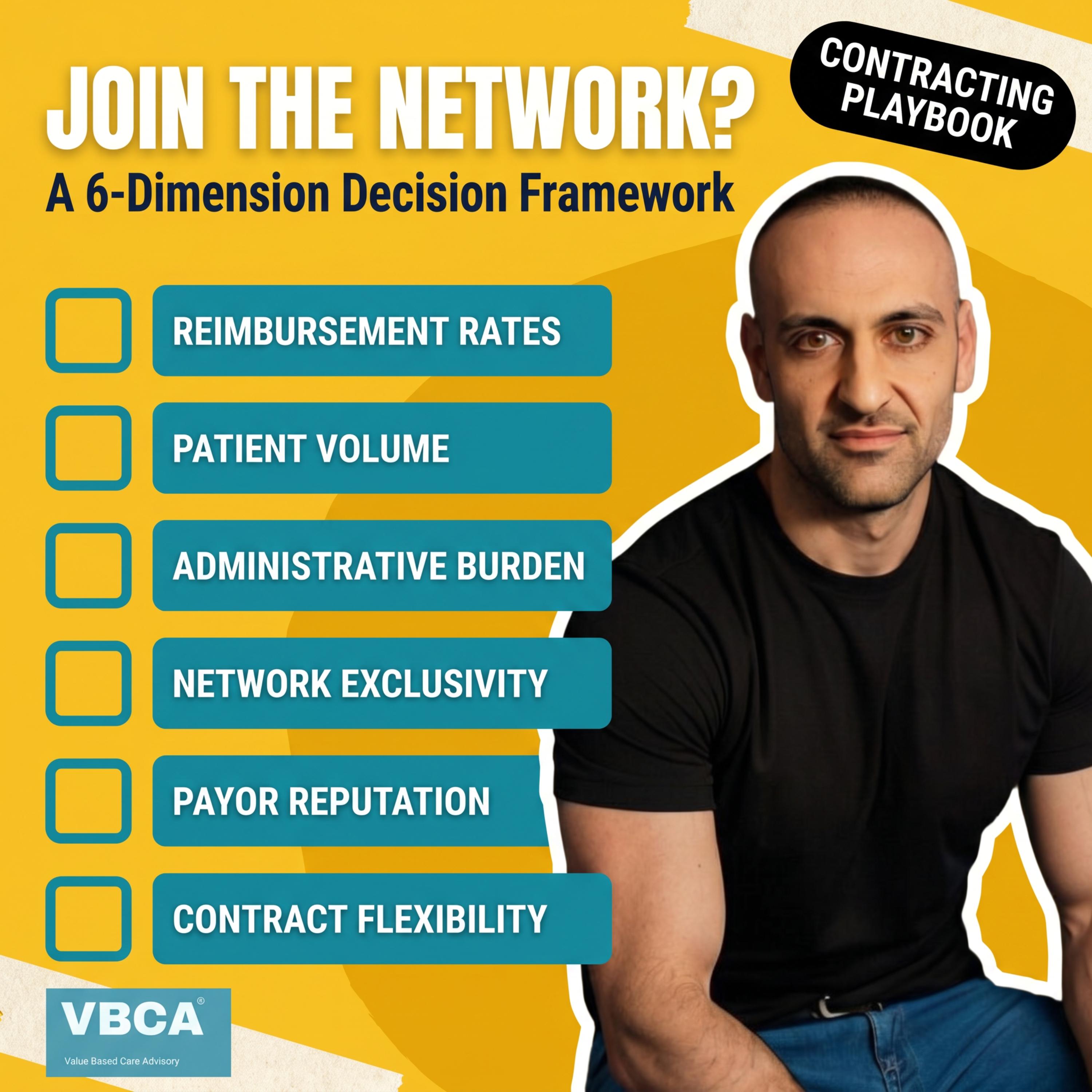
How to Decide to Contract with a Payer: Should You be Joining "the Network"?
Description
You've built the operation — clinicians credentialed, tech stack running, compliance buttoned up. Then a regional Medicaid managed care plan wants to talk about contracting. Your first instinct: great, let's do it. Then someone pulls up the 40-page contract with a 43-code prior authorization matrix and a data-sharing provision you're not sure sits cleanly with your other obligations.
The fee schedule is fine. Not great — fine. And now the question isn't can we do this. It's should we, and on what terms?
In this episode, Alex breaks down the payer contracting decision as what it actually is: a market entry and operational alignment commitment that happens to include a rate negotiation inside it. He walks through the six-dimension evaluation framework every health operator should run before signing anything.
On the Out-of-Network Alternative
Staying out of network intentionally can be a viable model — particularly in specialty markets where a practice can command premium rates on a self-pay or direct-pay basis. But it requires an honest accounting of trade-offs:
- Payment at UCR (usual and customary rates) — not your billed charges, not in-network contracted rates
- Limits on what patients can recover from their own plans, affecting your ability to attract and retain members
- Collection burden shifts to the practice, along with associated staff time and friction
- The No Surprises Act materially changed the out-of-network landscape for behavioral health providers in certain care settings — understand your exposure before assuming OON is a clean alternative
Key Takeaways
- Treat payer contracting as a market entry and operational alignment decision — not just a rate negotiation
- In high-concentration markets, staying out of network often means locking out of the majority of the addressable population
- Your value proposition — especially HEDIS gap closure and measurement-based care data — is a negotiating asset most practices leave on the table
- Operational alignment costs don't show up in the fee schedule. Map them before you sign
- The intersection of payer data sharing requirements and 42 CFR Part 2 is not hypothetical risk — it's real compliance exposure
- For contracts involving risk-sharing, value-based payment terms, or complex data provisions, involve experienced healthcare counsel before execution
Chapter Markers
00:00: Opening scenario — the 40-page contract lands in your inbox
01:30: Reframing the network decision — it's not a rate negotiation
02:40: Dimension 1 — Market access and concentration reality
04:00: Dimension 2 — Knowing and articulating your value proposition
05:10: Dimension 3 — Operational alignment and hidden administrative costs
06:20: Dimension 4 — Payer's past performance and claims adjudication reality
07:30: Dimension 5 — Physician profiling and measurement programs
09:00: Dimension 6 — Data sharing, 42 CFR Part 2, and compliance exposure
10:15: The out-of-network alternative — honest trade-offs
11:20: Practical takeaways and when to involve healthcare counsel