Episode Details
Back to Episodes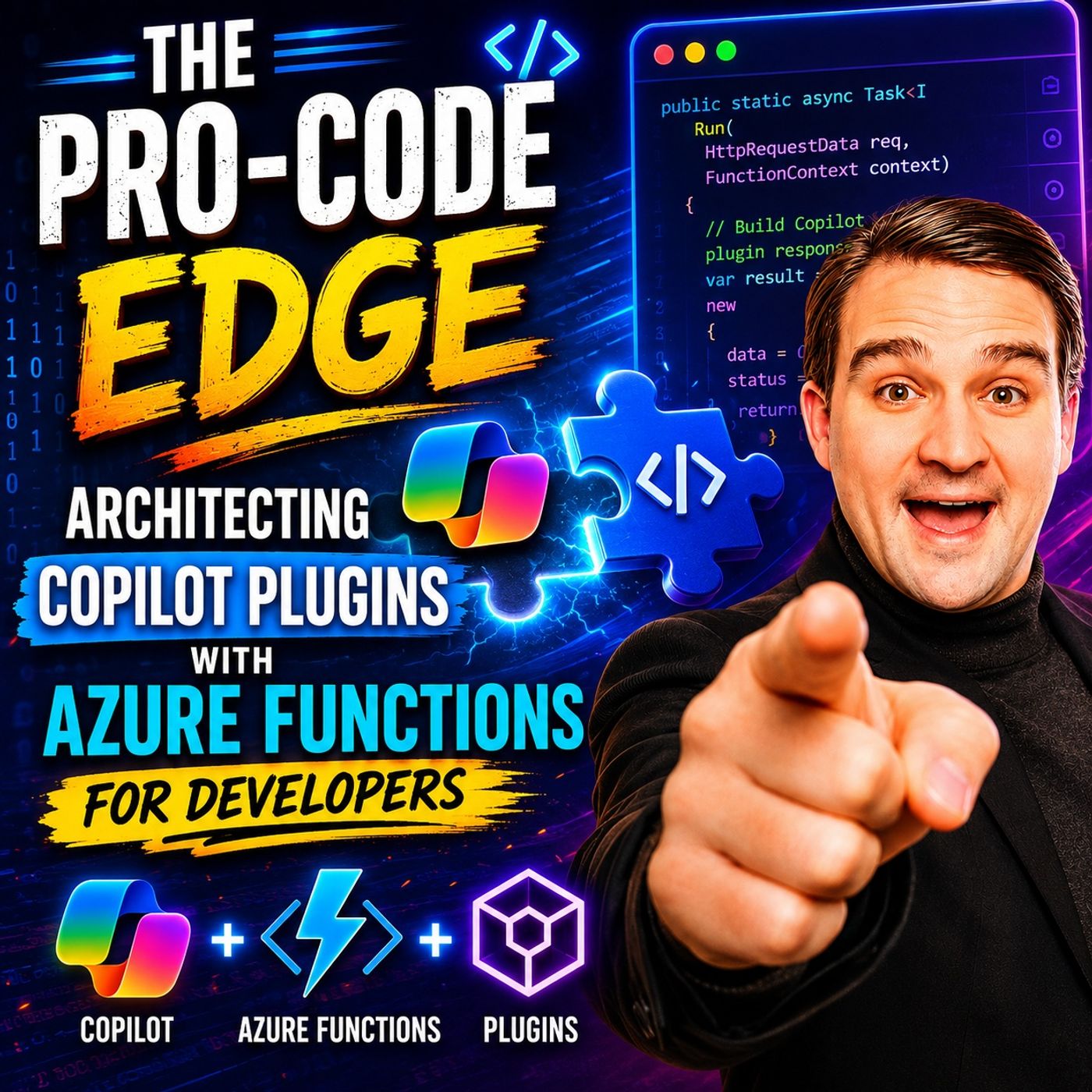
The Pro-Code Edge: Architecting Copilot Plugins with Azure Functions for Developers
Season 2
Published 2 months, 1 week ago
Description
Microsoft Copilot can reason, summarize, and interact with enterprise data, but when real business logic enters the picture, many organizations quickly discover the limitations of standard connectors and low-code workflows. Complex orchestration, multi-system validation, advanced calculations, and enterprise-grade integrations often push Power Platform beyond its comfort zone.In this episode of M365 FM, we explore how developers can extend Copilot using Azure Functions, OpenAPI, API Management, and modern cloud architecture patterns to build plugins that are scalable, secure, and production-ready.
WHY LOW-CODE HITS A WALL
Standard connectors are excellent for simple integrations, but enterprise workloads require much more than moving data between systems.We discuss why connector chains become difficult to maintain, how latency compounds across multiple services, and why low-code expressions eventually become a bottleneck for complex business scenarios. You'll learn where traditional Power Platform approaches begin to break down and why pro-code extensions become necessary.
AZURE FUNCTIONS AS THE EXECUTION LAYER
Azure Functions provide the computational engine behind advanced Copilot experiences.This episode explores:
• HTTP-triggered functions and serverless architectures
• C# isolated worker models
• Dependency injection and enterprise development patterns
• Reusable libraries and type-safe code
• Integration with Power Platform through custom connectorsLearn how Azure Functions become the bridge between conversational AI and real business execution.
THE FLEX CONSUMPTION ADVANTAGE
Performance matters when users expect instant responses.We break down:
• Cold start challenges in serverless environments
• Consumption vs Premium plans
• Flex Consumption architecture
• Always Ready instances
• Cost versus performance tradeoffsYou'll discover why Flex Consumption has become the preferred deployment model for many enterprise Copilot workloads.
OPENAPI: THE LANGUAGE OF AI INTEGRATION
Your OpenAPI specification is more than documentation. It becomes the contract between your code and the large language model.We discuss how to:
• Design AI-friendly operation descriptions
• Create effective parameter schemas
• Improve function discovery by Copilot
• Avoid operation collisions
• Build OpenAPI contracts optimized for LLM reasoningA well-designed specification often determines whether Copilot uses your function successfully or ignores it entirely.
BUILDING HIGH-PERFORMANCE FUNCTIONS
Fast plugins create better user experiences.This episode covers:
• Async programming patterns
• Connection pooling strategies
• Singleton services and dependency management
• ReadyToRun publishing
• Lazy initialization techniques
• Memory and CPU optimizationThese development patterns can dramatically reduce response times while lowering operational costs.
SECURITY, IDENTITY, AND GOVERNANCE
Enterprise plugins must be secure by design.
We examine:
• Managed identities and Entra ID integration
• Private endpoints and network isolation
• On-Behalf-Of authentication flows
• API Management security controls
• Secret management with Azure Key Vault
• Rate limiting and policy enforcementSecurity should never be bolted on after deployment. It must be part of the architecture from day one.
CUSTOM CONNECTORS AND DLP RISKS
Custom connectors provide flexibility, but they also introduce governance challenges.Learn how poorly governed connectors can become unintended pathways around Data Loss Prevention controls and how API Management can act as a security front door to enforce policies, auditing, and traffic inspection.
DUR
WHY LOW-CODE HITS A WALL
Standard connectors are excellent for simple integrations, but enterprise workloads require much more than moving data between systems.We discuss why connector chains become difficult to maintain, how latency compounds across multiple services, and why low-code expressions eventually become a bottleneck for complex business scenarios. You'll learn where traditional Power Platform approaches begin to break down and why pro-code extensions become necessary.
AZURE FUNCTIONS AS THE EXECUTION LAYER
Azure Functions provide the computational engine behind advanced Copilot experiences.This episode explores:
• HTTP-triggered functions and serverless architectures
• C# isolated worker models
• Dependency injection and enterprise development patterns
• Reusable libraries and type-safe code
• Integration with Power Platform through custom connectorsLearn how Azure Functions become the bridge between conversational AI and real business execution.
THE FLEX CONSUMPTION ADVANTAGE
Performance matters when users expect instant responses.We break down:
• Cold start challenges in serverless environments
• Consumption vs Premium plans
• Flex Consumption architecture
• Always Ready instances
• Cost versus performance tradeoffsYou'll discover why Flex Consumption has become the preferred deployment model for many enterprise Copilot workloads.
OPENAPI: THE LANGUAGE OF AI INTEGRATION
Your OpenAPI specification is more than documentation. It becomes the contract between your code and the large language model.We discuss how to:
• Design AI-friendly operation descriptions
• Create effective parameter schemas
• Improve function discovery by Copilot
• Avoid operation collisions
• Build OpenAPI contracts optimized for LLM reasoningA well-designed specification often determines whether Copilot uses your function successfully or ignores it entirely.
BUILDING HIGH-PERFORMANCE FUNCTIONS
Fast plugins create better user experiences.This episode covers:
• Async programming patterns
• Connection pooling strategies
• Singleton services and dependency management
• ReadyToRun publishing
• Lazy initialization techniques
• Memory and CPU optimizationThese development patterns can dramatically reduce response times while lowering operational costs.
SECURITY, IDENTITY, AND GOVERNANCE
Enterprise plugins must be secure by design.
We examine:
• Managed identities and Entra ID integration
• Private endpoints and network isolation
• On-Behalf-Of authentication flows
• API Management security controls
• Secret management with Azure Key Vault
• Rate limiting and policy enforcementSecurity should never be bolted on after deployment. It must be part of the architecture from day one.
CUSTOM CONNECTORS AND DLP RISKS
Custom connectors provide flexibility, but they also introduce governance challenges.Learn how poorly governed connectors can become unintended pathways around Data Loss Prevention controls and how API Management can act as a security front door to enforce policies, auditing, and traffic inspection.
DUR