Episode Details
Back to Episodes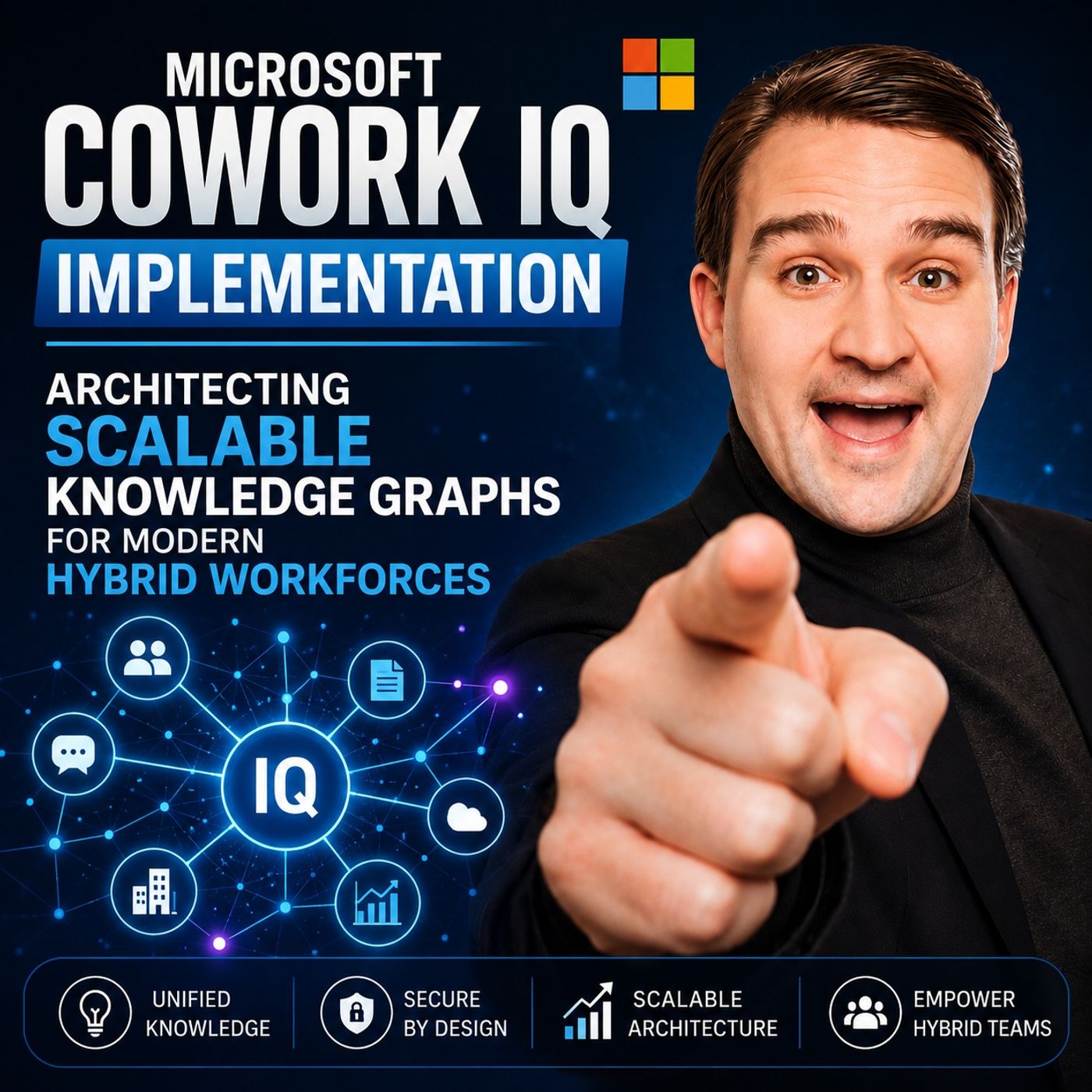
Microsoft Cowork IQ Implementation: Architecting Scalable Knowledge Graphs for Modern Hybrid Workforces
Season 2
Published 2 months, 1 week ago
Description
Most organizations believe they have an AI problem when the real issue is their knowledge architecture. Microsoft Copilot deployments are exposing a deeper enterprise challenge: organizations cannot reliably structure, govern, connect, or retrieve the knowledge they already own. Employees still spend enormous amounts of time searching across SharePoint, Teams, OneDrive, emails, project workspaces, and disconnected business systems trying to find information that technically already exists somewhere inside the tenant.In this episode, Mirko Peters explains why successful enterprise AI deployments in 2026 depend less on the language model itself and far more on the semantic architecture underneath it. This deep technical conversation explores how organizations can design scalable Microsoft CoWork IQ and knowledge graph architectures that transform Copilot from a basic search experience into a trusted enterprise intelligence layer capable of reasoning across organizational knowledge.
THE ENTERPRISE KNOWLEDGE PROBLEM
Hybrid work dramatically increased knowledge fragmentation inside organizations. Institutional knowledge that once moved naturally through conversations, office interactions, and proximity is now scattered across disconnected systems, duplicated documents, forgotten Teams channels, and poorly governed SharePoint environments.This episode explores why modern organizations struggle with discoverability, semantic consistency, and AI readiness even after years of digital transformation investments. Mirko explains why enterprise AI systems fail when organizational context is weak and why generative AI has fundamentally changed what employees expect from enterprise knowledge systems.
UNDERSTANDING MICROSOFT GRAPH & THE SEMANTIC INDEX
Most organizations misunderstand what Microsoft Graph actually is. This episode explains how Microsoft Graph functions as a relationship and context engine connecting people, documents, meetings, identities, permissions, and collaboration signals across Microsoft 365.The conversation breaks down the three architectural layers powering modern Copilot experiences:The Microsoft Graph relationship layer, the Semantic Index for Copilot, and Fabric semantic models.Mirko explains how these systems work together to create meaning-aware retrieval experiences that allow AI systems to reason across organizational relationships rather than simply searching files by keyword.
WHY COPILOT DEPLOYMENTS UNDERDELIVER
Many organizations experience the same deployment pattern after rolling out Copilot. Early demos create excitement, but production usage slowly exposes retrieval problems, governance gaps, outdated citations, overshared content, and weak answer quality.This episode explains why these failures are usually not model problems. They are architecture problems caused by weak metadata structures, inconsistent governance, poor permissions hygiene, and disconnected content estates.The conversation explores how retrieval quality directly shapes AI reliability and why organizations that skip foundational information architecture work consistently struggle with trust and adoption.
KNOWLEDGE GRAPHS IN MICROSOFT 365
Mirko breaks down what a knowledge graph actually means in a Microsoft 365 environment. The episode explores how entities, relationships, metadata, and organizational context combine to create AI-ready semantic architectures capable of supporting enterprise reasoning.Rather than functioning as a traditional search platform, a knowledge graph allows AI systems to traverse relationships between projects, people, systems, policies, documents, customers, and business processes in real time.The discussion explains how Microsoft 365 services including SharePoint, Teams, Entra ID, Purview, and Fabric semantic models contribute to building this organizational intelligence layer.
META
THE ENTERPRISE KNOWLEDGE PROBLEM
Hybrid work dramatically increased knowledge fragmentation inside organizations. Institutional knowledge that once moved naturally through conversations, office interactions, and proximity is now scattered across disconnected systems, duplicated documents, forgotten Teams channels, and poorly governed SharePoint environments.This episode explores why modern organizations struggle with discoverability, semantic consistency, and AI readiness even after years of digital transformation investments. Mirko explains why enterprise AI systems fail when organizational context is weak and why generative AI has fundamentally changed what employees expect from enterprise knowledge systems.
UNDERSTANDING MICROSOFT GRAPH & THE SEMANTIC INDEX
Most organizations misunderstand what Microsoft Graph actually is. This episode explains how Microsoft Graph functions as a relationship and context engine connecting people, documents, meetings, identities, permissions, and collaboration signals across Microsoft 365.The conversation breaks down the three architectural layers powering modern Copilot experiences:The Microsoft Graph relationship layer, the Semantic Index for Copilot, and Fabric semantic models.Mirko explains how these systems work together to create meaning-aware retrieval experiences that allow AI systems to reason across organizational relationships rather than simply searching files by keyword.
WHY COPILOT DEPLOYMENTS UNDERDELIVER
Many organizations experience the same deployment pattern after rolling out Copilot. Early demos create excitement, but production usage slowly exposes retrieval problems, governance gaps, outdated citations, overshared content, and weak answer quality.This episode explains why these failures are usually not model problems. They are architecture problems caused by weak metadata structures, inconsistent governance, poor permissions hygiene, and disconnected content estates.The conversation explores how retrieval quality directly shapes AI reliability and why organizations that skip foundational information architecture work consistently struggle with trust and adoption.
KNOWLEDGE GRAPHS IN MICROSOFT 365
Mirko breaks down what a knowledge graph actually means in a Microsoft 365 environment. The episode explores how entities, relationships, metadata, and organizational context combine to create AI-ready semantic architectures capable of supporting enterprise reasoning.Rather than functioning as a traditional search platform, a knowledge graph allows AI systems to traverse relationships between projects, people, systems, policies, documents, customers, and business processes in real time.The discussion explains how Microsoft 365 services including SharePoint, Teams, Entra ID, Purview, and Fabric semantic models contribute to building this organizational intelligence layer.
META