Episode Details
Back to Episodes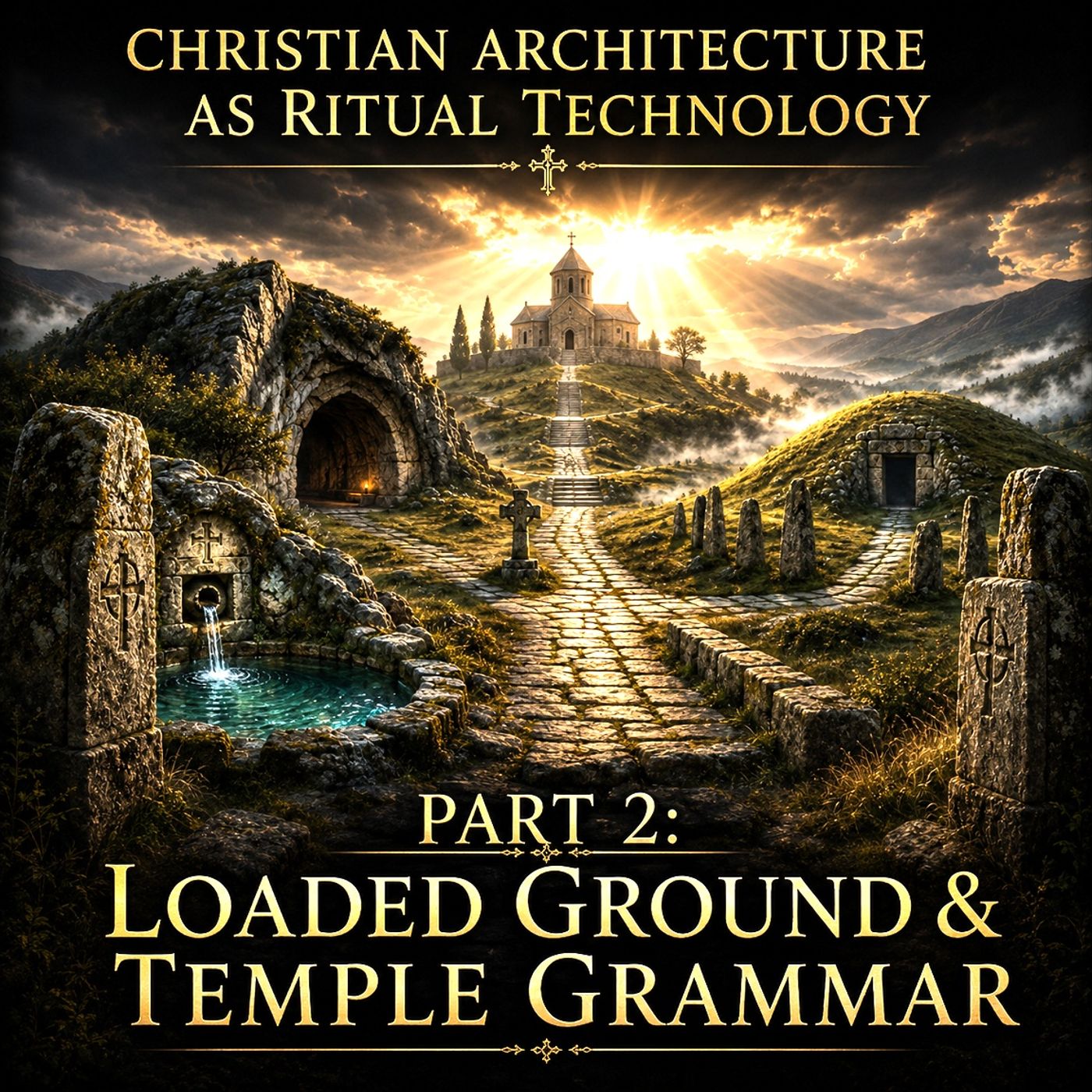
Christian Architecture as Ritual Technology Part 2- Loaded Ground and Temple Grammar
Published 3 months ago
Description
If you enjoy this episode, we’re sure you will enjoy more content like this on The Occult Rejects. In fact, we have curated playlists on occult topics like grimoires, esoteric concepts and phenomena, occult history, analyzing true crime and cults with an occult lens, Para politics, and occultism in music. Whether you enjoy consuming your content visually or via audio, we’ve got you covered - and it will always be provided free of charge. So, if you enjoy what we do and want to support our work of providing accessible, free content on various platforms, please consider making a donation to the links provided below.
Thank you and enjoy the episode!
Links For The Occult Rejects
https://linktr.ee/theoccultrejects
Occult Research Institute
https://www.occultresearchinstitute.org/
Substack
https://substack.com/@theoccultrejects?r=7auau0&utm_campaign=profile&utm_medium=profile-page
Cash App
https://cash.app/$theoccultrejects
Venmo
@TheOccultRejects
Buy Me A Coffee
buymeacoffee.com/TheOccultRejects
Patreon
https://www.patreon.com/TheOccultRejects
BIBLIOGRAPHY
Loaded Ground and Temple Grammar
Bradley, Richard. An Archaeology of Natural Places.
Key use: Natural features as ritual centers: springs, caves, mountains, watery places, unusual stones, and the way landscape itself becomes an active participant in sacred behavior.
Bradley, Richard. The Significance of Monuments: On the Shaping of Human Experience in Neolithic and Bronze Age Europe.
Key use: Monumentality, repeated movement, ritual landscapes, and how built earth/stone structures anchor memory and collective story.
Scarre, Chris, ed. Monuments and Landscape in Atlantic Europe: Perception and Society During the Neolithic and Early Bronze Age.
Key use: Landscape archaeology, perception, monument placement, sacred routes, and social memory.
Tilley, Christopher. A Phenomenology of Landscape: Places, Paths and Monuments.
Key use: Embodied movement through sacred landscapes. Good for explaining why approach, walking, turning, climbing, entering, and returning matter as much as the site itself.
Ruggles, Clive. Ancient Astronomy: An Encyclopedia of Cosmologies and Myth.
Key use: Archaeoastronomy, horizon alignment, sky events, and methodological caution against sloppy “everything is a star map” claims.
Ruggles, Clive. Astronomy in Prehistoric Britain and Ireland.
Key use: Prehistoric monuments, solar/lunar alignments, and sky-ground relationships.
Watson, Aaron, and David Keating. “Architecture and Sound: An Acoustic Analysis of Megalithic Monuments in Prehistoric Britain.” Antiquity 73, no. 280 (1999): 325–336.
Key use: Archaeoacoustics, megalithic sound environments, echo, resonance, and how ancient monuments may have shaped movement and perception through sound as well as sight.
Eliade, Mircea. The Sacred and the Profane: The Nature of Religion.
Key use: Sacred space, center, axis mundi, threshold, and the difference between ordinary space and holy space.
Smith, Jonathan Z. To Take Place: Toward Theory in Ritual.
Key use: Ritual as place-making. Useful for the idea that sacred places are not merely found; they are produced through repeated action, interpretation, and return.
Tuan, Yi-Fu. Space and Place: The Perspective of Experience.
Key use: Lived place, memory, orientation, and the difference between abstract space and meaningful place.
van Gennep, Arnold. The Rites of Passage.
Key use: Separation, threshold, and incorporation. Useful for crossings, caves, temples, initiation, and the movement from ordinary to sacred space.
Turner, Victor. The Ritual Process: Structure and Anti-Structure.
Key use: Liminality, betweenness, communitas, and why thresholds create psychological and social transformation.
Vitruv
Thank you and enjoy the episode!
Links For The Occult Rejects
https://linktr.ee/theoccultrejects
Occult Research Institute
https://www.occultresearchinstitute.org/
Substack
https://substack.com/@theoccultrejects?r=7auau0&utm_campaign=profile&utm_medium=profile-page
Cash App
https://cash.app/$theoccultrejects
Venmo
@TheOccultRejects
Buy Me A Coffee
buymeacoffee.com/TheOccultRejects
Patreon
https://www.patreon.com/TheOccultRejects
BIBLIOGRAPHY
Loaded Ground and Temple Grammar
Bradley, Richard. An Archaeology of Natural Places.
Key use: Natural features as ritual centers: springs, caves, mountains, watery places, unusual stones, and the way landscape itself becomes an active participant in sacred behavior.
Bradley, Richard. The Significance of Monuments: On the Shaping of Human Experience in Neolithic and Bronze Age Europe.
Key use: Monumentality, repeated movement, ritual landscapes, and how built earth/stone structures anchor memory and collective story.
Scarre, Chris, ed. Monuments and Landscape in Atlantic Europe: Perception and Society During the Neolithic and Early Bronze Age.
Key use: Landscape archaeology, perception, monument placement, sacred routes, and social memory.
Tilley, Christopher. A Phenomenology of Landscape: Places, Paths and Monuments.
Key use: Embodied movement through sacred landscapes. Good for explaining why approach, walking, turning, climbing, entering, and returning matter as much as the site itself.
Ruggles, Clive. Ancient Astronomy: An Encyclopedia of Cosmologies and Myth.
Key use: Archaeoastronomy, horizon alignment, sky events, and methodological caution against sloppy “everything is a star map” claims.
Ruggles, Clive. Astronomy in Prehistoric Britain and Ireland.
Key use: Prehistoric monuments, solar/lunar alignments, and sky-ground relationships.
Watson, Aaron, and David Keating. “Architecture and Sound: An Acoustic Analysis of Megalithic Monuments in Prehistoric Britain.” Antiquity 73, no. 280 (1999): 325–336.
Key use: Archaeoacoustics, megalithic sound environments, echo, resonance, and how ancient monuments may have shaped movement and perception through sound as well as sight.
Eliade, Mircea. The Sacred and the Profane: The Nature of Religion.
Key use: Sacred space, center, axis mundi, threshold, and the difference between ordinary space and holy space.
Smith, Jonathan Z. To Take Place: Toward Theory in Ritual.
Key use: Ritual as place-making. Useful for the idea that sacred places are not merely found; they are produced through repeated action, interpretation, and return.
Tuan, Yi-Fu. Space and Place: The Perspective of Experience.
Key use: Lived place, memory, orientation, and the difference between abstract space and meaningful place.
van Gennep, Arnold. The Rites of Passage.
Key use: Separation, threshold, and incorporation. Useful for crossings, caves, temples, initiation, and the movement from ordinary to sacred space.
Turner, Victor. The Ritual Process: Structure and Anti-Structure.
Key use: Liminality, betweenness, communitas, and why thresholds create psychological and social transformation.
Vitruv