Episode Details
Back to Episodes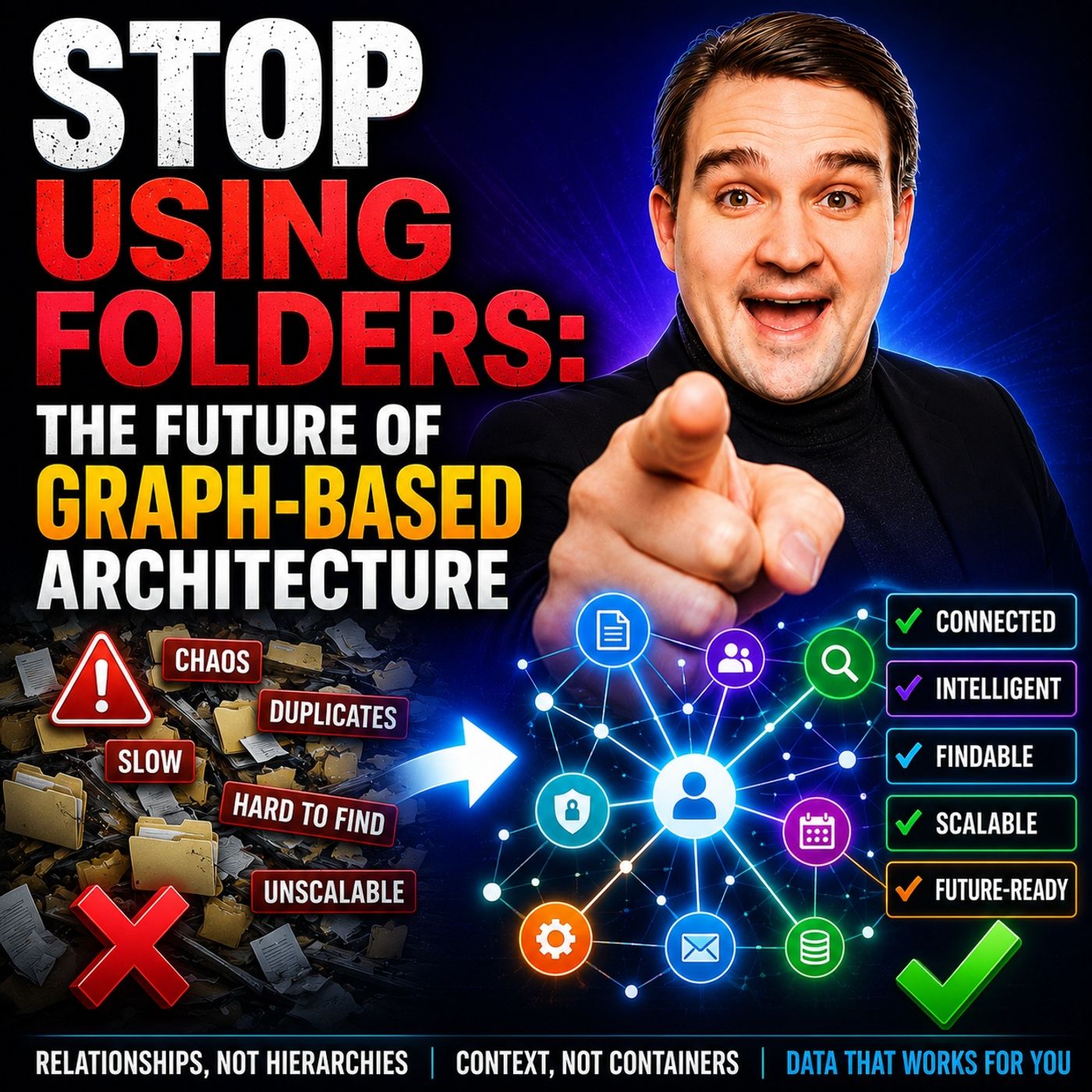
Stop Using Folders: The Future of Graph-Based Architecture
Season 2
Published 2 months, 1 week ago
Description
For decades, enterprises built their digital workplaces around folders, directories, and deeply nested hierarchies. The assumption was simple: if information was organized into the right structure, people would always be able to find it. But in 2026, that assumption is collapsing under the weight of modern data complexity. Work no longer starts with navigation. It starts with context. This episode explores why traditional folder structures are becoming obsolete and how graph-based architecture is redefining the future of Microsoft 365, SharePoint, and enterprise collaboration. Instead of organizing files by location, modern systems organize information by meaning, relationships, and intent. The result is a complete shift away from static hierarchies toward intelligent connected knowledge networks.
THE NAVIGATION MYTH
Most organizations still accept “folder hell” as a normal part of work. But the cost is enormous. Research shows employees spend nearly nineteen percent of their day simply searching for information across folders, drives, and disconnected repositories. That represents a massive productivity tax hidden inside everyday collaboration. The problem is not just speed. Folder structures force users to remember where another human decided to save something years earlier. That creates constant cognitive overload and turns collaboration into an exercise in digital archaeology.
WHY FOLDERS FAIL AT SCALE
THE COLLAPSE OF STATIC HIERARCHIES
A single document today often serves multiple purposes simultaneously. A contract may represent a legal record, a revenue event, a project milestone, and a customer relationship artifact all at once. Traditional folders force organizations to choose one “correct” location, even though the data naturally exists across multiple business dimensions. That limitation creates one of the biggest enterprise problems in modern collaboration systems: duplication. When users cannot decide where a file belongs, they create copies. Those copies slowly diverge, producing conflicting versions of the truth across departments and workflows. What begins as organization eventually becomes fragmentation. The folder model was designed for physical filing cabinets. Enterprise data is no longer physical. It is relational.
THE RISE OF MICROSOFT GRAPH AND SEMANTIC ARCHITECTURE
This episode dives deep into the rise of Microsoft Graph and semantic indexing as the foundation of next-generation information architecture. Instead of treating files as isolated objects stored in containers, graph-based systems understand relationships between people, projects, meetings, conversations, documents, and workflows. The system no longer focuses on where information lives. It focuses on what the information means. The Microsoft Graph transforms enterprise content into an interconnected neural network of organizational knowledge. Through vector-based semantic indexing, systems can now understand concepts, intent, and contextual relationships instead of relying purely on keyword matching.
KEY GRAPH-BASED CONCEPTS DISCUSSED
SHAREPOINT PREMIUM AND THE METADAT
THE NAVIGATION MYTH
Most organizations still accept “folder hell” as a normal part of work. But the cost is enormous. Research shows employees spend nearly nineteen percent of their day simply searching for information across folders, drives, and disconnected repositories. That represents a massive productivity tax hidden inside everyday collaboration. The problem is not just speed. Folder structures force users to remember where another human decided to save something years earlier. That creates constant cognitive overload and turns collaboration into an exercise in digital archaeology.
WHY FOLDERS FAIL AT SCALE
- Deep hierarchies overwhelm human memory
- File duplication creates conflicting versions of truth
- Teams waste time navigating instead of creating
- Information becomes trapped inside organizational silos
THE COLLAPSE OF STATIC HIERARCHIES
A single document today often serves multiple purposes simultaneously. A contract may represent a legal record, a revenue event, a project milestone, and a customer relationship artifact all at once. Traditional folders force organizations to choose one “correct” location, even though the data naturally exists across multiple business dimensions. That limitation creates one of the biggest enterprise problems in modern collaboration systems: duplication. When users cannot decide where a file belongs, they create copies. Those copies slowly diverge, producing conflicting versions of the truth across departments and workflows. What begins as organization eventually becomes fragmentation. The folder model was designed for physical filing cabinets. Enterprise data is no longer physical. It is relational.
THE RISE OF MICROSOFT GRAPH AND SEMANTIC ARCHITECTURE
This episode dives deep into the rise of Microsoft Graph and semantic indexing as the foundation of next-generation information architecture. Instead of treating files as isolated objects stored in containers, graph-based systems understand relationships between people, projects, meetings, conversations, documents, and workflows. The system no longer focuses on where information lives. It focuses on what the information means. The Microsoft Graph transforms enterprise content into an interconnected neural network of organizational knowledge. Through vector-based semantic indexing, systems can now understand concepts, intent, and contextual relationships instead of relying purely on keyword matching.
KEY GRAPH-BASED CONCEPTS DISCUSSED
- Semantic indexing and vector similarity
- Context-aware information discovery
- Relationship-driven architecture
- AI-powered organizational intelligence
SHAREPOINT PREMIUM AND THE METADAT