Episode Details
Back to Episodes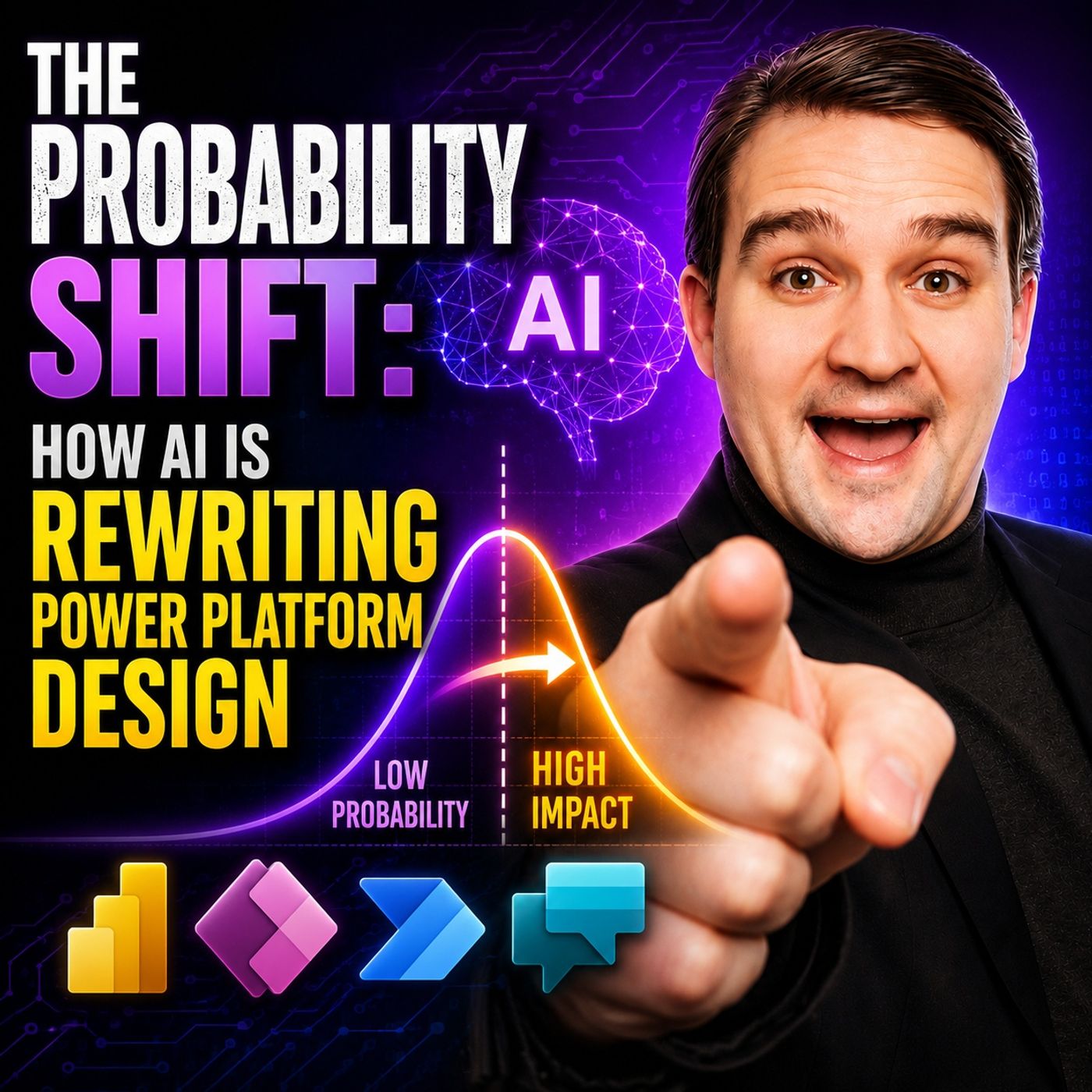
The Probability Shift: How AI is Rewriting Power Platform Design
Season 2
Published 2 months, 2 weeks ago
Description
Most Power Platform automations are failing for one simple reason: they were built for a world that no longer exists. Traditional low-code systems depend on rigid “if-then” logic, clean data, and predictable inputs. But modern enterprise data is chaotic, unstructured, and constantly changing. The result is what many organizations are experiencing right now — brittle automations that collapse the moment reality gets messy. This episode explores the massive architectural shift happening across the Power Platform ecosystem as AI transforms automation from deterministic logic into probabilistic design. Instead of asking, “Is this exactly correct?” modern systems ask, “How likely is this to be correct?” That subtle change is rewriting how enterprise workflows are designed, governed, and scaled.
THE DEATH OF DETERMINISTIC AUTOMATION
For years, enterprise automation depended on exact matches and structured logic. If a field matched perfectly, the flow continued. If a single character changed, the system failed. That worked when business data lived inside carefully structured databases. But today, most enterprise information exists in emails, PDFs, Teams chats, voice transcripts, and unstructured documents. Traditional Power Automate flows struggle in this environment because they cannot understand context or intent. A deterministic system sees “Invoice 202” and “Inv-202” as completely unrelated values. AI-powered systems see similarity instead of exactness. That shift changes everything.
KEY TOPICS COVERED
THE RISE OF CONFIDENCE-BASED ROUTING
One of the biggest changes AI introduces into Power Platform design is the concept of the confidence score. Instead of binary true-or-false logic, AI models return probabilities that quantify uncertainty. That means workflows can finally understand doubt instead of pretending certainty always exists. This episode breaks down the architecture behind confidence-based routing and explains how modern Power Platform solutions now separate actions into Green, Yellow, and Red confidence zones. High-confidence outputs move automatically. Medium-confidence results trigger human review. Low-confidence outputs are rejected or escalated before they damage production systems.
WHY CONFIDENCE SCORES MATTER
FUZZY MATCHING AND SEMANTIC LOGIC
The conversation also dives deep into fuzzy matching, semantic reasoning, and the evolution from character-based automation toward meaning-based automation. Traditional systems compare syntax. AI compares concepts. That means a probabilistic system can understand that “IBM” and “I.B.M.” likely refer to the same entity, or that “Customer” and “Client” often represent identical business meaning. This dramatically increases match rates and reduces the amount of manual cleanup required to keep workflows operational. The episode explores how techniques like Levenshtein distance, semantic embeddings, and AI-powered classification are changing the way architects design resilient low-code systems capable of handling imperfect human-generated data.
BUILDING SELF-CORRECTING WORKFLOWS
AI systems are powerful, but they hallucinate. That reality
THE DEATH OF DETERMINISTIC AUTOMATION
For years, enterprise automation depended on exact matches and structured logic. If a field matched perfectly, the flow continued. If a single character changed, the system failed. That worked when business data lived inside carefully structured databases. But today, most enterprise information exists in emails, PDFs, Teams chats, voice transcripts, and unstructured documents. Traditional Power Automate flows struggle in this environment because they cannot understand context or intent. A deterministic system sees “Invoice 202” and “Inv-202” as completely unrelated values. AI-powered systems see similarity instead of exactness. That shift changes everything.
KEY TOPICS COVERED
- Why rigid low-code automations keep breaking
- The rise of probabilistic workflow design
- How confidence scores redefine governance
- Why fuzzy matching matters more than exact matching
THE RISE OF CONFIDENCE-BASED ROUTING
One of the biggest changes AI introduces into Power Platform design is the concept of the confidence score. Instead of binary true-or-false logic, AI models return probabilities that quantify uncertainty. That means workflows can finally understand doubt instead of pretending certainty always exists. This episode breaks down the architecture behind confidence-based routing and explains how modern Power Platform solutions now separate actions into Green, Yellow, and Red confidence zones. High-confidence outputs move automatically. Medium-confidence results trigger human review. Low-confidence outputs are rejected or escalated before they damage production systems.
WHY CONFIDENCE SCORES MATTER
- They expose uncertainty instead of hiding it
- They reduce silent automation failures
- They align business risk with automation logic
- They enable scalable human-in-the-loop governance
FUZZY MATCHING AND SEMANTIC LOGIC
The conversation also dives deep into fuzzy matching, semantic reasoning, and the evolution from character-based automation toward meaning-based automation. Traditional systems compare syntax. AI compares concepts. That means a probabilistic system can understand that “IBM” and “I.B.M.” likely refer to the same entity, or that “Customer” and “Client” often represent identical business meaning. This dramatically increases match rates and reduces the amount of manual cleanup required to keep workflows operational. The episode explores how techniques like Levenshtein distance, semantic embeddings, and AI-powered classification are changing the way architects design resilient low-code systems capable of handling imperfect human-generated data.
BUILDING SELF-CORRECTING WORKFLOWS
AI systems are powerful, but they hallucinate. That reality