Episode Details
Back to Episodes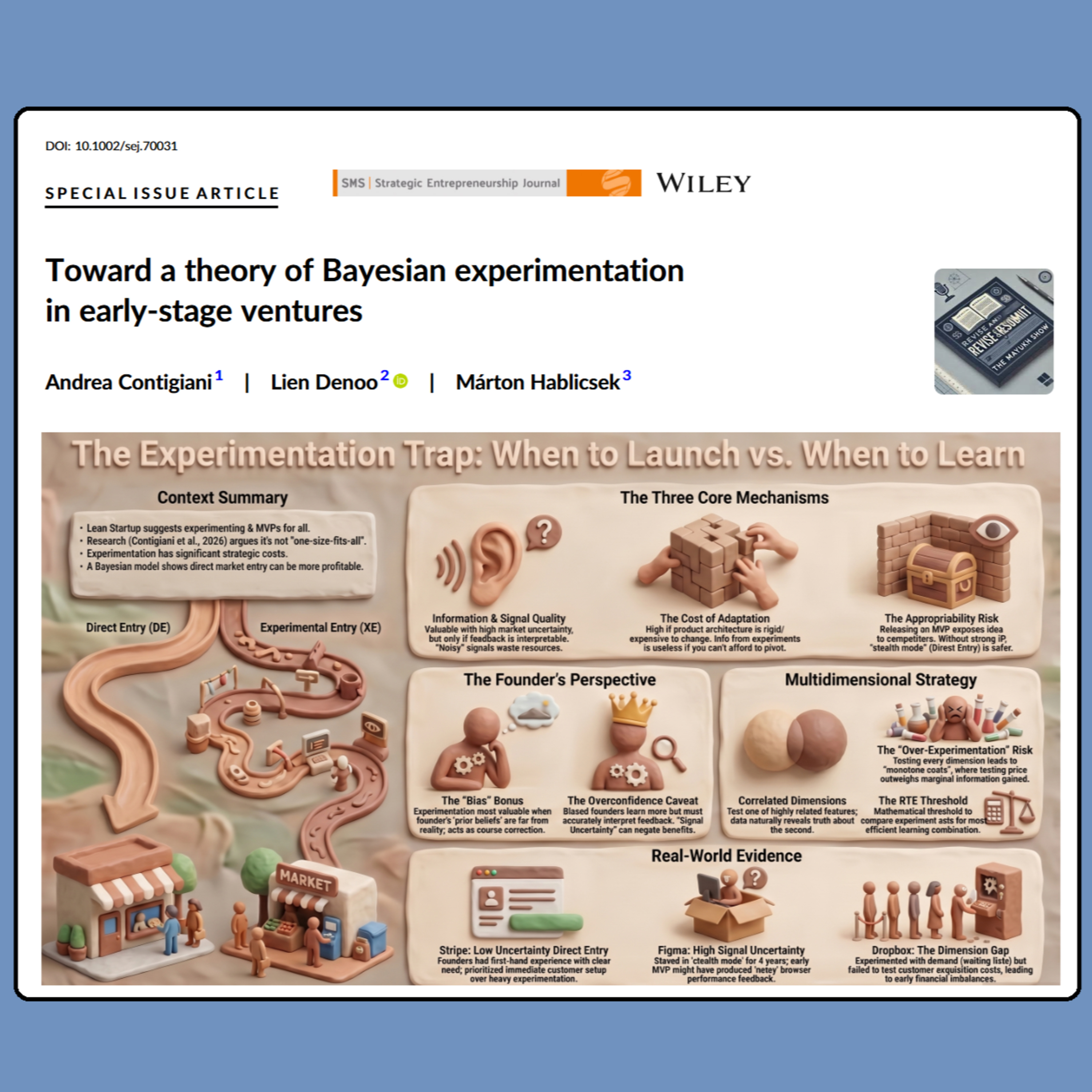
Bayesian Experimentation in Early-Stage Ventures (Contigiani et al. 2026) | FT50 SEJ
Description
English Podcast Starts at 00:00:00
Bengali Podcast Starts at 00:48:48
Hindi Podcast Starts at 01:07:41
Danish Podcast Starts at 01:26:30
Reference
Contigiani, A., Denoo, L., & Hablicsek, M. (2026). Toward a theory of Bayesian experimentation in early-stage ventures. Strategic Entrepreneurship Journal, 1–34. https://doi.org/10.1002/sej.70031
Youtube Channel
https://www.youtube.com/@weekendresearcher
Podcast Website
https://mayukhmukhopadhyay.com/reviseandresubmit
Academy of Management PDW on Space Economy Registration Flyer
https://cto.aom.org/discussion/flagship-aom-2026-pdw-space-economy-consolidating-a-research-agenda-8
🎙️📚 Welcome to Revise and Resubmit ✨
There is something strangely comforting about the myth of the entrepreneur who simply knows. The founder with perfect instincts. The visionary who walks into uncertainty and somehow comes out carrying the future in both hands. But this paper, thoughtful and quietly provocative, asks us to slow down and reconsider that story. 🤔⚡
Today, we’re diving into Toward a Theory of Bayesian Experimentation in Early-Stage Ventures by Andrea Contigiani, Lien Denoo, and Márton Hablicsek, published online on 20 May 2026 in the Strategic Entrepreneurship Journal 📖🌍
And this matters not only because the ideas are powerful, but because Strategic Entrepreneurship Journal belongs to the prestigious FT50 journal list, one of the most respected collections of academic journals in management and business research. 🎓🏆
What fascinated me about this article is its refusal to worship experimentation as some universal cure. In startup culture, we hear endless praise for testing, pivoting, iterating. But the authors ask a harder question: what if experimentation itself carries costs? 💡⚙️
Using a Bayesian framework, the paper explores when startups should experiment and when they should move directly into the market. And the answer, as it turns out, depends on uncertainty, adaptation costs, and the lurking possibility that competitors may copy what founders learn along the way. 📈🔍
The paper becomes even more human when it talks about bias. Founders often begin with strong beliefs about what customers want, beliefs shaped by ego, hope, obsession, or intuition. The authors argue that the more biased those beliefs are, the more valuable experimentation becomes. In other words, testing is not just about learning about the market. Sometimes it is about learning the limits of ourselves. ❤️🧠
I kept thinking about how deeply this applies beyond startups. We all carry priors into our lives. Assumptions about work, relationships, ambition, success. And reality keeps handing us evidence, asking whether we are brave enough to update what we believe. 🌌
This paper gives entrepreneurs a rigorous framework, even a measurable “Return to Experimentation,” but beneath the equations is a profoundly human tension between conviction and correction. Between holding onto an idea and letting the world reshape it. ✨
So maybe the real question is not whether experimentation helps startups succeed. Maybe it’s this: how do we know when persistence is wisdom, and when it is simply refusing to learn? 🎧🤍
Our thanks to Andrea Contigiani, Lien Denoo, Márton Hablicsek, and to John Wiley & Sons Ltd and the Strategic Management Society for publishing this remarkable work. 🙏📘
Subscribe to Revise and Resubmit on Spotify and follow Weekend Researcher on YouTube 🎥🎙️
Also available on Amazon Prime and Apple Podcasts 🍎🎶