Episode Details
Back to Episodes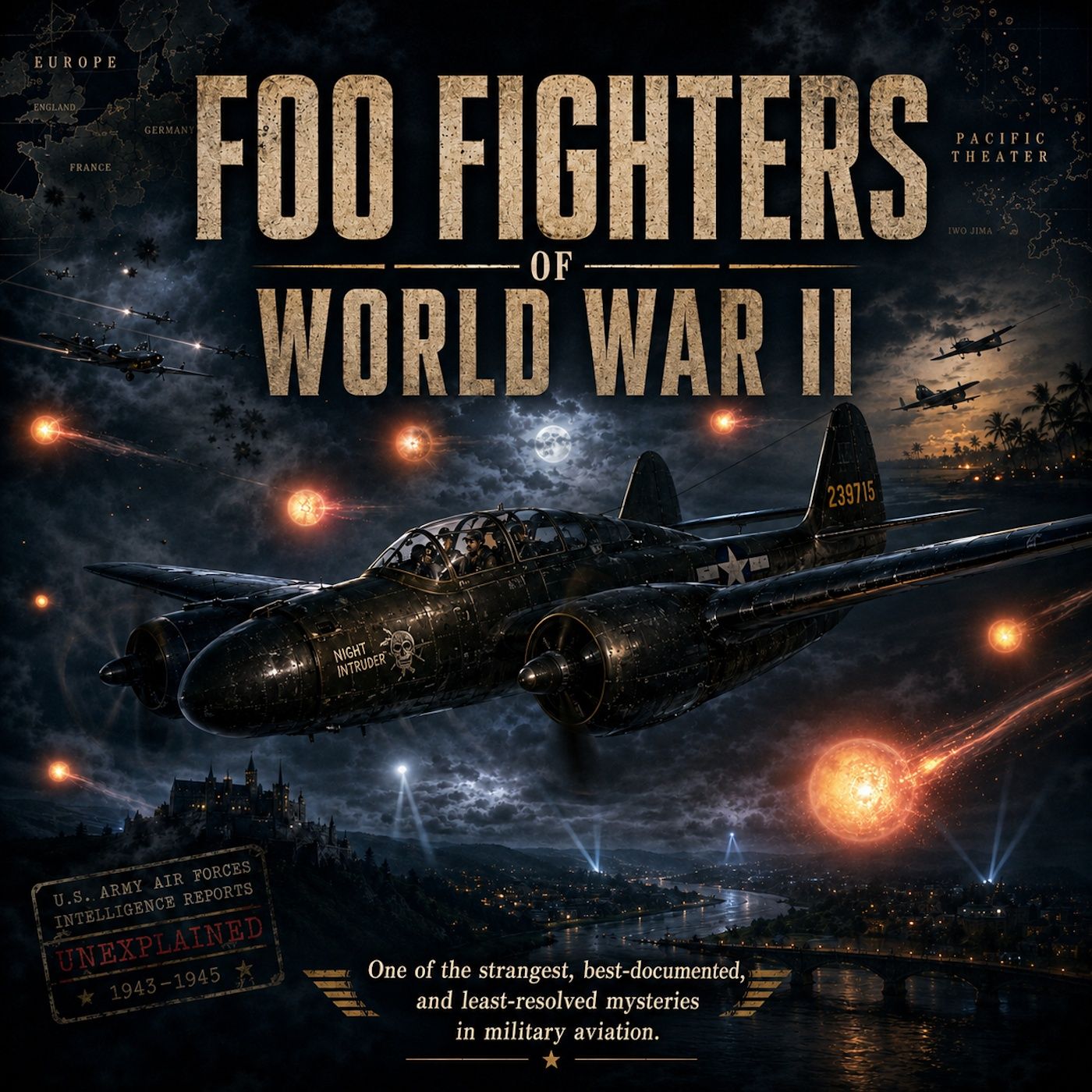
The Foo Fighters of World War Two
Published 3 months, 4 weeks ago
Description
The story of the Foo Fighters of World War Two is one of the strangest, best-documented, and least-resolved cases in the history of military aviation. In the late autumn of nineteen forty-four, pilots of the United States Army Air Forces, flying night fighter and bomber missions over Europe, began returning to their bases with reports of glowing objects that paced their aircraft, performed seemingly impossible maneuvers, and then vanished into the dark.
The reports were taken seriously by intelligence officers. They were corroborated by multiple witnesses across multiple squadrons. They reached the press in early nineteen forty-five, when Time magazine ran a feature on the phenomenon. And they continued through the end of the war, in both the European and Pacific theaters, with no satisfactory official explanation.
This episode follows the story from its earliest documented appearances over the Rhine Valley, with the Four Hundred Fifteenth Night Fighter Squadron and pilots like Lieutenant Edward Schlueter, through the coining of the term foo fighter by radar observer Donald Meiers, who borrowed the word from the cult-favorite Smokey Stover comic strip by Bill Holman.
From there, the episode traces the spread of the phenomenon to Pacific theater bomber crews, examines the postwar theories offered to explain it, and follows its tangled relationship to the modern UFO era, including its treatment by Project Blue Book and the Robertson Panel.
The candidate explanations are examined honestly and at length. Natural atmospheric phenomena like St. Elmo's fire and ball lightning are considered and weighed against the actual content of the witness reports. Theories about Nazi secret weapons, including Renato Vesco's controversial claims about the Feuerball program, are discussed and contextualized. The psychological strain of combat aviation, including the role of Benzedrine and chronic fatigue, is given serious treatment. And the awkward, persistent residue of unexplained cases is examined for what it tells us about the limits of historical knowledge and the gaps in our collective record.
The episode closes by drawing a careful, non-sensational line between the wartime foo fighter cases and the modern Unidentified Aerial Phenomena conversation, noting the similarities in witness language across more than eighty years, and the implications that has for how we treat phenomena that resist neat explanation. The men of the Four Hundred Fifteenth, and the bomber crews of the Pacific, and even the Luftwaffe pilots who reported the same kinds of objects over their own skies, deserve to have their experience taken seriously.
This episode is one small contribution to that ongoing effort.
For listeners following along with the Disturbing History series on presidential politics, regular programming on that subject will resume in the next episode. Tonight's installment is a deliberate detour into one of the most haunting, well-witnessed, and least-explained chapters of twentieth-century history.
Sometimes the disturbing thing isn't a man in a suit making a terrible decision. Sometimes it's a question that history hands us and then walks away from, leaving us to live with the silence.
Have a forgotten historical mystery, disturbing event, unsolved crime, or hidden conspiracy you think deserves investigation?
Send your suggestions to brian@paranormalworldproductions.com.
Disturbing History is a dark history podcast exploring unsolved mysteries, secret societies, historical conspiracies, lost civilizations, and the shadowy stories buried beneath the surface of the past.
Follow the show and enable automatic downloads so you never miss a deep dive into history’s most unsettling secrets.
Because sometimes the truth is darker than fiction.
The reports were taken seriously by intelligence officers. They were corroborated by multiple witnesses across multiple squadrons. They reached the press in early nineteen forty-five, when Time magazine ran a feature on the phenomenon. And they continued through the end of the war, in both the European and Pacific theaters, with no satisfactory official explanation.
This episode follows the story from its earliest documented appearances over the Rhine Valley, with the Four Hundred Fifteenth Night Fighter Squadron and pilots like Lieutenant Edward Schlueter, through the coining of the term foo fighter by radar observer Donald Meiers, who borrowed the word from the cult-favorite Smokey Stover comic strip by Bill Holman.
From there, the episode traces the spread of the phenomenon to Pacific theater bomber crews, examines the postwar theories offered to explain it, and follows its tangled relationship to the modern UFO era, including its treatment by Project Blue Book and the Robertson Panel.
The candidate explanations are examined honestly and at length. Natural atmospheric phenomena like St. Elmo's fire and ball lightning are considered and weighed against the actual content of the witness reports. Theories about Nazi secret weapons, including Renato Vesco's controversial claims about the Feuerball program, are discussed and contextualized. The psychological strain of combat aviation, including the role of Benzedrine and chronic fatigue, is given serious treatment. And the awkward, persistent residue of unexplained cases is examined for what it tells us about the limits of historical knowledge and the gaps in our collective record.
The episode closes by drawing a careful, non-sensational line between the wartime foo fighter cases and the modern Unidentified Aerial Phenomena conversation, noting the similarities in witness language across more than eighty years, and the implications that has for how we treat phenomena that resist neat explanation. The men of the Four Hundred Fifteenth, and the bomber crews of the Pacific, and even the Luftwaffe pilots who reported the same kinds of objects over their own skies, deserve to have their experience taken seriously.
This episode is one small contribution to that ongoing effort.
For listeners following along with the Disturbing History series on presidential politics, regular programming on that subject will resume in the next episode. Tonight's installment is a deliberate detour into one of the most haunting, well-witnessed, and least-explained chapters of twentieth-century history.
Sometimes the disturbing thing isn't a man in a suit making a terrible decision. Sometimes it's a question that history hands us and then walks away from, leaving us to live with the silence.
Have a forgotten historical mystery, disturbing event, unsolved crime, or hidden conspiracy you think deserves investigation?
Send your suggestions to brian@paranormalworldproductions.com.
Disturbing History is a dark history podcast exploring unsolved mysteries, secret societies, historical conspiracies, lost civilizations, and the shadowy stories buried beneath the surface of the past.
Follow the show and enable automatic downloads so you never miss a deep dive into history’s most unsettling secrets.
Because sometimes the truth is darker than fiction.