Episode Details
Back to Episodes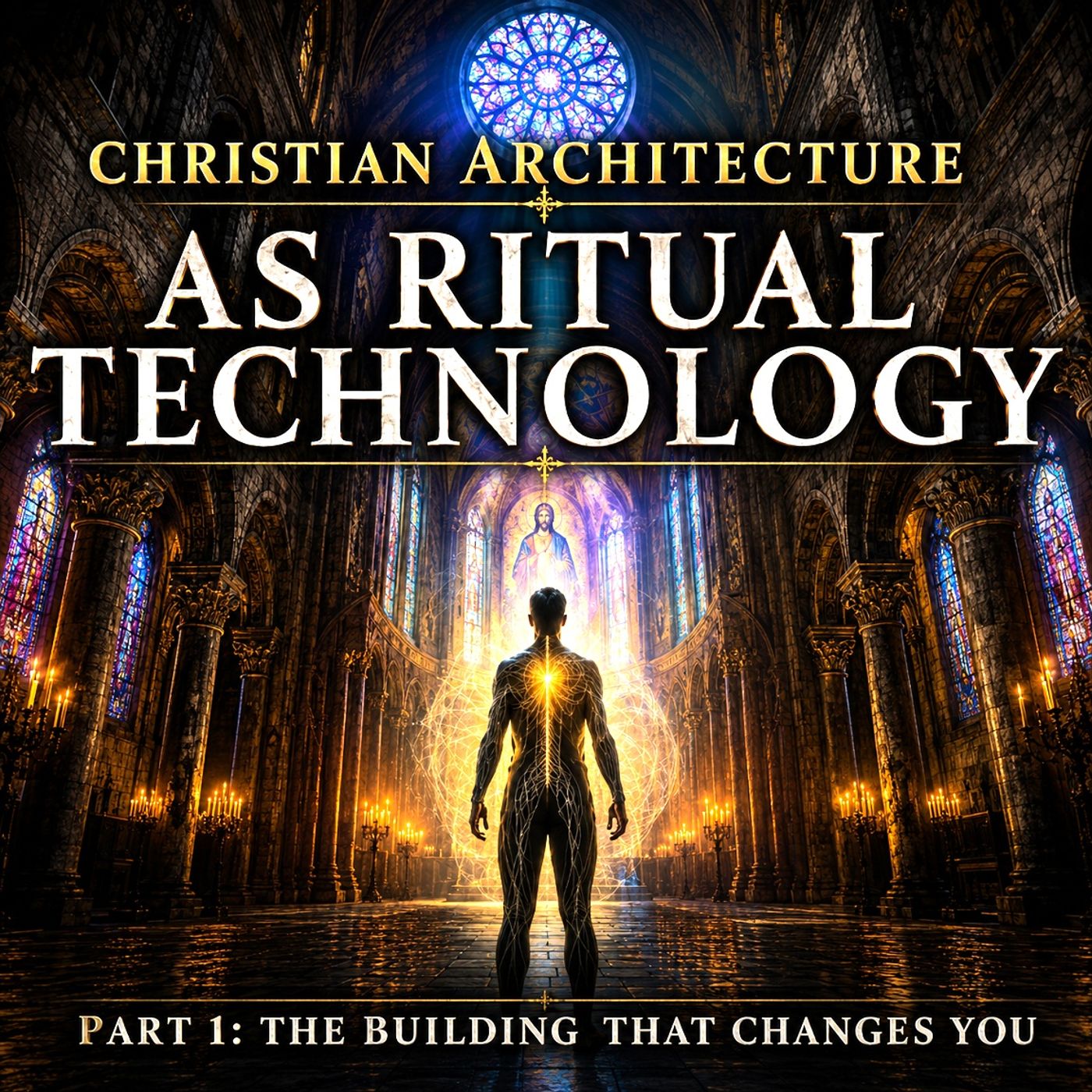
Christian Architecture as Ritual Technology Part 1: The Building That Changes You
Published 3 months ago
Description
If you enjoy this episode, we’re sure you will enjoy more content like this on The Occult Rejects. In fact, we have curated playlists on occult topics like grimoires, esoteric concepts and phenomena, occult history, analyzing true crime and cults with an occult lens, Para politics, and occultism in music. Whether you enjoy consuming your content visually or via audio, we’ve got you covered - and it will always be provided free of charge. So, if you enjoy what we do and want to support our work of providing accessible, free content on various platforms, please consider making a donation to the links provided below.
Thank you and enjoy the episode!
Links For The Occult Rejects
https://linktr.ee/theoccultrejects
Occult Research Institute
https://www.occultresearchinstitute.org/
Substack
https://substack.com/@theoccultrejects?r=7auau0&utm_campaign=profile&utm_medium=profile-page
Cash App
https://cash.app/$theoccultrejects
Venmo
@TheOccultRejects
Buy Me A Coffee
buymeacoffee.com/TheOccultRejects
Patreon
https://www.patreon.com/TheOccultRejects
EPISODE 1 BIBLIOGRAPHY
The Building That Changes You
Ackerman, Joshua M., Christopher C. Nocera, and John A. Bargh. “Incidental Haptic Sensations Influence Social Judgments and Decisions.” Science 328, no. 5986 (2010): 1712–1715.
Key use: Haptics, touch, weight, texture, hardness, and the idea that physical sensation can influence judgment and social interpretation. This supports the tactile layer of the episode: heavy doors, cold stone, worn rails, kneelers, relic cases, and sacred matter as meaningful contact.
Higuera-Trujillo, Juan Luis, Carmen Llinares, and Eduardo Macagno. “The Cognitive-Emotional Design and Study of Architectural Space: A Scoping Review of Neuroarchitecture and Its Precursor Approaches.” Sensors 21, no. 6 (2021): 2193.
Key use: Neuroarchitecture, emotional response to built environments, and the idea that architecture can be studied as a cognitive-emotional stimulus rather than only as art or style.
Kilde, Jeanne Halgren. Sacred Power, Sacred Space: An Introduction to Christian Architecture and Worship. Oxford University Press, 2008.
Key use: Major backbone source for Christian architecture as a system of worship, power, spatial order, and embodied religious experience. Oxford’s description emphasizes Kilde’s argument that church buildings represent and reify different forms of power, especially divine power.
Morgan, David. The Sacred Gaze: Religious Visual Culture in Theory and Practice. University of California Press, 2005.
Key use: Religious seeing, visual culture, sacred images, and the idea that vision is an active religious practice that can invest images, persons, times, and places with spiritual meaning.
Taves, Ann. Religious Experience Reconsidered: A Building-Block Approach to the Study of Religion and Other Special Things. Princeton University Press, 2009.
Key use: Helps frame religious experience without reducing it to one fixed category. Useful for the episode’s approach to how experiences become interpreted, named, and treated as religious or sacred.
Clark, Andy. Surfing Uncertainty: Prediction, Action, and the Embodied Mind. Oxford University Press, 2016.
Key use: Predictive processing, active inference, and the idea that perception is not passive recording but active prediction and model-building. This supports the “brain does not enter a church like a camera” argument.
Krueger, Joel. “Extended Mind and Religious Cognition.” 2016.
Key use: Extended and embodied cognition applied to religious practice, ritual objects, and environments. Useful for arguing that worship is not only inside the head but supported by bodies, tools, spaces, and shared action.
Oxford Academic. “Embodied Cognitio
Thank you and enjoy the episode!
Links For The Occult Rejects
https://linktr.ee/theoccultrejects
Occult Research Institute
https://www.occultresearchinstitute.org/
Substack
https://substack.com/@theoccultrejects?r=7auau0&utm_campaign=profile&utm_medium=profile-page
Cash App
https://cash.app/$theoccultrejects
Venmo
@TheOccultRejects
Buy Me A Coffee
buymeacoffee.com/TheOccultRejects
Patreon
https://www.patreon.com/TheOccultRejects
EPISODE 1 BIBLIOGRAPHY
The Building That Changes You
Ackerman, Joshua M., Christopher C. Nocera, and John A. Bargh. “Incidental Haptic Sensations Influence Social Judgments and Decisions.” Science 328, no. 5986 (2010): 1712–1715.
Key use: Haptics, touch, weight, texture, hardness, and the idea that physical sensation can influence judgment and social interpretation. This supports the tactile layer of the episode: heavy doors, cold stone, worn rails, kneelers, relic cases, and sacred matter as meaningful contact.
Higuera-Trujillo, Juan Luis, Carmen Llinares, and Eduardo Macagno. “The Cognitive-Emotional Design and Study of Architectural Space: A Scoping Review of Neuroarchitecture and Its Precursor Approaches.” Sensors 21, no. 6 (2021): 2193.
Key use: Neuroarchitecture, emotional response to built environments, and the idea that architecture can be studied as a cognitive-emotional stimulus rather than only as art or style.
Kilde, Jeanne Halgren. Sacred Power, Sacred Space: An Introduction to Christian Architecture and Worship. Oxford University Press, 2008.
Key use: Major backbone source for Christian architecture as a system of worship, power, spatial order, and embodied religious experience. Oxford’s description emphasizes Kilde’s argument that church buildings represent and reify different forms of power, especially divine power.
Morgan, David. The Sacred Gaze: Religious Visual Culture in Theory and Practice. University of California Press, 2005.
Key use: Religious seeing, visual culture, sacred images, and the idea that vision is an active religious practice that can invest images, persons, times, and places with spiritual meaning.
Taves, Ann. Religious Experience Reconsidered: A Building-Block Approach to the Study of Religion and Other Special Things. Princeton University Press, 2009.
Key use: Helps frame religious experience without reducing it to one fixed category. Useful for the episode’s approach to how experiences become interpreted, named, and treated as religious or sacred.
Clark, Andy. Surfing Uncertainty: Prediction, Action, and the Embodied Mind. Oxford University Press, 2016.
Key use: Predictive processing, active inference, and the idea that perception is not passive recording but active prediction and model-building. This supports the “brain does not enter a church like a camera” argument.
Krueger, Joel. “Extended Mind and Religious Cognition.” 2016.
Key use: Extended and embodied cognition applied to religious practice, ritual objects, and environments. Useful for arguing that worship is not only inside the head but supported by bodies, tools, spaces, and shared action.
Oxford Academic. “Embodied Cognitio