Episode Details
Back to Episodes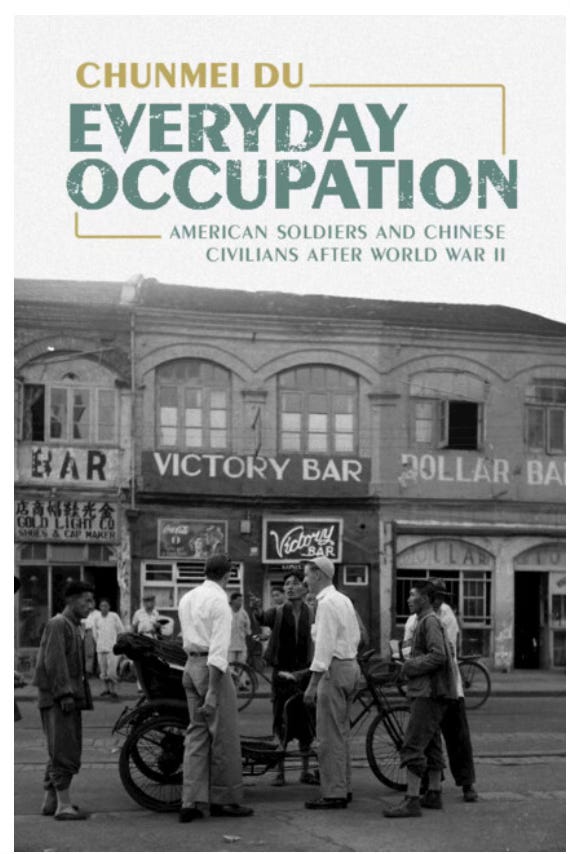
Chunmei Du | Everyday Encounter
Description
Note:This excerpt is taken from the book Everyday Occupation: American Soldiers and Chinese Civilians after World War II (Cambridge University Press, November 27,2025)by Chunmei Du, Associate Professor at Lingnan University, Hong Kong. Footnotes omitted.
This introduction Everyday Encounter provides historical and theoretical framings for this book. It situates the American military presence in postwar China within two interconnected contexts of China’s civil war confrontations and America’s global occupation. It engages with existing historiographies by locating China in the American empire and locating America in Communist propaganda. Through the micro-lens of the everyday, it also analyzes the actual and critical links between grassroots frictions and Sino-US relations.
Authorized by the author for publication.
This sophisticated book connects everyday offenses and geopolitics into a broad historical argument about the limits of ideology, policy, and propaganda to grasp popular outrage. The Jeep transitioned from a symbol of Allied victory to a representation of American imperialism in postwar China when the U.S. military occupation of North China let loose soldiers who bullied, raped, disregarded traffic signs and offended ordinary people. Reconstructing a complex history of the U.S. Marine III Amphibian Corps (IIIAC)’s fifty-thousand-man force sent to help end the Japanese occupation, Du creates a detailed account for another explanation for how the U.S. ‘lost’ the People’s Republic of China. Deftly wrapping macro-politics (the rise of the U.S. Empire and Cold War) around a regional struggle to capture the Chinese state, this book clarifies how it is still possible to write about the people as a motive force. Beneath abstraction, Du argues, is the terrain of everyday experience where we decide to act or not.’
Tani Barlow - Rice University
Nanjing, Christmas Day, 1946. General George C. Marshall, US Special Envoy to China, was attending a concert organized by his hospitable Nationalist hosts in the capital when his Jeep with the special “USA20593633” plate went missing. As it turned out, the Jeep was stolen by a local thief who quickly turned it on the thriving black market. One Chinese critic called the Jeep incident an omen and allegory of the American failure in China.1 However, it was not just the failure of Marshall’s mediation in the Chinese civil war, or even the failure of US policy in China at large, but also America’s failure to sustain the image of a good and special ally just a little more than one year after winning World War II (WWII). One day earlier, and more than six hundred miles to the north, in the ancient capital of Beijing (Peiping), nineteen-year-old college student Shen Chong had been raped by an intoxicated US marine. Nationwide protests broke out over the next few days, calling for severe punishment of the American rapist and the complete withdrawal of the US military from China. But as we zoom in to the actual scene of the protest, GI spectators inside a locked compound were spotted joining outside protesters, who were shouting “Get out of China” (gun chu Zhongguo), by shouting back, “I want to go home!”2 The exchange of these messages, steeped in emotions, reveals a highly volatile and ultimately defining moment in Sino-US history that is often called the “loss of China.”
Listen Now
Love PodBriefly?
If you like Podbriefly.com, please consider donating to support the ongoing development.
Support Us