Episode Details
Back to Episodes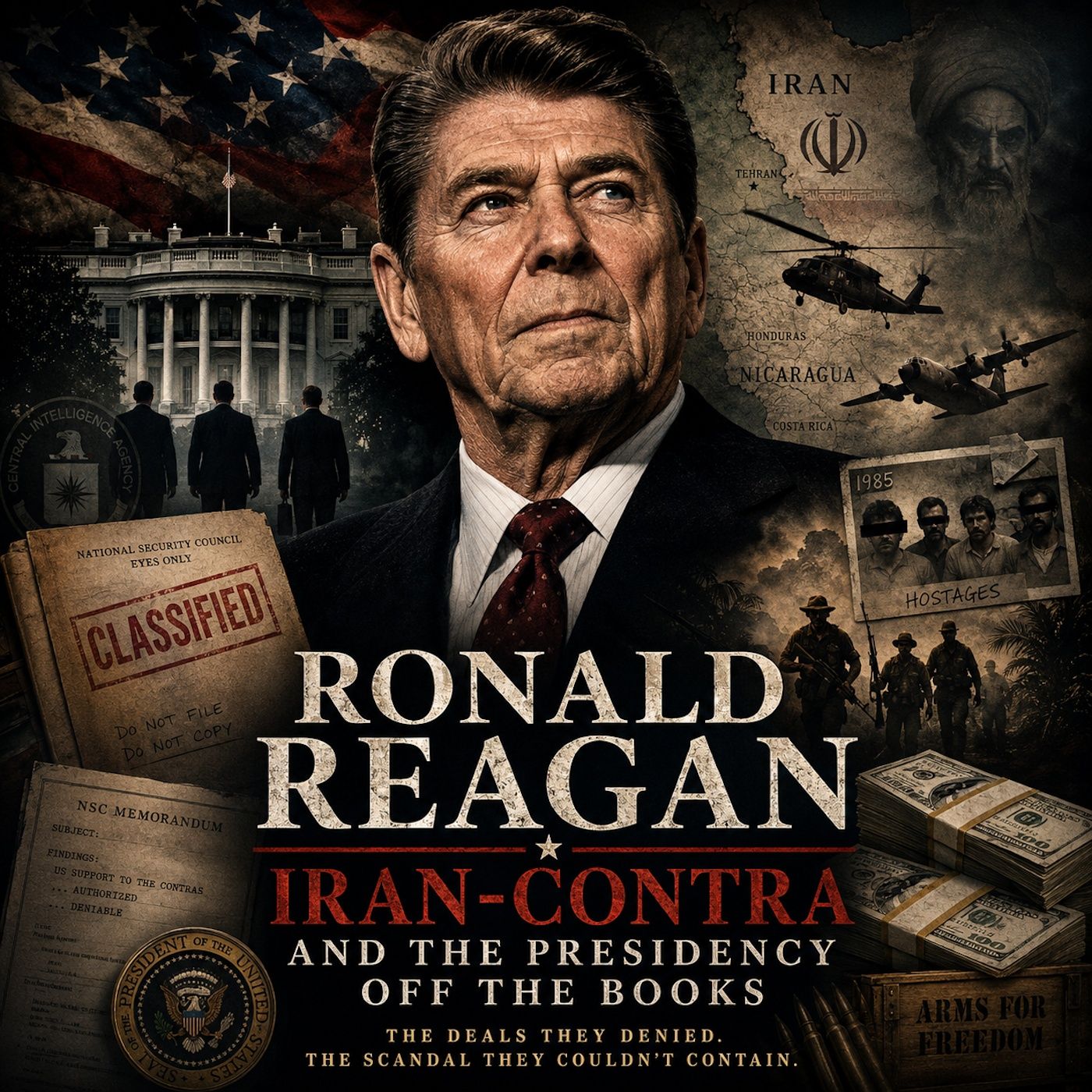
Ronald Reagan: Presidency Off the Books
Published 4 months ago
Description
In the late afternoon of November twenty-first, 1986, Marine Lieutenant Colonel Oliver North and his secretary Fawn Hall stood inside an office a short walk from the Oval Office and fed classified documents into a shredder. They jammed the machine. They smuggled pages out in her boots. They were trying to outrun a federal investigation that was already moving down the hallway toward them.
What they were destroying was the paper trail of what investigators would later call a parallel government, a secret apparatus running an off-the-books foreign policy out of the Reagan White House, in defiance of an act of Congress and in contradiction of every public statement the President of the United States had made about negotiating with terrorists. In this episode of Disturbing History, host Brian unpacks the Iran-Contra affair, the biggest American political scandal since Watergate, and the moment the modern presidency learned how to operate off the books and survive.
This is the story of how the Reagan administration secretly sold American TOW and Hawk missiles to the Islamic Republic of Iran through Israeli intermediaries beginning in August of 1985, despite the President's repeated public claims that the United States would never negotiate with hostage takers. It is also the story of how the same administration funneled the profits from those Iranian arms sales, through Swiss bank accounts controlled by retired Air Force General Richard Secord and Iranian-American businessman Albert Hakim, to support the Contra rebels in Nicaragua, after the United States Congress had passed the Boland Amendments in 1982 and 1984 explicitly prohibiting that exact kind of support.
Two scandals, one architecture, one continuous criminal conspiracy stitched together inside the National Security Council under the direction of Lieutenant Colonel Oliver North, National Security Adviser Robert McFarlane, his successor John Poindexter, and CIA Director William Casey, with the knowledge or willful blindness of President Ronald Reagan and Vice President George H.W. Bush.The episode traces every thread in detail.
It begins with Reagan's carefully constructed public persona of optimism, patriotism, and certainty, the General Electric Theater years, the 1984 reelection landslide, the image of the friendly grandfather that made the country reluctant to believe what was happening underneath. It moves through the 1979 Sandinista revolution in Nicaragua, the rise of Daniel Ortega, the Reagan administration's decision to back the Contras, the CIA mining of Nicaraguan harbors, the World Court case, and Congress's eventual push to cut off funding through the Boland Amendments.
From there, the story crosses the world to Beirut, where CIA station chief William Buckley was kidnapped in March of 1984 and tortured to death by Hezbollah, where journalists like Terry Anderson, clergy like Reverend Benjamin Weir and Father Lawrence Jenco, and academics like Thomas Sutherland and David Jacobsen were taken hostage, and where Reagan's private anguish over American captives became the lever that Saudi arms dealer Adnan Khashoggi and Iranian middleman Manucher Ghorbanifar would use to open the secret arms channel.
The epsiode covers the bizarre May 1986 trip to Tehran, when Robert McFarlane traveled under a false passport carrying a Bible inscribed by Ronald Reagan and a chocolate cake shaped like a key. It covers the October 5, 1986 shootdown of the cargo plane carrying Eugene Hasenfus over Nicaragua, the loose thread that began unraveling the entire Enterprise.
We get into the November 3, 1986 Al-Shiraa magazine story out of Lebanon that broke the news of the arms sales, Reagan's failed November 13, 1986 Oval Office denial, Attorney General Edwin Meese's stunning November 25, 1986 announcement of the diversion of funds to the Contras, the Tower Commission report of February 1987, the joint congressional
What they were destroying was the paper trail of what investigators would later call a parallel government, a secret apparatus running an off-the-books foreign policy out of the Reagan White House, in defiance of an act of Congress and in contradiction of every public statement the President of the United States had made about negotiating with terrorists. In this episode of Disturbing History, host Brian unpacks the Iran-Contra affair, the biggest American political scandal since Watergate, and the moment the modern presidency learned how to operate off the books and survive.
This is the story of how the Reagan administration secretly sold American TOW and Hawk missiles to the Islamic Republic of Iran through Israeli intermediaries beginning in August of 1985, despite the President's repeated public claims that the United States would never negotiate with hostage takers. It is also the story of how the same administration funneled the profits from those Iranian arms sales, through Swiss bank accounts controlled by retired Air Force General Richard Secord and Iranian-American businessman Albert Hakim, to support the Contra rebels in Nicaragua, after the United States Congress had passed the Boland Amendments in 1982 and 1984 explicitly prohibiting that exact kind of support.
Two scandals, one architecture, one continuous criminal conspiracy stitched together inside the National Security Council under the direction of Lieutenant Colonel Oliver North, National Security Adviser Robert McFarlane, his successor John Poindexter, and CIA Director William Casey, with the knowledge or willful blindness of President Ronald Reagan and Vice President George H.W. Bush.The episode traces every thread in detail.
It begins with Reagan's carefully constructed public persona of optimism, patriotism, and certainty, the General Electric Theater years, the 1984 reelection landslide, the image of the friendly grandfather that made the country reluctant to believe what was happening underneath. It moves through the 1979 Sandinista revolution in Nicaragua, the rise of Daniel Ortega, the Reagan administration's decision to back the Contras, the CIA mining of Nicaraguan harbors, the World Court case, and Congress's eventual push to cut off funding through the Boland Amendments.
From there, the story crosses the world to Beirut, where CIA station chief William Buckley was kidnapped in March of 1984 and tortured to death by Hezbollah, where journalists like Terry Anderson, clergy like Reverend Benjamin Weir and Father Lawrence Jenco, and academics like Thomas Sutherland and David Jacobsen were taken hostage, and where Reagan's private anguish over American captives became the lever that Saudi arms dealer Adnan Khashoggi and Iranian middleman Manucher Ghorbanifar would use to open the secret arms channel.
The epsiode covers the bizarre May 1986 trip to Tehran, when Robert McFarlane traveled under a false passport carrying a Bible inscribed by Ronald Reagan and a chocolate cake shaped like a key. It covers the October 5, 1986 shootdown of the cargo plane carrying Eugene Hasenfus over Nicaragua, the loose thread that began unraveling the entire Enterprise.
We get into the November 3, 1986 Al-Shiraa magazine story out of Lebanon that broke the news of the arms sales, Reagan's failed November 13, 1986 Oval Office denial, Attorney General Edwin Meese's stunning November 25, 1986 announcement of the diversion of funds to the Contras, the Tower Commission report of February 1987, the joint congressional