Episode Details
Back to Episodes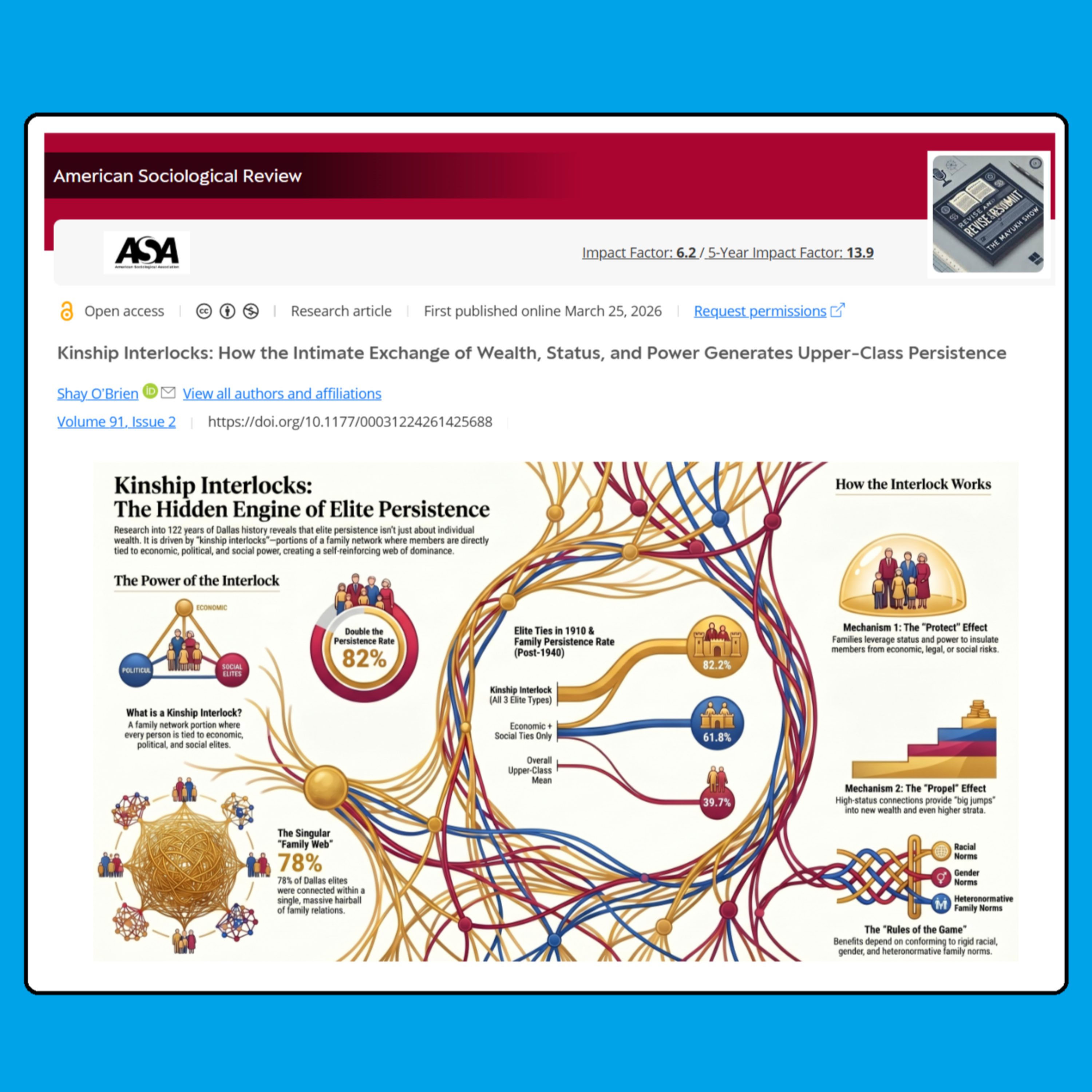
Kinship Interlocks (O’Brien, 2026) | FT50 ASR
Description
English Podcast Starts at 00:00:00
Bengali Podcast Starts at 00:41:56
Hindi Podcast Starts at 00:56:22
Danish Podcast Starts at 01:20:39
Reference
O’Brien, S. (2026). Kinship Interlocks: How the Intimate Exchange of Wealth, Status, and Power Generates Upper-Class Persistence. American Sociological Review. https://doi.org/10.1177/00031224261425688
Youtube Channel
https://www.youtube.com/@weekendresearcher
Podcast Website
https://mayukhmukhopadhyay.com/reviseandresubmit
🎙️✨ Welcome to Revise and Resubmit.
Sometimes a research paper does more than explain the world. Sometimes it lifts a corner of the fabric and shows us the hidden stitching, the quiet arrangements by which power survives itself. Today, I want to sit with one of those papers. 📚👀
This episode turns to Kinship Interlocks: How the Intimate Exchange of Wealth, Status, and Power Generates Upper-Class Persistence by Shay O’Brien, published online on 25 March 2026 in the American Sociological Review, a prestigious FT50 journal published by SAGE Publications. That matters because the venue signals serious scholarship. But the paper’s real force comes from its question: how do some families remain on top for generations while others do not? 🏛️💼👑
What makes this paper so striking is that the answer is not money alone. Wealth matters, yes, but O’Brien asks us to see something more intimate and more unsettling. Families at the top endure because they braid wealth, status, and power through kinship itself. Through marriage, obligation, protection, and the soft invisible traffic of advantage, they create what the paper calls kinship interlocks. 🧬🔗
It is a powerful phrase because it captures a hard truth. The upper class is not just a collection of successful individuals. It is a networked inheritance machine. It protects its own from risk, cushions them from failure, and gives them lifts that can look from the outside like merit or luck, when often it is family structure quietly doing the work behind closed doors. 🚪✨
And the paper does not let us look away from the social conditions of that durability. These arrangements are shaped by race, gender, and sexuality, by the deep cultural rules that decide who counts as proper family and who does not. So upper-class persistence is not only an economic story. It is a moral and political one. It is about who gets protected, who gets promoted, and who gets written into continuity itself. 🧠⚖️
Using a remarkable mixed-methods dataset spanning 122 years of elite life in Dallas, Texas, O’Brien shows that elite persistence is not accidental. It is collaborative, organized, and intimate. A class project carried across generations in the language of loyalty and family, but with consequences far beyond the family tree. 🌳📊
I love papers like this because they make abstraction feel personal, and the personal feel structural. They remind me that sociology, at its best, does not just name inequality. It shows us how inequality learns to reproduce itself with elegance, patience, and devastating efficiency.
My sincere thanks to Shay O’Brien for this extraordinary work, and to SAGE Publications for publishing it in the American Sociological Review, one of the most prestigious journals on the FT50 list. 🙏📖
If this kind of research conversation speaks to you, please subscribe to Revise and Resubmit on Spotify, and subscribe to the YouTube channel Weekend Researcher. You can also find the show on Amazon Prime and Apple Podcast. 🔔🎧📺
And as we begin, here is the question I cannot shake: when privilege survives for generations, are we really looking at inheritance, or at a family’s quiet genius for turning intimacy into infrastructure? 🤔✨