Episode Details
Back to Episodes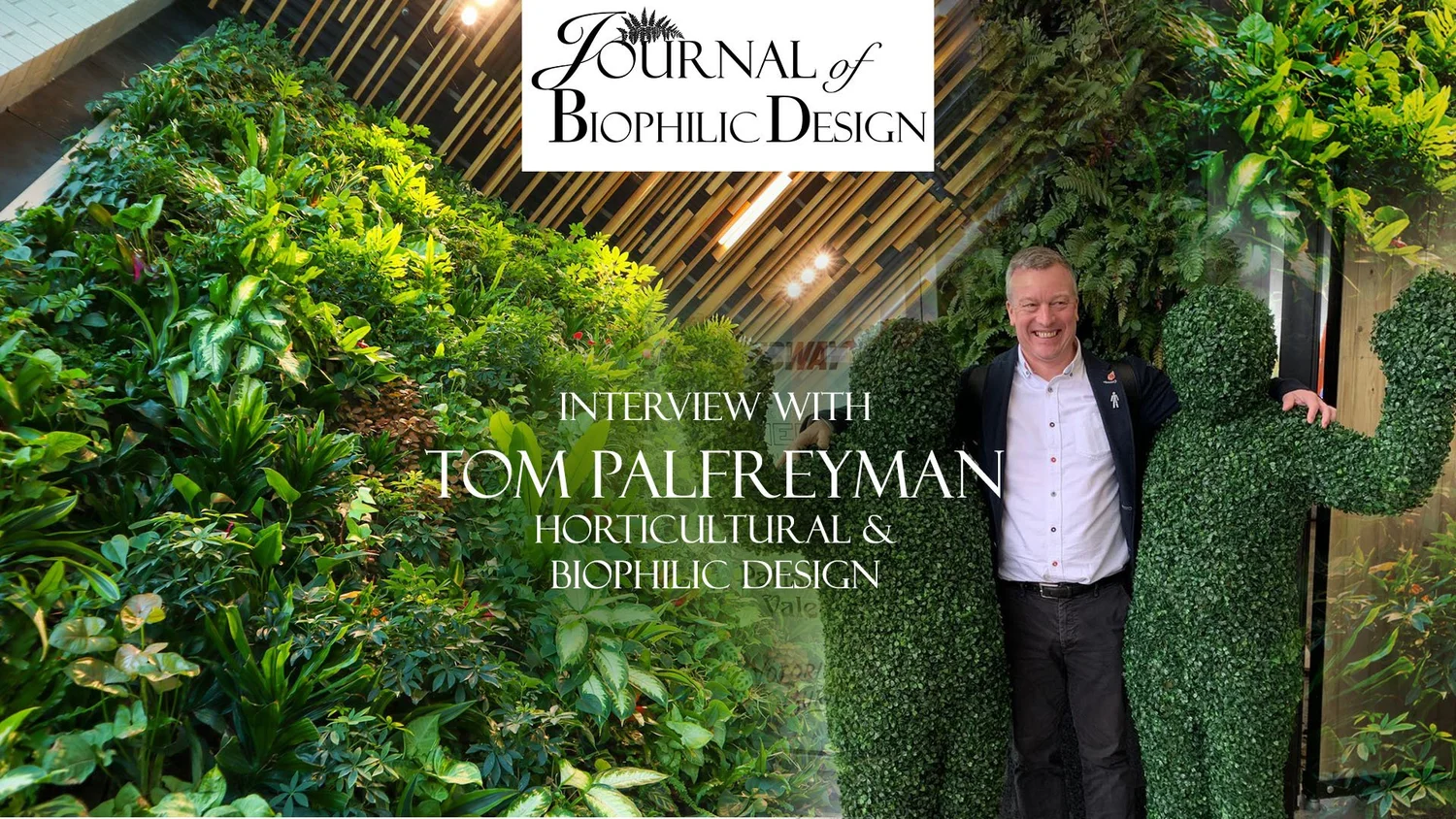
Why we need Nature inside our Buildings - The Future of Healthy Buildings with Biophilic Design
Description
In this episode of the Journal of Biophilic Design podcast, we speak with landscape specialist Tom Palfreyman, whose work across commercial, hospitality, retail and workplace environments has focused on the principle that plants fundamentally change how people experience space. With more than twenty years’ involvement in interior and exterior landscaping, Tom has spent his career exploring how nature can improve the places where we work, rest and play, and why maintenance, care and long-term thinking are just as important as the initial design itself.
As Tom reflects during the conversation, “Plants have transitioned from a nice-to-have decoration in the corner of the building to being an intrinsic essential part of any building.” It is a shift many designers are now recognising. The conversation around biophilic design has matured significantly over the past decade. What was once dismissed as aesthetic enhancement is increasingly understood as part of a much wider discussion around health, wellbeing, productivity, ecology and human resilience.
The heart of biophilic design beats out that human beings are not separate from nature, we are an intrinsic part of it. “We evolved to live outside,” Tom says. “That connection with nature, sadly, I believe, has been lost.”
Modern life has created increasingly artificial environments - sealed buildings, screen-based working, urban density and spaces designed more for efficiency than human experience. Yet our biology has not changed at the same pace as our architecture. Research across neuroscience, environmental psychology and workplace wellbeing continues to show that exposure to nature can reduce stress, restore attention, support cognitive performance and improve emotional wellbeing.
What becomes clear in this discussion is that successful biophilic design is never simply about adding greenery into a room. It is about creating meaningful and lasting relationships between people and living systems.
For Tom, this begins with understanding plants properly. “Putting the right plant in the right place so it’s happy, healthy, survives,” he explains. There is something important in that statement. Too often, planting schemes are treated as visual afterthoughts rather than living ecosystems requiring expertise, maintenance and long-term stewardship.
The strongest biophilic projects understand that planting design is not decoration. It is infrastructure for wellbeing.
Tom highlights his collaboration with Dr. Craig Knight, emphasising the benefits of biophilic ‘enrichment’, a word maybe more commonly associated with ecology or animal wellbeing than commercial interiors. “Enrichment is a very, very strong part of what we do, putting the right plants in the right place,” he says. “If we can have engaged enric