Episode Details
Back to Episodes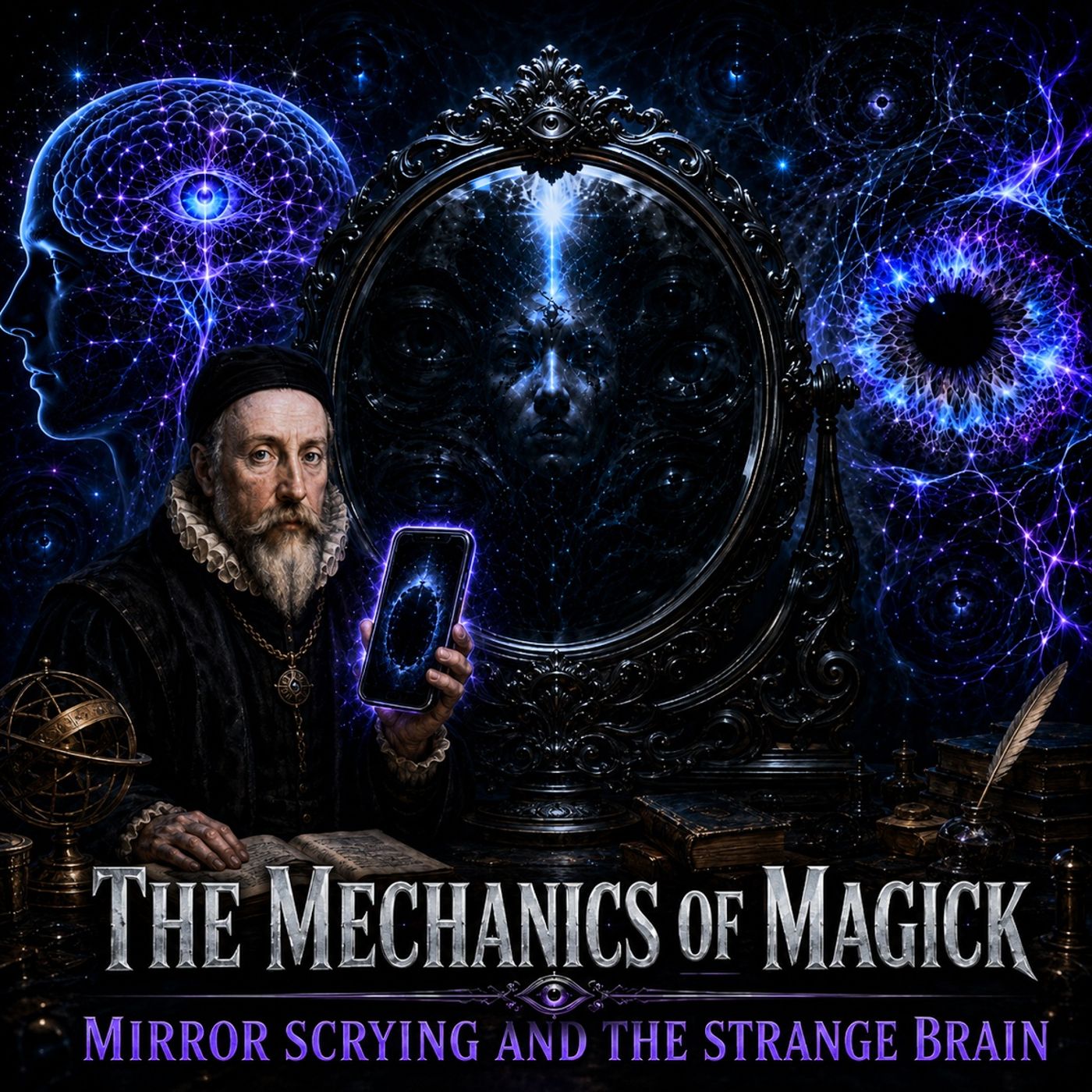
The Mechanics of Magick: Mirror Scrying and the Strange Brain
Published 3 months, 1 week ago
Description
This episode draws on experimental and review literature on mirror-gazing, strange-face illusions, anomalous self-experience, dissociation, agency, face pareidolia, and face-distortion disorders, especially the work of Giovanni B. Caputo, Caputo/Lynn/Houran, Mash et al., Bregman-Hai and Soffer-Dudek, Derome et al., Palmer and Clifford, and Blom et al. Historical and occult context comes from research on catoptromancy, John Dee’s angelic scrying records, the British Museum’s “Dr Dee’s Magical Mirror,” Campbell et al.’s Antiquity study on the mirror’s Mexican/Aztec obsidian origin, and Mesoamerican material on Tezcatlipoca and the “Smoking Mirror.”
Links For The Occult Rejects
https://linktr.ee/theoccultrejects
Occult Research Institute
https://www.occultresearchinstitute.org/
Cash App
https://cash.app/$theoccultrejects
Venmo
@TheOccultRejects
Buy Me A Coffee
buymeacoffee.com/TheOccultRejects
Patreon
https://www.patreon.com/TheOccultRejects
Core Scientific Sources: Mirror-Gazing, Strange Faces, and Altered Self-ExperienceCaputo, Giovanni B. “Strange-Face-in-the-Mirror Illusion.” Perception 39, no. 7, 2010, 1007–1008.
Key use: This is the main science anchor for the episode. Caputo showed that prolonged mirror-gazing under low illumination can produce strange-face apparitions, including distortions, unknown faces, monstrous faces, animal-like faces, archetypal faces, and faces of relatives or deceased people.Caputo, Giovanni B., Steven Jay Lynn, and James Houran. “Mirror- and Eye-Gazing: An Integrative Review of Induced Altered and Anomalous Experiences.” Imagination, Cognition and Personality 40, no. 4, 2021, 418–457.
Key use: This is one of the strongest overview sources. It reviews empirical studies on mirror-gazing, psychomanteum work, and eye-to-eye gazing, especially in relation to altered perception, anomalous experiences, bodily experience, and self-identity.Mash, Joanna, Paul M. Jenkinson, Charlotte E. Dean, and Keith R. Laws. “Strange Face Illusions: A Systematic Review and Quality Analysis.” Consciousness and Cognition 109, 2023, article 103480.
Key use: Newer review source. Useful because it supports strange-face illusions as a reliable phenomenon in both mirror-gazing and interpersonal gazing, while also warning that stronger research is still needed on mechanisms and prevalence.Bregman-Hai, Noa, and Nirit Soffer-Dudek. “Mirror-Gazing-Induced Dissociation Impairs Self-Reported and Implicit Sense of Agency: A Causal Investigation of Dissociation and Agency Under Controlled Laboratory Conditions.” PLOS ONE 21, no. 2, 2026, e0341316.
Key use: Excellent source for the agency section. This connects mirror-gazing-induced dissociation with weakened sense of agency, which pairs well with mediumship, possession, automatic writing, and the feeling that “something else” is present.Derome, Mélodie, Eduardo Fonseca-Pedrero, Giovanni Battista Caputo, and Martin Debbané. “A Developmental Study of Mirror-Gazing-Induced Anomalous Self-Experiences and Self-Reported Schizotypy from 7 to 28 Years of Age.” Psychopathology 55, no. 1, 2022, 49–61.
Key use: Useful developmental source. It connects mirror-gazing-induced anomalous self-experiences with age, self-perception, and schizotypal traits.Caputo, Giovanni B. “Visual Perception During Mirror-Gazing at One’s Own Face in Patients with Depression.” The Scientific World Journal, 2014.
Key use: Useful for the emotion/self-face relationship section. Caputo found that strange-face apparitions were reduced in patients with depression compared with healthy controls, including shorter duration, fewer strange faces, weaker intensity, and lower emotional response.Tramacere, Antonella. “Face Yourself: The Social Neuroscience of Mirror Gazing.” Frontiers in Psychology 13, 2022, article 949211.
Key use: Strong support for the idea that mirror-gazing is like seeing yourself as another. It co
Links For The Occult Rejects
https://linktr.ee/theoccultrejects
Occult Research Institute
https://www.occultresearchinstitute.org/
Cash App
https://cash.app/$theoccultrejects
Venmo
@TheOccultRejects
Buy Me A Coffee
buymeacoffee.com/TheOccultRejects
Patreon
https://www.patreon.com/TheOccultRejects
Core Scientific Sources: Mirror-Gazing, Strange Faces, and Altered Self-ExperienceCaputo, Giovanni B. “Strange-Face-in-the-Mirror Illusion.” Perception 39, no. 7, 2010, 1007–1008.
Key use: This is the main science anchor for the episode. Caputo showed that prolonged mirror-gazing under low illumination can produce strange-face apparitions, including distortions, unknown faces, monstrous faces, animal-like faces, archetypal faces, and faces of relatives or deceased people.Caputo, Giovanni B., Steven Jay Lynn, and James Houran. “Mirror- and Eye-Gazing: An Integrative Review of Induced Altered and Anomalous Experiences.” Imagination, Cognition and Personality 40, no. 4, 2021, 418–457.
Key use: This is one of the strongest overview sources. It reviews empirical studies on mirror-gazing, psychomanteum work, and eye-to-eye gazing, especially in relation to altered perception, anomalous experiences, bodily experience, and self-identity.Mash, Joanna, Paul M. Jenkinson, Charlotte E. Dean, and Keith R. Laws. “Strange Face Illusions: A Systematic Review and Quality Analysis.” Consciousness and Cognition 109, 2023, article 103480.
Key use: Newer review source. Useful because it supports strange-face illusions as a reliable phenomenon in both mirror-gazing and interpersonal gazing, while also warning that stronger research is still needed on mechanisms and prevalence.Bregman-Hai, Noa, and Nirit Soffer-Dudek. “Mirror-Gazing-Induced Dissociation Impairs Self-Reported and Implicit Sense of Agency: A Causal Investigation of Dissociation and Agency Under Controlled Laboratory Conditions.” PLOS ONE 21, no. 2, 2026, e0341316.
Key use: Excellent source for the agency section. This connects mirror-gazing-induced dissociation with weakened sense of agency, which pairs well with mediumship, possession, automatic writing, and the feeling that “something else” is present.Derome, Mélodie, Eduardo Fonseca-Pedrero, Giovanni Battista Caputo, and Martin Debbané. “A Developmental Study of Mirror-Gazing-Induced Anomalous Self-Experiences and Self-Reported Schizotypy from 7 to 28 Years of Age.” Psychopathology 55, no. 1, 2022, 49–61.
Key use: Useful developmental source. It connects mirror-gazing-induced anomalous self-experiences with age, self-perception, and schizotypal traits.Caputo, Giovanni B. “Visual Perception During Mirror-Gazing at One’s Own Face in Patients with Depression.” The Scientific World Journal, 2014.
Key use: Useful for the emotion/self-face relationship section. Caputo found that strange-face apparitions were reduced in patients with depression compared with healthy controls, including shorter duration, fewer strange faces, weaker intensity, and lower emotional response.Tramacere, Antonella. “Face Yourself: The Social Neuroscience of Mirror Gazing.” Frontiers in Psychology 13, 2022, article 949211.
Key use: Strong support for the idea that mirror-gazing is like seeing yourself as another. It co