Episode Details
Back to Episodes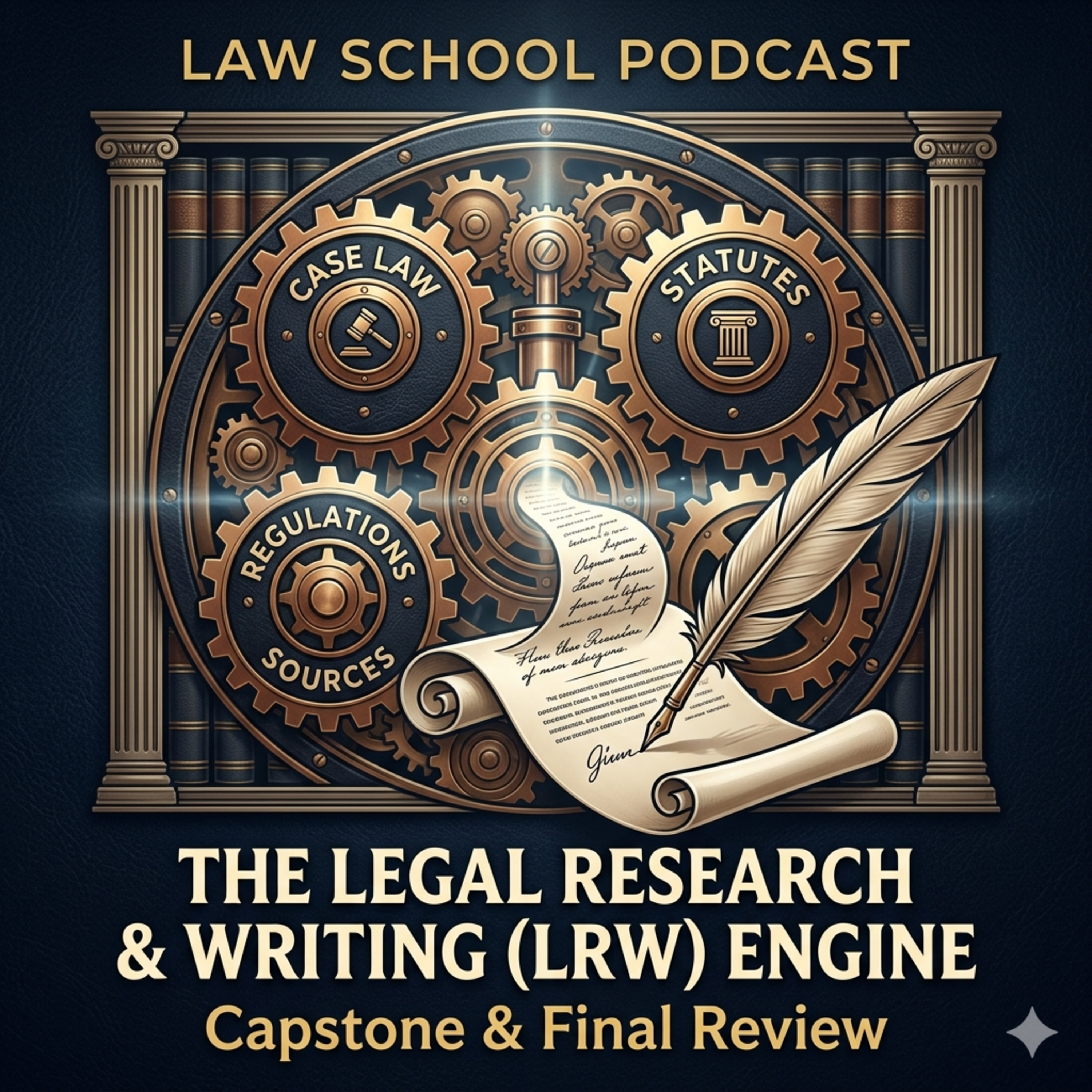
Capstone & Final Review: The Legal Research & Writing (LRW) Engine
Description
Review Guide: The Legal Research & Writing (LRW) Engine
Legal Research & Writing: The Engine Powering Your Law Practice
This deep dive into legal research and writing unpacks how this critical skill transforms raw legal knowledge into effective professional action. From mastering the research cycle to applying the CREAC architecture and understanding ethical obligations, this episode guides future lawyers through the mechanics that separate good from great legal practitioners.
Most law students overlook a hidden engine that transforms static knowledge into real courtroom power. This episode unveils the brutal truth: mastering the legal research and writing engine is the key to turning dormant doctrine into confident advocacy. If you’re serious about passing the bar, climbing the ranks, or simply working smarter, you need to understand how to systematically hunt down mandatory authority, craft crystal-clear arguments, and navigate the ethical minefield of modern law practice.
We break down the entire process—from the five-step research cycle that filters the chaos of American jurisprudence, to the disciplined architecture of the CREAC writing formula. Discover how the two axes of authority—weight and source—dictate your strategic decision-making, and how secondary sources like ALRs serve as vital navigational tools—not binding rules, no matter how prestigious. You’ll learn why validation with citators isn’t optional, and how a single overruled case can blow your entire engine.
This episode isn’t just about research; it’s about discipline. You’ll see how to compartmentalize complex issues with modular CREAC structures, and why clarity in your prose is the ultimate weapon in court — no legalese, no fluff. We explore the ethical responsibilities embedded in every citation, every statement, and how the rising tide of AI tools offers unprecedented speed but also peril—hallucinations, fabricated authorities, and the critical human in-the-loop.
Finally, we confront the future: As AI accelerates legal research, the true value shifts. The real game isn’t just what you find, but how you interpret and ethically present it. The ultimate challenge? Transitioning from a mechanical engine to a strategic, client-centered lawyer—ready for the high-stakes, high-speed reality of modern legal practice. Perfect for law students, junior attorneys, or anyone aspiring to elevate their mastery—this is the essential blueprint for the authentic lawyer’s toolkit. Hit play and unlock the engine that makes your legal knowledge come alive.
In this episode:
The pandemic of legal complexity: viewing law as a diagnostic landscape rather than binary solutions
The legal research engine: understanding its two interconnected systems—research cycle and writing architecture
Hierarchy of authority: navigating primary vs secondary, mandatory vs persuasive sources
The five-step research cycle: facts, queries, secondary sources, primary authority, validation
Avoiding the blown engine trap: importance of citators like Shepard's and Keysight
The CREAC framework: structuring logical, effective legal documents with clear flow
Micro vs macro mistakes: issue-specific CREAC vs comprehensive issue handling
Objective vs persuasive writing: tone, purpose, and ethical boundaries
The importance of citations and adherence to The Blue Book standards
Ethical duties: disclosing adverse authority, avoiding plagiarism, and maintaining professionalism
The evolving landscape: AI as a tool, not a substitute, and the future role of human judgment