Episode Details
Back to EpisodesAmerica and the Old, Dark Christmas
Description
In earlier centuries, Americans partook in many of the same dark Christmas traditions that gave birth to Europe’s Krampus. This episode examines our untamed holiday history.
The most obvious example of this is the character of Belsnickel, (sometimes: Pelznickel, Belschnickle, Bells Nickel, etc.), who, like the Krampus, usually appeared on St. Nicholas Day, carrying a whip with which to threaten or strike naughty children. He was found particularly in German-settled areas of eastern Pennsylvania, but also in Appalachian West Virginia, Maryland, North Carolina, and Southern Indiana.
Belsnickel’s costume could vary widely depending upon what was available to the performer, but usually involved a long coat, hat, and almost always false whiskers — all chosen primarily to cover the actor and make him difficult to recognize. For that same reason, his face would also often blackened with soot or covered by any sort of mask available.
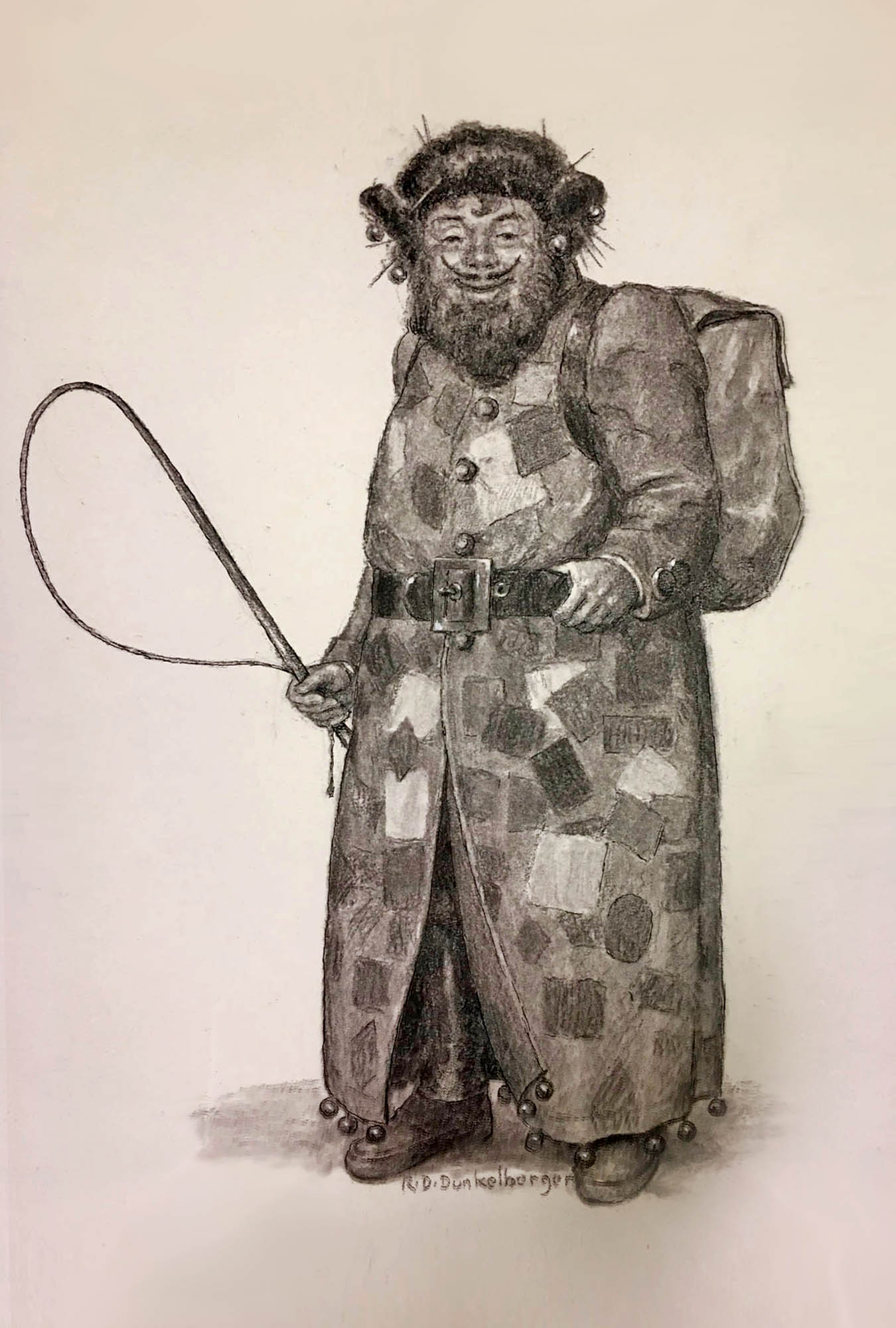
Belsnickel often wore a fur coat or hat, a coat trimmed with fur, or a fur-lined coat turned inside out (to create a weird effect and make the garment less recognizable). The choice of fur probably had less to do with some essential attribute of the character and more to do with the season itself. Nonetheless, the name “Belsnickel,” which is a derivation of the German “Pelznickel,” has often been incorrectly interpreted as “Fur Nicholas.” In fact, the “Pelz” here derives from pelzen, meaning, “to beat.” Pelznickel (and Belsnickel) carried in his pocket or bag, small treats, which he would scatter over the ground. Naughty children trying to grab these would feel his whip.
Like Germany’s Knecht Ruprecht or the Krampus of Alpine Austria and Bavaria, the whip was the Belsnickel’s essential attribute. In fact, in the 1800s, Pelznickel/Belsnickel would probably not have been that different in appearance from the Krampus as the modern image we have of that creature was only standardized as such with advent of Krampus postcards and their imagery dreamed up by city-dwelling artists, along with growth of a competitive community of mask-carvers in the early 20th century.
The popularity of the Belsnickel tradition soon saw it spill over from its original December 5-6 celebration to all the days leading up to Christmas and later New Year. As the tradition grew in popularity, Belsnickel was no longer represented as a solitary character but by groups of Belsnickels, whose behavior became increasingly rowdy and unwelcome. Rather than giving gifts or treats, these groups tended to ask for handouts from homes and businesses visited. Mrs. Karswell reads for us a number of American newspaper accounts documenting this trend.
Listen Now
Love PodBriefly?
If you like Podbriefly.com, please consider donating to support the ongoing development.
Support Us