Episode Details
Back to Episodes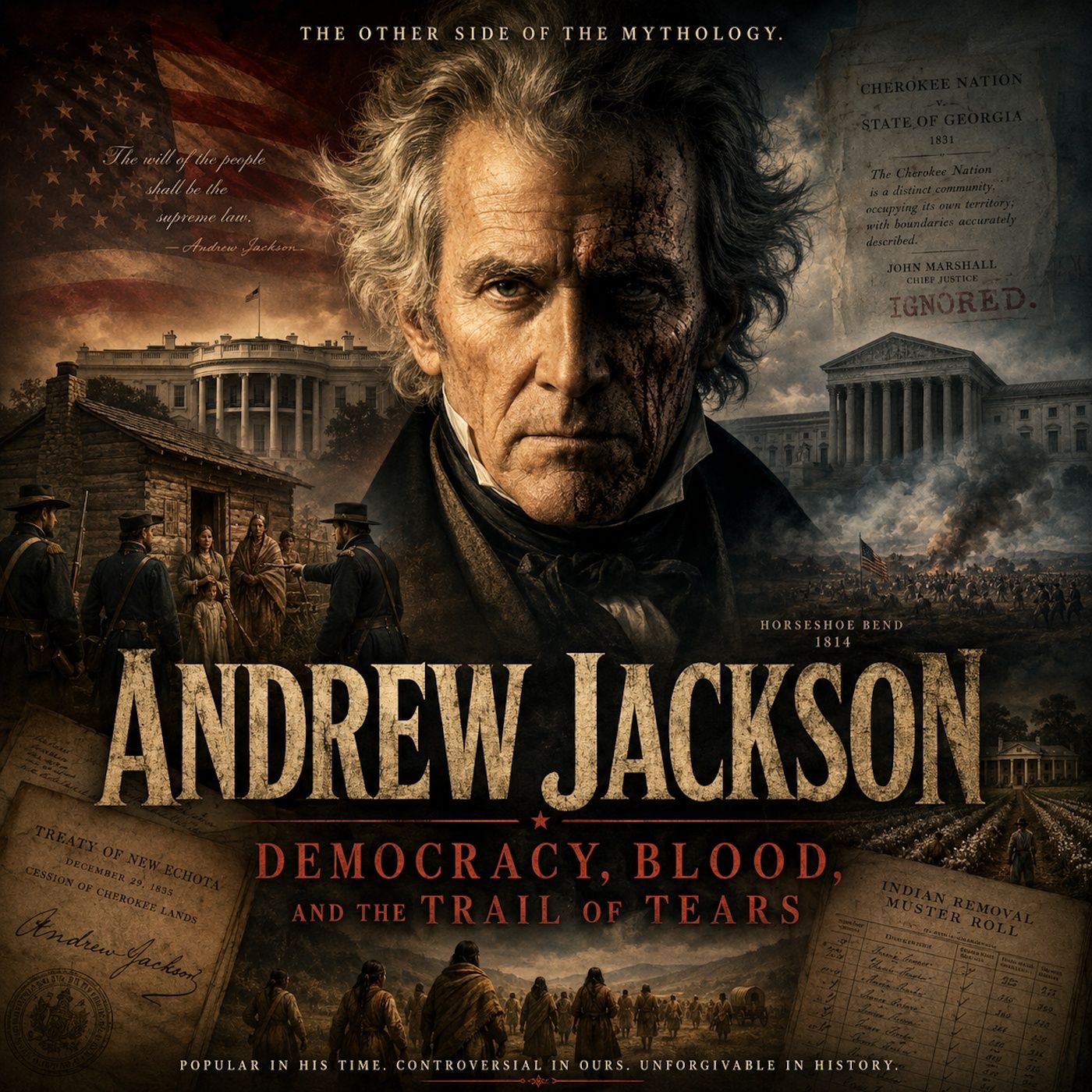
Andrew Jackson: Democracy, Blood, and the Trail of Tears
Published 4 months, 1 week ago
Description
Andrew Jackson sold himself as the champion of the common man. His face has been on the twenty dollar bill since 1928. There are statues of him in city squares from Tennessee to Washington. He's been claimed, in successive eras, by Democrats and Republicans, by progressives and conservatives, by every politician who ever wanted to wrap himself in the language of populism without owning what that language actually delivered when Jackson was the one speaking it.
This episode is the other side of that mythology.We start in north Georgia in the spring of 1838, the morning soldiers arrive at a Cherokee family's door with orders to clear them out. Then we cut back to the man who set that morning in motion. Born in the Carolina backcountry in 1767.
Orphaned by the Revolution at fourteen. A lawyer, a duelist, a slave owner, a planter who built his fortune on the forced labor of more than one hundred and fifty enslaved men, women, and children at the Hermitage. The general who broke the Red Stick Creeks at Horseshoe Bend, took 23 million acres of their land in the Treaty of Fort Jackson, and went home to grieve over the death of a Creek child he'd adopted from a different battlefield in the same war.We follow him into the White House. The Bank War. The cabinet shakeups. The temperament that made him willing to ignore his own Treasury Department, his own Congress, and eventually his own Supreme Court when they got in his way.
We walk through the Indian Removal Act of 1830, passed by five votes in the House after Theodore Frelinghuysen spoke against it for six hours over three days. We follow the Cherokee Nation's legal fight to John Marshall's bench, where they won the ruling that should have saved them, and we sit with the fact that a Supreme Court decision is only as strong as the executive willing to enforce it.
Jackson was not willing. We talk about the Treaty of New Echota, signed by fewer than five hundred Cherokee out of a nation of more than sixteen thousand, ratified by the United States Senate in 1836 by a single vote. We talk about what happened to the men who signed it. We talk about the bureaucracy that turned removal from chaos into policy: the muster rolls, the contracts, the chain of small decisions made by ordinary people in offices who could tell themselves they were just doing their jobs.
We don't retell the Trail of Tears in this one. That road has its own episode. This one's about the man who pointed at it, and the country that picked up his face and put it in our pockets.
If you've ever wondered how a democratic republic, working more or less the way it was designed to work, ends up administering an atrocity, this is that story.
Have a forgotten historical mystery, disturbing event, unsolved crime, or hidden conspiracy you think deserves investigation?
Send your suggestions to brian@paranormalworldproductions.com.
Disturbing History is a dark history podcast exploring unsolved mysteries, secret societies, historical conspiracies, lost civilizations, and the shadowy stories buried beneath the surface of the past.
Follow the show and enable automatic downloads so you never miss a deep dive into history’s most unsettling secrets.
Because sometimes the truth is darker than fiction.
This episode is the other side of that mythology.We start in north Georgia in the spring of 1838, the morning soldiers arrive at a Cherokee family's door with orders to clear them out. Then we cut back to the man who set that morning in motion. Born in the Carolina backcountry in 1767.
Orphaned by the Revolution at fourteen. A lawyer, a duelist, a slave owner, a planter who built his fortune on the forced labor of more than one hundred and fifty enslaved men, women, and children at the Hermitage. The general who broke the Red Stick Creeks at Horseshoe Bend, took 23 million acres of their land in the Treaty of Fort Jackson, and went home to grieve over the death of a Creek child he'd adopted from a different battlefield in the same war.We follow him into the White House. The Bank War. The cabinet shakeups. The temperament that made him willing to ignore his own Treasury Department, his own Congress, and eventually his own Supreme Court when they got in his way.
We walk through the Indian Removal Act of 1830, passed by five votes in the House after Theodore Frelinghuysen spoke against it for six hours over three days. We follow the Cherokee Nation's legal fight to John Marshall's bench, where they won the ruling that should have saved them, and we sit with the fact that a Supreme Court decision is only as strong as the executive willing to enforce it.
Jackson was not willing. We talk about the Treaty of New Echota, signed by fewer than five hundred Cherokee out of a nation of more than sixteen thousand, ratified by the United States Senate in 1836 by a single vote. We talk about what happened to the men who signed it. We talk about the bureaucracy that turned removal from chaos into policy: the muster rolls, the contracts, the chain of small decisions made by ordinary people in offices who could tell themselves they were just doing their jobs.
We don't retell the Trail of Tears in this one. That road has its own episode. This one's about the man who pointed at it, and the country that picked up his face and put it in our pockets.
If you've ever wondered how a democratic republic, working more or less the way it was designed to work, ends up administering an atrocity, this is that story.
Have a forgotten historical mystery, disturbing event, unsolved crime, or hidden conspiracy you think deserves investigation?
Send your suggestions to brian@paranormalworldproductions.com.
Disturbing History is a dark history podcast exploring unsolved mysteries, secret societies, historical conspiracies, lost civilizations, and the shadowy stories buried beneath the surface of the past.
Follow the show and enable automatic downloads so you never miss a deep dive into history’s most unsettling secrets.
Because sometimes the truth is darker than fiction.