Episode Details
Back to Episodes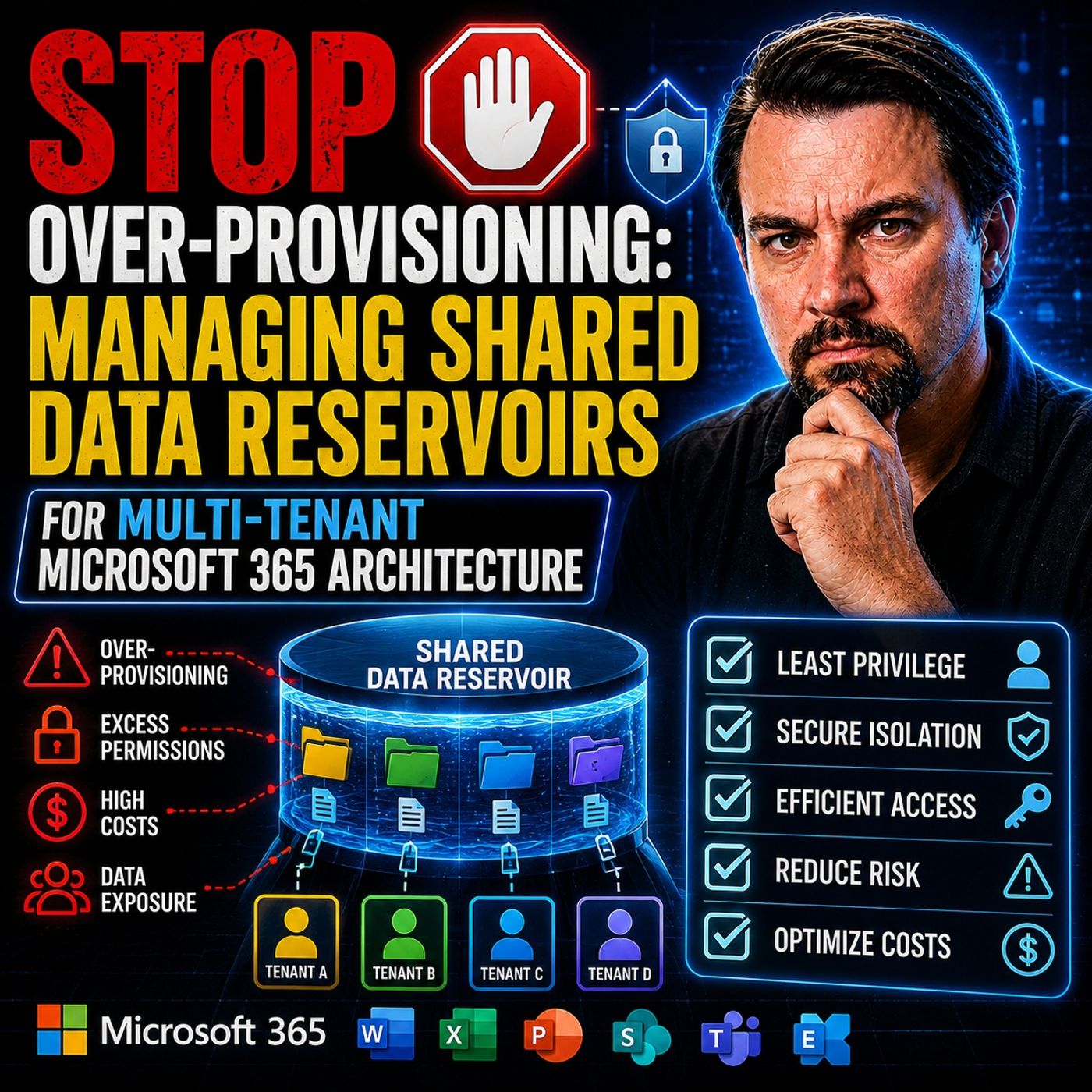
Stop Over-Provisioning: Managing Shared Data Reservoirs For Multi-Tenant Microsoft 365 Architecture
Season 2
Published 2 months, 4 weeks ago
Description
In this deep-dive episode of the m365.fm podcast, Mirko Peters breaks down one of the most expensive and misunderstood problems inside modern Microsoft 365 environments: over-provisioning caused by static quota architecture. Most organizations believe they are being safe by maintaining massive storage buffers, oversized environments, and rigid capacity allocations across Microsoft 365, SharePoint, OneDrive, Teams, Power Platform, and Azure infrastructure. But according to this episode, that “buffer mentality” is quietly creating a fiscal hemorrhage across enterprise environments. Organizations are paying for storage, performance, and licensing capacity that often sits unused while dark data silos continue growing in the background. This episode explores why traditional static quota models are failing modern cloud environments — and why the future of scalable Microsoft 365 architecture belongs to elastic shared data reservoirs powered by automation, orchestration, governance, and multi-tenant optimization strategies. If your Microsoft 365 environment is growing faster than your budget, this episode delivers a blueprint for building scalable, secure, and cost-efficient multi-tenant infrastructure before data growth overwhelms your operational model.
THE FISCAL HEMORRHAGE OF STATIC QUOTAS: WHY MOST M365 ENVIRONMENTS ARE BLEEDING MONEY
The episode opens by exposing the hidden cost problem behind most Microsoft 365 storage strategies. Traditional administration models rely heavily on static quotas and oversized safety margins designed to prevent emergency capacity failures. The fear is simple: Nobody wants the two AM support call where a tenant hits a storage limit and critical workloads stop functioning. To avoid that scenario, organizations massively over-provision capacity across:
THE MYTH OF THE BUFFER MENTALITY: WHY STATIC SAFETY MARGINS FAIL AT SCALE
A major section of the episode focuses on what Mirko calls the “Buffer Mentality.” This is the outdated operational philosophy where administrators add massive extra capacity “just in case” future growth occurs. The logic sounds reasonable. But at enterprise scale, these static safety margins become extremely expensive. The episode explains how organizations routinely add thirty percent or more excess storage and compute capacity across environments simply to avoid potential outages. The result is infrastructure that remains partially empty most of the year while operational costs continue climbing. Topics explored include:
THE FISCAL HEMORRHAGE OF STATIC QUOTAS: WHY MOST M365 ENVIRONMENTS ARE BLEEDING MONEY
The episode opens by exposing the hidden cost problem behind most Microsoft 365 storage strategies. Traditional administration models rely heavily on static quotas and oversized safety margins designed to prevent emergency capacity failures. The fear is simple: Nobody wants the two AM support call where a tenant hits a storage limit and critical workloads stop functioning. To avoid that scenario, organizations massively over-provision capacity across:
- SharePoint Online
- OneDrive
- Teams
- Power Platform environments
- Azure storage pools
- Multi-tenant workloads
- AI indexing infrastructure
- Dark data silos
- Idle performance capacity
- Wasted licensing spend
- Fragmented storage pools
- Performance bottlenecks
- Artificial scaling limitations
- Long-term operational inefficiency
THE MYTH OF THE BUFFER MENTALITY: WHY STATIC SAFETY MARGINS FAIL AT SCALE
A major section of the episode focuses on what Mirko calls the “Buffer Mentality.” This is the outdated operational philosophy where administrators add massive extra capacity “just in case” future growth occurs. The logic sounds reasonable. But at enterprise scale, these static safety margins become extremely expensive. The episode explains how organizations routinely add thirty percent or more excess storage and compute capacity across environments simply to avoid potential outages. The result is infrastructure that remains partially empty most of the year while operational costs continue climbing. Topics explored include:
- Capacity fragmentation
- Idle storage allocation
- Resource silos
- Multi-tenant inefficiency
- Static performance purchasing
- Unused quota overhead
- Long-term cost drift