Episode Details
Back to Episodes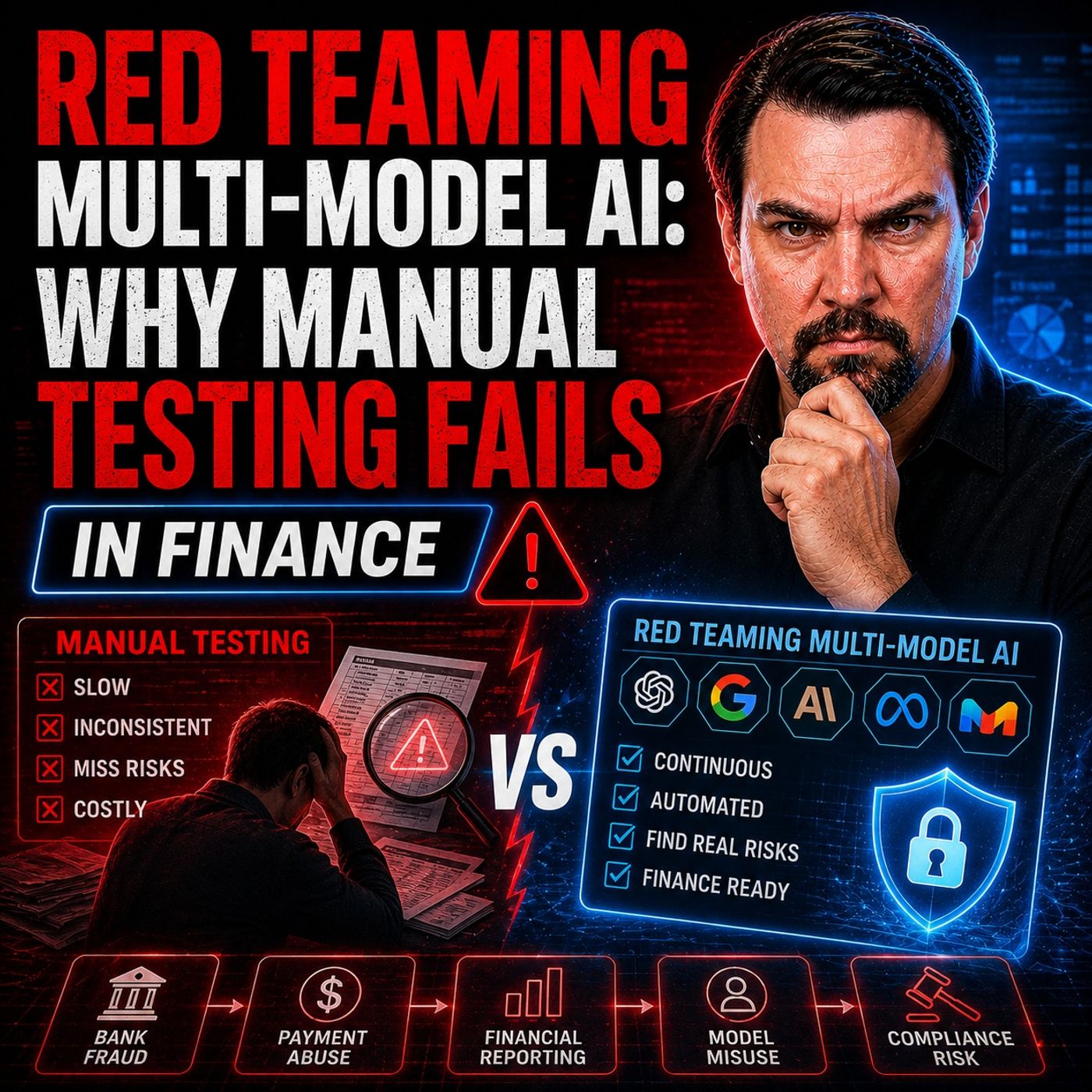
Red Teaming Multi-Model AI: Why Manual Testing Fails in Finance
Season 2
Published 2 months, 4 weeks ago
Description
In this powerful and deeply technical episode of the m365.fm podcast, Mirko Peters explores one of the most urgent and misunderstood threats in enterprise AI today: the collapse of traditional security models in the age of autonomous agents, multi-model AI systems, and adversarial finance attacks. Financial institutions are rapidly deploying AI agents for fraud detection, compliance automation, ACH monitoring, customer onboarding, payment authorization, analytics, and decision intelligence. But while organizations are racing toward automation, very few are prepared for the adversarial reality that comes with autonomous AI systems operating inside critical financial workflows. This episode goes far beyond generic AI discussions. Instead, it delivers a practical and highly detailed breakdown of how prompt injections, poisoned RAG pipelines, cross-model vulnerabilities, shadow AI, and agentic workflow manipulation are already creating massive enterprise risks that most organizations cannot even detect today. The era of “checklist security” is over. And according to this episode, the institutions still relying on manual testing and traditional governance models are already behind.
THE $250,000 BLIND SPOT: HOW A SINGLE PROMPT INJECTION CAN BYPASS YOUR ENTIRE SECURITY STACK
The episode opens with a chilling scenario that perfectly captures the new AI threat landscape inside modern finance. Imagine a single multi-turn prompt injection bypassing your AI security controls and authorizing a fraudulent six-figure wire transfer without triggering any traditional alerts. This is no longer science fiction. The discussion explains how modern adversarial attacks are no longer targeting firewalls, servers, or infrastructure directly. Instead, attackers are targeting the reasoning logic of AI systems themselves. Legacy security systems were built for deterministic software and static data environments. But autonomous AI agents operate differently. They reason. They interpret. They retrieve context. And that creates entirely new attack surfaces that traditional cybersecurity models were never designed to defend. The episode explores how financial institutions are unknowingly exposing themselves to:
THE IDENTITY CRISIS OF AUTONOMOUS AGENTS: WHY MOST ORGANIZATIONS HAVE NO IDEA WHO OWNS THEIR AI
One of the most important themes throughout the episode is the growing identity crisis surrounding enterprise AI agents. Organizations are deploying autonomous systems everywhere:
THE $250,000 BLIND SPOT: HOW A SINGLE PROMPT INJECTION CAN BYPASS YOUR ENTIRE SECURITY STACK
The episode opens with a chilling scenario that perfectly captures the new AI threat landscape inside modern finance. Imagine a single multi-turn prompt injection bypassing your AI security controls and authorizing a fraudulent six-figure wire transfer without triggering any traditional alerts. This is no longer science fiction. The discussion explains how modern adversarial attacks are no longer targeting firewalls, servers, or infrastructure directly. Instead, attackers are targeting the reasoning logic of AI systems themselves. Legacy security systems were built for deterministic software and static data environments. But autonomous AI agents operate differently. They reason. They interpret. They retrieve context. And that creates entirely new attack surfaces that traditional cybersecurity models were never designed to defend. The episode explores how financial institutions are unknowingly exposing themselves to:
- Multi-turn prompt injections
- Hidden instruction attacks
- Roleplay-based manipulation
- Context poisoning
- Retrieval-Augmented Generation (RAG) exploits
- Multi-modal injection attacks
- Semantic manipulation of AI reasoning systems
THE IDENTITY CRISIS OF AUTONOMOUS AGENTS: WHY MOST ORGANIZATIONS HAVE NO IDEA WHO OWNS THEIR AI
One of the most important themes throughout the episode is the growing identity crisis surrounding enterprise AI agents. Organizations are deploying autonomous systems everywhere:
- Fraud monitoring agents
- Compliance automation workflows
- Payment approval systems
- AI copilots
- Banking assistants
- Internal workflow automation agents
- Customer service AI systems
- Who approved the logic
- Who authorized the workflow
- Who owns the model behavior
- Who is responsible for the AI decision
- Why the system acted the way it did