Episode Details
Back to Episodes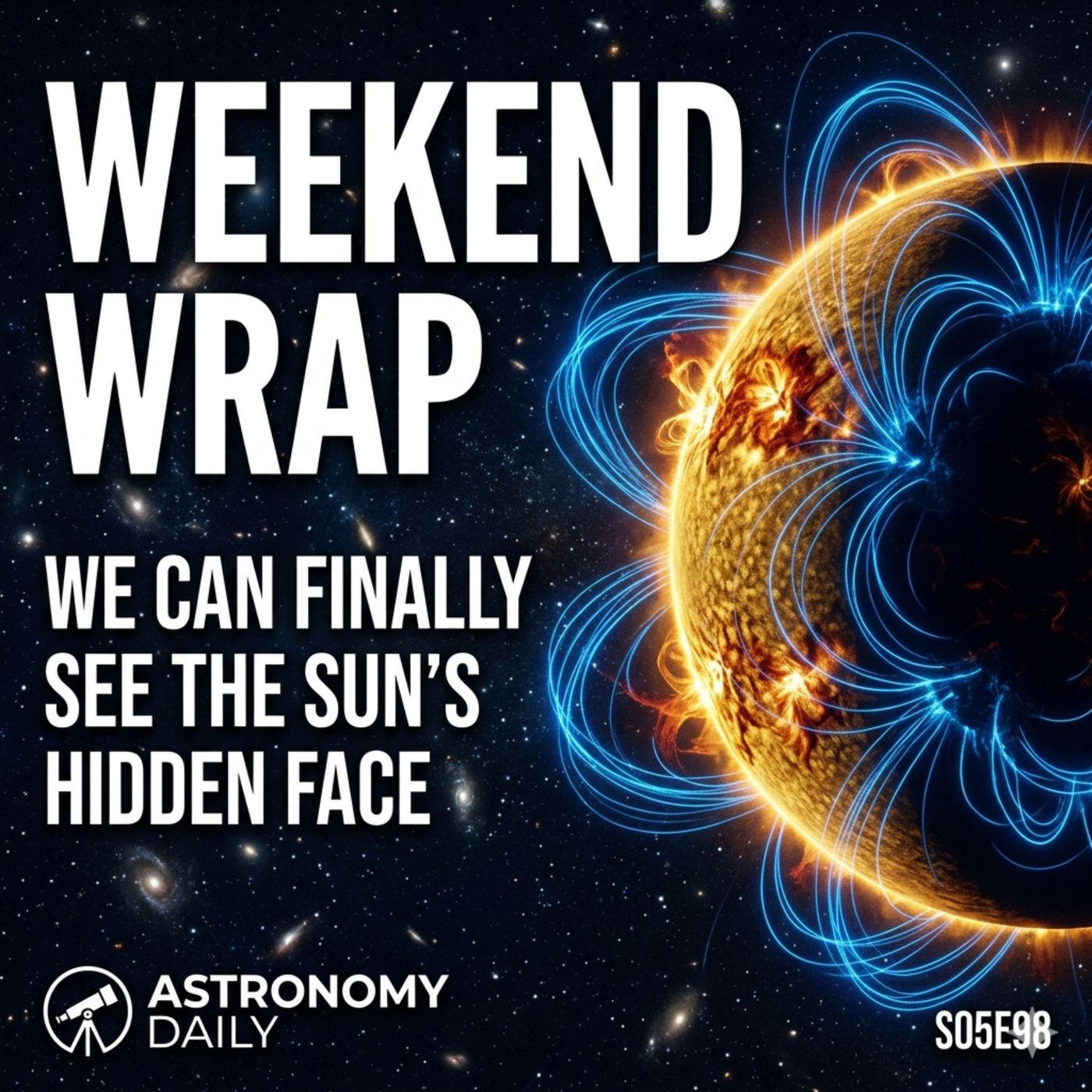
The Sun's Hidden Face Mapped, A Galaxy That Forgot to Spin | Plus Weekend Wrap
Season 5
Episode 98
Published 1 month, 3 weeks ago
Description
Sponsor Link
When your ready to upgrade your digital security online, do what we did and get the best - NordVPN. And right now you can save a heap of money and help support the show. For details on the full deal CLICK HERE
Astronomy Daily — S05E98 | Weekend Wrap | May 9, 2026 Welcome to the Astronomy Daily Weekend Space & Astronomy News Wrap! Every Saturday, Anna and Avery bring you a roundup of the biggest stories from the past week in space and astronomy — plus two fresh stories to open the show. Here's what we covered this week: Fresh Stories 🌞 The Sun's Hidden Face Finally Gets a Full Read-Out For 25 years, helioseismology has let scientists detect sunspot groups forming on the Sun's far side — but not their magnetic polarity, the key factor in forecasting how dangerous an eruption might be. A new technique developed by the National Solar Observatory's GONG network changes that, enabling polarity-resolved magnetic maps of the Sun's hidden hemisphere for the first time. With a significant far-side flare firing just days ago, the real-world stakes couldn't be clearer. Published in Scientific Reports. 🌀 Webb Finds an Ancient Galaxy That Simply Refuses to Spin James Webb has spotted XMM-VID1-2075, a massive galaxy formed less than 2 billion years after the Big Bang that shows no rotation — a trait normally reserved for much older, evolved systems. Current theory says young galaxies should still be spinning. This one isn't. The UC Davis-led team is now searching for similar objects to understand how rare this truly is. Published in Nature Astronomy. Weekly Wrap — The Four Biggest Stories 🪐 The Planetary Odd Couple That Defies the Rules 190 light-years away, a hot Jupiter and a mini-Neptune are orbiting the same star — an arrangement once thought nearly impossible, since hot Jupiters typically scatter anything in their neighbourhood. Using JWST, MIT researchers have now read the mini-Neptune's atmosphere for the first time, finding a heavy mix of water vapour, CO₂, SO₂ and methane that points to formation far beyond the frost line. Both planets likely migrated inward together. Published in Astrophysical Journal Letters. 🟤 200,000 Volunteers Double the Known Brown Dwarf Population NASA's citizen science project Backyard Worlds: Planet 9 has announced the discovery of more than 3,000 brown dwarfs over 10 years — essentially doubling the known count. The 75-author paper in The Astronomical Journal includes 61 volunteer co-authors. New finds include extreme T subdwarfs, ultra-cool objects, and a brown dwarf that may have aurorae. The search continues through more than 2 billion WISE sources. 🍩 NASA Launches Space Doughnut Mission Tuesday SpaceX CRS-34 launches May 12 carrying STORIE (Storm Time O+ Ring Current Imaging Evolution), a joint NASA/U.S. Space Force instrument to be mounted outside the ISS. STORIE will study Earth's ring current — a doughnut-shaped region of trapped charged particles that can surge during solar storms, disrupting satellites and power grids — from the inside out. Six-month mission duration. 🪨 Webb Directly Reads an Exoplanet's Surface for the First Time JWST has achieved a planetary science first — directly characterising the surface of a super-Earth 48 light-years away. The findings reveal a dark, airless, Mercury-like world with no atmosphere. The technique marks a significant shift from atmospheric to direct surface analysis, opening new possibilities for characterising rocky planets in and near habitable zones.
Become a supporter of this podcast: https://www.spreaker.com/podcast/astronomy-daily-space-news-updates--5648921/support.
When your ready to upgrade your digital security online, do what we did and get the best - NordVPN. And right now you can save a heap of money and help support the show. For details on the full deal CLICK HERE
Astronomy Daily — S05E98 | Weekend Wrap | May 9, 2026 Welcome to the Astronomy Daily Weekend Space & Astronomy News Wrap! Every Saturday, Anna and Avery bring you a roundup of the biggest stories from the past week in space and astronomy — plus two fresh stories to open the show. Here's what we covered this week: Fresh Stories 🌞 The Sun's Hidden Face Finally Gets a Full Read-Out For 25 years, helioseismology has let scientists detect sunspot groups forming on the Sun's far side — but not their magnetic polarity, the key factor in forecasting how dangerous an eruption might be. A new technique developed by the National Solar Observatory's GONG network changes that, enabling polarity-resolved magnetic maps of the Sun's hidden hemisphere for the first time. With a significant far-side flare firing just days ago, the real-world stakes couldn't be clearer. Published in Scientific Reports. 🌀 Webb Finds an Ancient Galaxy That Simply Refuses to Spin James Webb has spotted XMM-VID1-2075, a massive galaxy formed less than 2 billion years after the Big Bang that shows no rotation — a trait normally reserved for much older, evolved systems. Current theory says young galaxies should still be spinning. This one isn't. The UC Davis-led team is now searching for similar objects to understand how rare this truly is. Published in Nature Astronomy. Weekly Wrap — The Four Biggest Stories 🪐 The Planetary Odd Couple That Defies the Rules 190 light-years away, a hot Jupiter and a mini-Neptune are orbiting the same star — an arrangement once thought nearly impossible, since hot Jupiters typically scatter anything in their neighbourhood. Using JWST, MIT researchers have now read the mini-Neptune's atmosphere for the first time, finding a heavy mix of water vapour, CO₂, SO₂ and methane that points to formation far beyond the frost line. Both planets likely migrated inward together. Published in Astrophysical Journal Letters. 🟤 200,000 Volunteers Double the Known Brown Dwarf Population NASA's citizen science project Backyard Worlds: Planet 9 has announced the discovery of more than 3,000 brown dwarfs over 10 years — essentially doubling the known count. The 75-author paper in The Astronomical Journal includes 61 volunteer co-authors. New finds include extreme T subdwarfs, ultra-cool objects, and a brown dwarf that may have aurorae. The search continues through more than 2 billion WISE sources. 🍩 NASA Launches Space Doughnut Mission Tuesday SpaceX CRS-34 launches May 12 carrying STORIE (Storm Time O+ Ring Current Imaging Evolution), a joint NASA/U.S. Space Force instrument to be mounted outside the ISS. STORIE will study Earth's ring current — a doughnut-shaped region of trapped charged particles that can surge during solar storms, disrupting satellites and power grids — from the inside out. Six-month mission duration. 🪨 Webb Directly Reads an Exoplanet's Surface for the First Time JWST has achieved a planetary science first — directly characterising the surface of a super-Earth 48 light-years away. The findings reveal a dark, airless, Mercury-like world with no atmosphere. The technique marks a significant shift from atmospheric to direct surface analysis, opening new possibilities for characterising rocky planets in and near habitable zones.
Become a supporter of this podcast: https://www.spreaker.com/podcast/astronomy-daily-space-news-updates--5648921/support.
Listen Now
Love PodBriefly?
If you like Podbriefly.com, please consider donating to support the ongoing development.
Support Us