Episode Details
Back to Episodes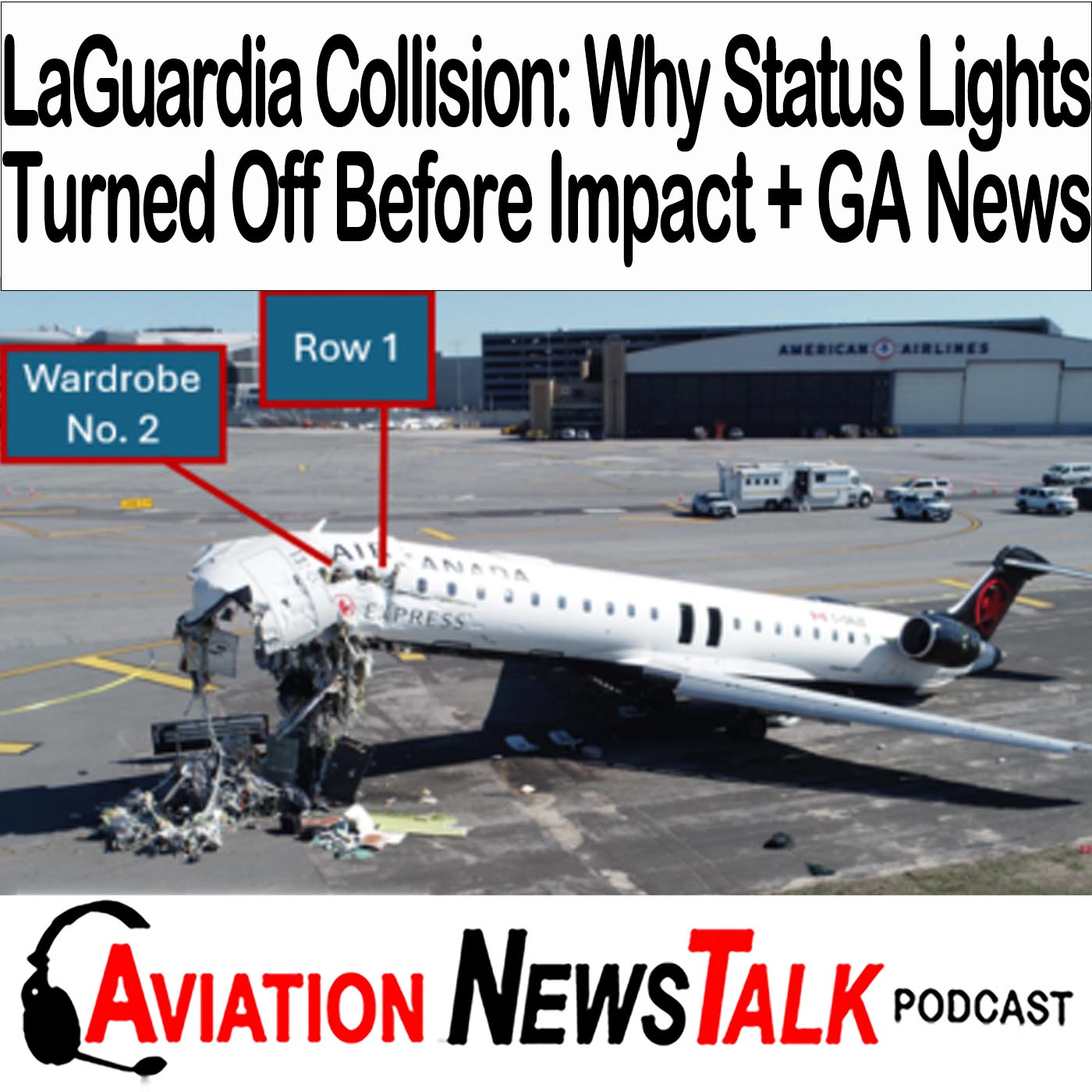
LaGuardia Runway Collision: Why the Runway Lights Turned Off Before Impact + GA News
Description
LaGuardia Runway Collision and the NTSB Preliminary Report Max talks about the fatal LaGuardia Airport runway collision involving Jazz Flight 646 and an ARFF fire truck responding to an emergency near Terminal B. The accident occurred at night, in rain and reduced visibility, as multiple airport rescue firefighting vehicles were moving toward an emergency scene and needed to cross Runway 4 at Taxiway D.
Dr. Victor Vogel Max also gives a tribute to Dr. Victor Vogel, who recently passed away.
The basic outline sounds simple: a fire truck was cleared to cross an active runway and was struck by a landing regional airliner. But the NTSB preliminary report reveals a much more complicated chain of events involving ATC communications, emergency response workload, runway status lights, ASDE-X limitations, and human factors.
Truck 1 was part of a larger convoy of emergency vehicles. The tower controller cleared Jazz Flight 646 to land, then later cleared Truck 1 and company to cross Runway 4. About 20 seconds before the collision, the airplane was very low on final approach and roughly a quarter mile from the runway. Truck 1 read back the crossing clearance and began moving toward the runway. The controller then instructed Truck 1 to stop, but the truck continued accelerating and entered the runway just before impact.
Why the Runway Entrance Lights Turned Off One of the most surprising details in the episode is that the runway entrance lights, or RELs, turned off just before Truck 1 entered the runway. These red in-pavement lights are part of the Runway Status Light system, which is installed at only a limited number of airports. They are designed to warn pilots and vehicle operators when it is unsafe to enter or cross a runway.
At first glance, it sounds like the system failed. But Max explains that the lights apparently worked as designed. For arriving aircraft, runway entrance lights illuminate when an aircraft is approaching the runway, then extinguish at each equipped taxiway intersection a few seconds before the aircraft reaches that intersection. That timing supports ATC's use of anticipated separation, which allows controllers to issue clearances based on the expectation that required separation will exist by the time the clearance is actually used.
That design may make sense when a crossing aircraft or vehicle is stopped at or near the hold-short line. But in this accident, Truck 1 was already rolling toward the runway and reached the runway edge just as the red lights extinguished. Max explains why that creates a serious human-factors trap. To a pilot or driver, red means stop. When red lights go dark, the intuitive message may be that the danger has ended. But with Runway Status Lights, dark does not mean "go." It only means the lights are no longer providing a stop warning, and an ATC clearance is still required.
Why ASDE-X Did Not Alert Controllers The episode also examines why ASDE-X, the airport surface detection system, did not generate an aural or visual alert warning controllers of the conflict. The problem appears to involve the way the system detected the group of emergency vehicles.
The responding vehicles were not equipped with transponders, so ASDE-X could not uniquely identify each vehicle. Multiple vehicles were intermittently detected as radar targets, but because they were close together and moving near each other, their radar returns merged and separated in a way that prevented the system from creating high-confidence tracks. At one point, the system displayed only two radar targets where there were actually seven response vehicles.
Without reliable tracks for Truck 1 and the other vehicles, ASDE-X could not correlate Truck 1's m