Episode Details
Back to Episodes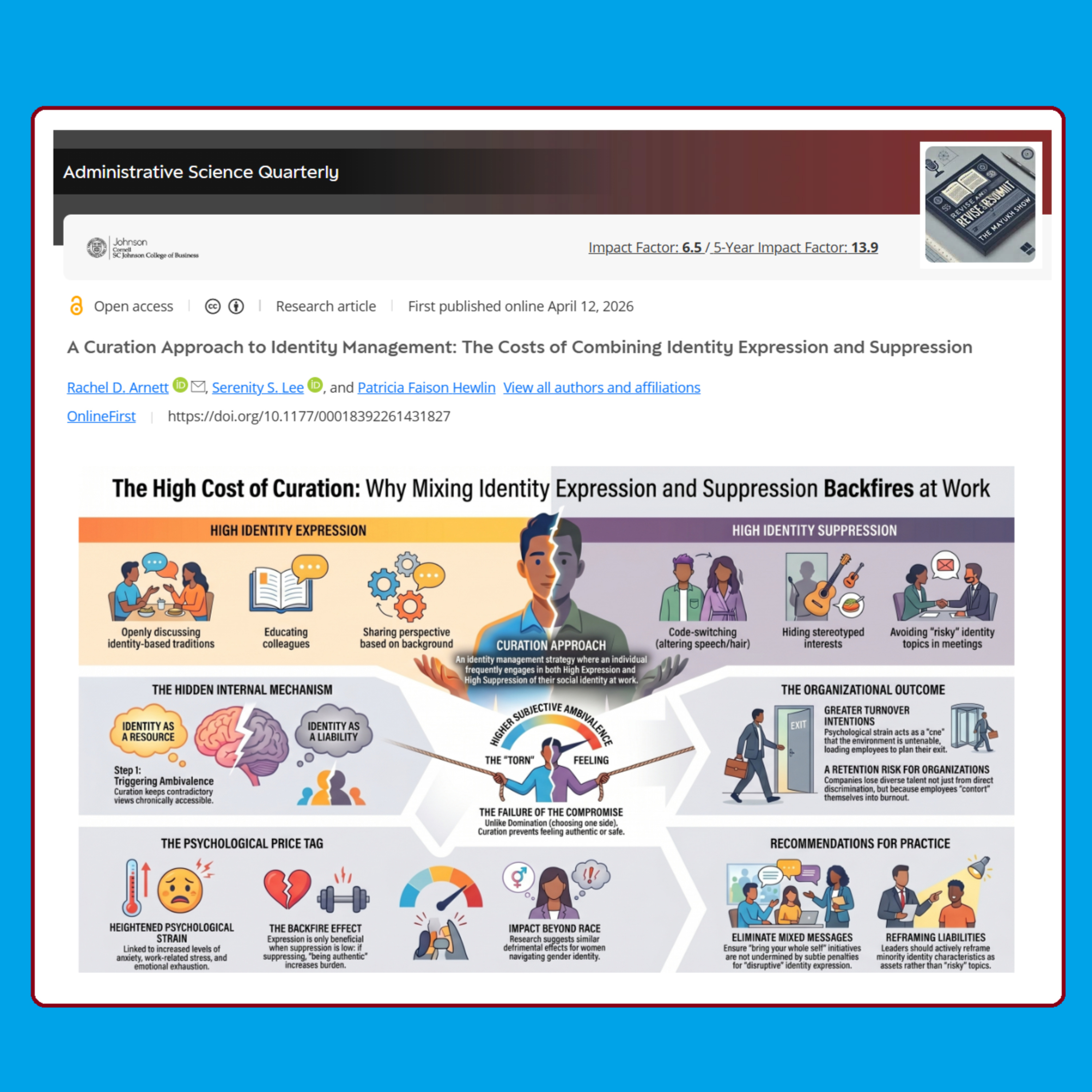
A Curation Approach to Identity Management (Arnett 2026) | FT50 ASQ
Description
English Podcast Starts at 00:00:00
Bengali Podcast Starts at 00:18:56
Hindi Podcast Starts at 00:36:40
Danish Podcast Starts at 00:51:25
Reference
Arnett, R. D., Lee, S. S., & Hewlin, P. F. (2026). A Curation Approach to Identity Management: The Costs of Combining Identity Expression and Suppression. Administrative Science Quarterly. https://doi.org/10.1177/00018392261431827
Youtube Channel
https://www.youtube.com/@weekendresearcher
Podcast Website
https://mayukhmukhopadhyay.com/reviseandresubmit
Academy of Management PDW on Space Economy Registration Flyer
https://cto.aom.org/discussion/flagship-aom-2026-pdw-space-economy-consolidating-a-research-agenda-8
🎧 Welcome to Revise and Resubmit.
There are some research papers that do more than explain the workplace. They reveal what it costs to survive it.
Today, I want to spend a little time with a remarkable new paper titled A Curation Approach to Identity Management: The Costs of Combining Identity Expression and Suppression by Rachel D. Arnett, Serenity S. Lee, and Patricia Faison Hewlin, published online on 12 April 2026 in Administrative Science Quarterly 📚✨, one of the most prestigious academic journals in management and organization studies, and proudly part of the FT50 journal list. That matters, of course, because FT50 signals rigor, influence, and scholarly weight. But what matters even more to me is the ache inside this paper, the human truth it is trying to name.
Because what this article studies is not simply identity at work. It studies the exhausting choreography of deciding, every day, which parts of yourself can come into the room and which parts must wait outside. 🪞💼
The authors focus on employees from marginalized groups, especially employees of color, and they examine something called curation. Now that word sounds elegant, almost artistic. It makes you think of museums, playlists, beautiful selections. 🎨🎵 But in the workplace, curation can mean something far more intimate and far more painful. It means expressing parts of your identity in ways that feel acceptable, while suppressing other parts that might be judged, misunderstood, or used against you.
And what this paper shows, with stunning clarity, is that this balancing act is not necessarily a smart compromise. It may actually deepen psychological strain. Why? Because it creates ambivalence. It leaves a person wondering whether their identity is a source of strength or a source of danger. 🌗💭 A resource or a liability. A truth to live by or a truth to edit.
That tension does something to the spirit. It wears people down. It turns self-presentation into self-surveillance. And eventually, for many, it does not just produce discomfort. It produces the desire to leave.
I think that is what makes this paper so powerful. It does not only tell us something about marginalized employees. It tells us something about institutions, about belonging, and about the hidden emotional taxes that formal inclusion can still fail to erase. 🧠❤️
So in this episode, I want to sit with that tension. I want to ask what happens when authenticity becomes strategic, and when survival at work begins to look like a form of careful, exhausting curation.
If you value thoughtful conversations on powerful academic research, please subscribe to Revise and Resubmit on Spotify 🎙️ and follow Weekend Researcher on YouTube 📺✨. You can also find the channel on Amazon Prime and Apple Podcast 🍎🎧 Your support truly helps keep these conversations alive.
My sincere thanks to the authors, Rachel D. Arnett, Serenity S. Lee, and Patricia Faison Hewlin, and to SAGE Publications for bringing this important research into the world 🙏📘
So here is the question I want to leave with you today 🤔<