Episode Details
Back to Episodes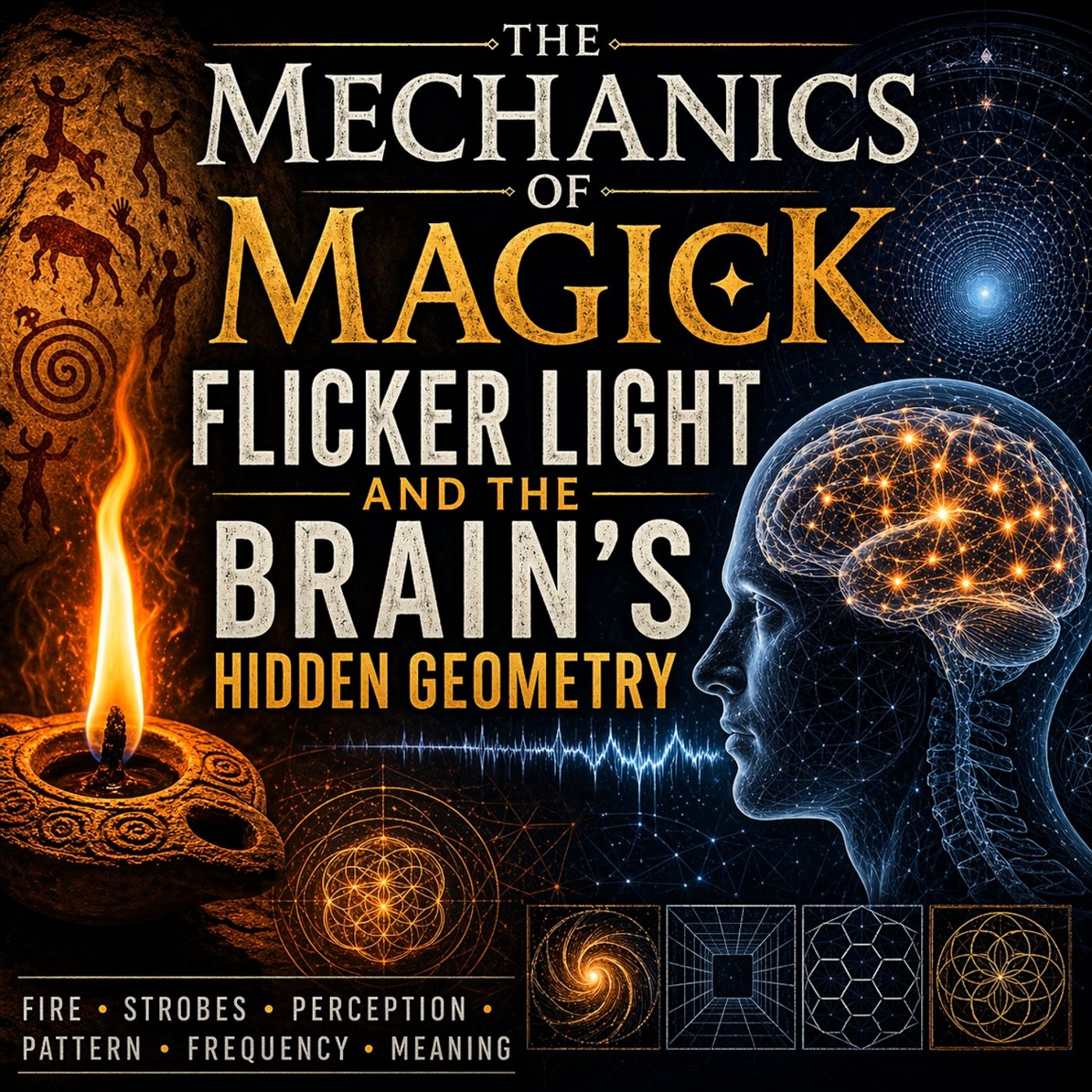
The Mechanics of Magick: Flicker Light and the Brain’s Hidden Geometry
Published 3 months, 3 weeks ago
Description
If you enjoy this episode, we’re sure you will enjoy more content like this on The Occult Rejects. In fact, we have curated playlists on occult topics like grimoires, esoteric concepts and phenomena, occult history, analyzing true crime and cults with an occult lens, Para politics, and occultism in music. Whether you enjoy consuming your content visually or via audio, we’ve got you covered - and it will always be provided free of charge. So, if you enjoy what we do and want to support our work of providing accessible, free content on various platforms, please consider making a donation to the links provided below.
Thank you and enjoy the episode!
Links For The Occult Rejects
https://linktr.ee/theoccultrejects
Occult Research Institute
https://www.occultresearchinstitute.org/
Cash App
https://cash.app/$theoccultrejects
Venmo
@TheOccultRejects
Buy Me A Coffee
buymeacoffee.com/TheOccultRejects
Patreon
https://www.patreon.com/TheOccultRejects
Bibliography / Show Notes
Thank you and enjoy the episode!
Links For The Occult Rejects
https://linktr.ee/theoccultrejects
Occult Research Institute
https://www.occultresearchinstitute.org/
Cash App
https://cash.app/$theoccultrejects
Venmo
@TheOccultRejects
Buy Me A Coffee
buymeacoffee.com/TheOccultRejects
Patreon
https://www.patreon.com/TheOccultRejects
Bibliography / Show Notes
- Amaya, I. A., Behrens, F., et al. “Effect of Frequency and Rhythmicity on Flicker Light-Induced Visual Hallucinations.” PLOS ONE, 2023.
Key use: frequency, rhythmicity, 10 Hz flicker, Klüver forms. - Shenyan, O., Lisi, M., Greenwood, J. A., Skipper, J. I., & Dekker, T. M. “Visual Hallucinations Induced by Ganzflicker and Ganzfeld Differ in Frequency, Complexity, and Content.” Scientific Reports, 2024.
Key use: Ganzfeld vs. Ganzflicker. - Bressloff, P. C., Cowan, J. D., Golubitsky, M., Thomas, P. J., & Wiener, M. C. “Geometric Visual Hallucinations, Euclidean Symmetry and the Functional Architecture of Striate Cortex.” Philosophical Transactions of the Royal Society B, 2001.
Key use: form constants, tunnels, spirals, lattices, honeycombs, visual cortex modeling. - Bressloff, P. C. “What Geometric Visual Hallucinations Tell Us About the Visual Cortex.” Neural Computation, 2002.
Key use: Klüver form constants and visual cortex explanation. - Mauro, F., et al. “A Bidirectional Link Between Brain Oscillations and Geometric Patterns.” Journal of Neuroscience, 2015.
Key use: brain oscillations and geometric visual patterns. - Hewitt, T., et al. “Stroboscopically Induced Visual Hallucinations.” Neuroscience of Consciousness, 2025.
Key use: history and science of stroboscopic hallucinations. - Netherlands Institute for Neuroscience. “Hallucinations from Flickering Lights: What Happens in Our Brain?” 2024.
Key use: standing waves / visual cortex explanation. - Purkinje, J. E. Early 19th-century writings on subjective visual phenomena and flicker effects.
Key use: historical scientific observation of flicker-induced visual effects. - Klüver, H. Mescal and Mechanisms of Hallucinations. University of Chicago Press, 1966.
Key use: form constants: tunnels, spirals, lattices, cobwebs. - Epilepsy Foundation / clinical photosensitivity guidance.
Key use: photosensitive epilepsy safety warning; flashing lights and visual patterns can trigger seizures in susceptible people. - “Visually-Provoked Seizures: Consensus of the Epilepsy Foundation of America Working Group.” Epilepsia.
Key use: safety, photosensitive seizure risk. - Ofcom / broadcast photosensitive epilepsy standards and strobe-light safety cases.
Key use: real-world risk from rapid flashing light in media environments.
- Gysin, B., and Sommerville, I. Dreamachine-related writings and documentation.
Key use: 20th-century flicker device, art, counterculture, visionary technology. - Huxley, A. The Doors of Perception.
Key use: altered perception context, though not specifically flicker science. - Lewis-Williams, D. The Mind in the Cave.
Key use: cave art, altered states, entoptic imagery, vi