Episode Details
Back to Episodes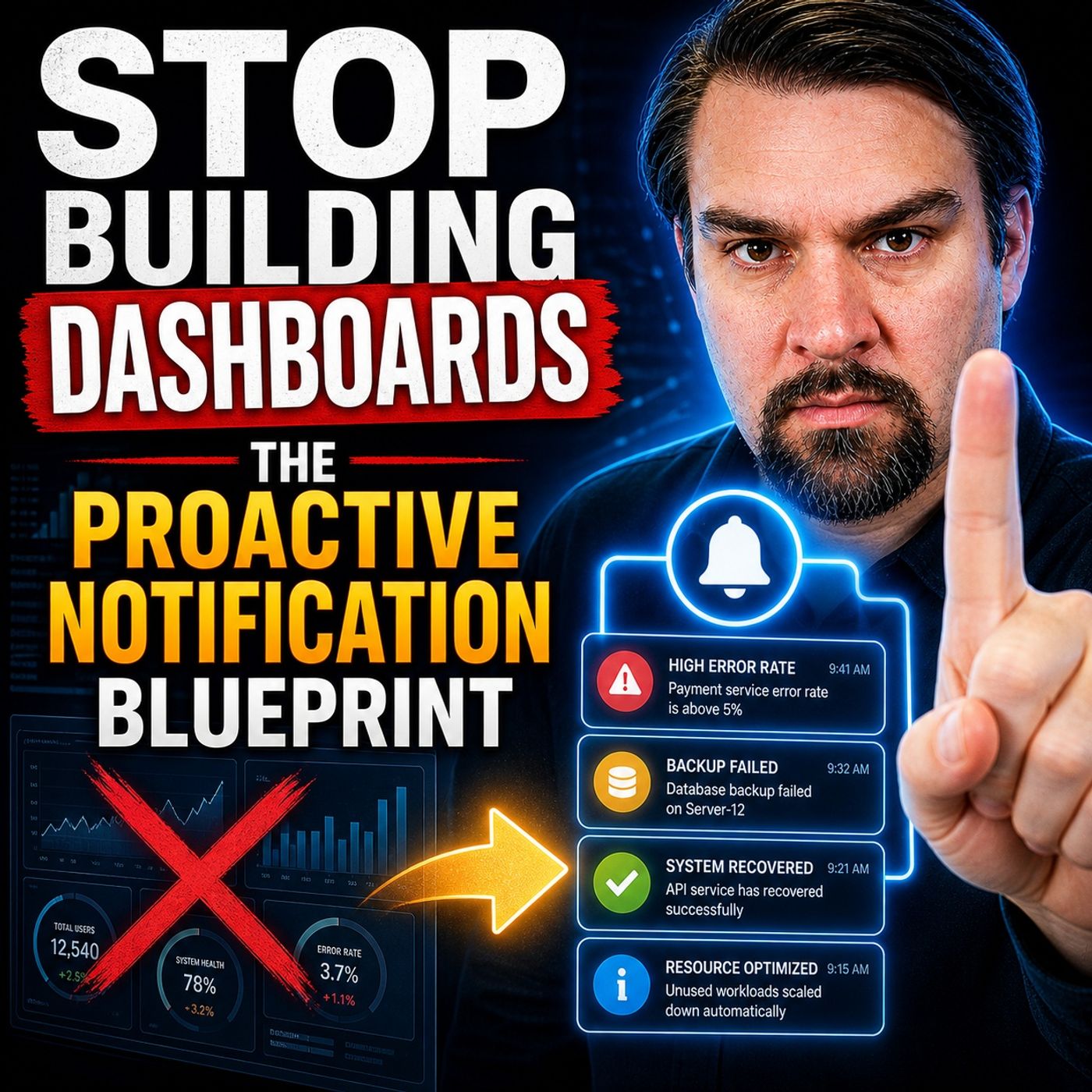
Stop Building Dashboards: The Proactive Notification Blueprint
Season 2
Published 3 months, 1 week ago
Description
Your dashboard looks perfect on launch day. Clean visuals, aligned KPIs, and a sense that everything is finally “visible.” But the decay starts immediately. Because dashboards depend on one fragile assumption: someone will open them at the exact moment something matters. That rarely happens. In this episode, we challenge one of the most accepted patterns in modern BI—the idea that dashboards are the end product. Instead, we reframe analytics as an intervention system, where insight doesn’t wait to be discovered. It shows up at the right moment, in the right place, with a clear path to action. This is the shift from pull-based analytics to push-based decision systems.
THE HIDDEN FAILURE OF DASHBOARD-DRIVEN THINKING
Dashboards don’t fail because they’re poorly designed. They fail because they rely on human timing. People check data:
THE RISE OF THE DATA GRAVEYARD
Most dashboards don’t die dramatically. They fade. They sit in tabs. They get opened less. Eventually, they become storage instead of insight. This is what we call the data graveyard. The data might still be fresh. The visuals might still be accurate. But the system around them is broken. It depends on users stopping their work, navigating to a report, interpreting the data, and acting—fast enough for it to matter. In real organizations, that sequence collapses. People are overloaded with tools, messages, and decisions. Analytics becomes just another place to check. And once something becomes optional, it becomes ignored.
WHY VISIBILITY IS NOT THE SAME AS ACTION
A dashboard gives you awareness. But awareness is passive. It tells you something could be known—if someone goes looking. But it doesn’t intervene. It doesn’t interrupt. It doesn’t create urgency. That’s the gap between:
THE SHIFT FROM PULL TO PUSH
The real transformation isn’t better dashboards. It’s a different operating model. Instead of asking: “How do we visualize this data?” You ask: “What business moment deserves a response?” This is event-first thinking. You stop designing pages. You start designing moments of action:
FROM DASHBOARDS TO EVENT-DRIVEN SYSTEMS
Once you adopt event thinking, everything changes. Instead of building reports, you define:
WHY MOST ALERTING STRATEGIES FAIL
Many teams try to evolve by adding alerts. That usually makes things worse. Why? Because most alerts:
THE HIDDEN FAILURE OF DASHBOARD-DRIVEN THINKING
Dashboards don’t fail because they’re poorly designed. They fail because they rely on human timing. People check data:
- When they remember
- When they have time
- When they already suspect a problem
THE RISE OF THE DATA GRAVEYARD
Most dashboards don’t die dramatically. They fade. They sit in tabs. They get opened less. Eventually, they become storage instead of insight. This is what we call the data graveyard. The data might still be fresh. The visuals might still be accurate. But the system around them is broken. It depends on users stopping their work, navigating to a report, interpreting the data, and acting—fast enough for it to matter. In real organizations, that sequence collapses. People are overloaded with tools, messages, and decisions. Analytics becomes just another place to check. And once something becomes optional, it becomes ignored.
WHY VISIBILITY IS NOT THE SAME AS ACTION
A dashboard gives you awareness. But awareness is passive. It tells you something could be known—if someone goes looking. But it doesn’t intervene. It doesn’t interrupt. It doesn’t create urgency. That’s the gap between:
- Exploration (what dashboards do well)
- Intervention (what modern systems require)
THE SHIFT FROM PULL TO PUSH
The real transformation isn’t better dashboards. It’s a different operating model. Instead of asking: “How do we visualize this data?” You ask: “What business moment deserves a response?” This is event-first thinking. You stop designing pages. You start designing moments of action:
- A budget crosses a threshold
- An SLA starts drifting
- A risk pattern emerges
- A process stalls
FROM DASHBOARDS TO EVENT-DRIVEN SYSTEMS
Once you adopt event thinking, everything changes. Instead of building reports, you define:
- Signals (what changed)
- Thresholds (when it matters)
- Owners (who is responsible)
- Routes (where it shows up)
- Actions (what happens next)
WHY MOST ALERTING STRATEGIES FAIL
Many teams try to evolve by adding alerts. That usually makes things worse. Why? Because most alerts:
- Trigger on raw numbers
- Ignore context
- Lack clear action paths
- What changed
- Why it matters now
- What action is expected