Episode Details
Back to Episodes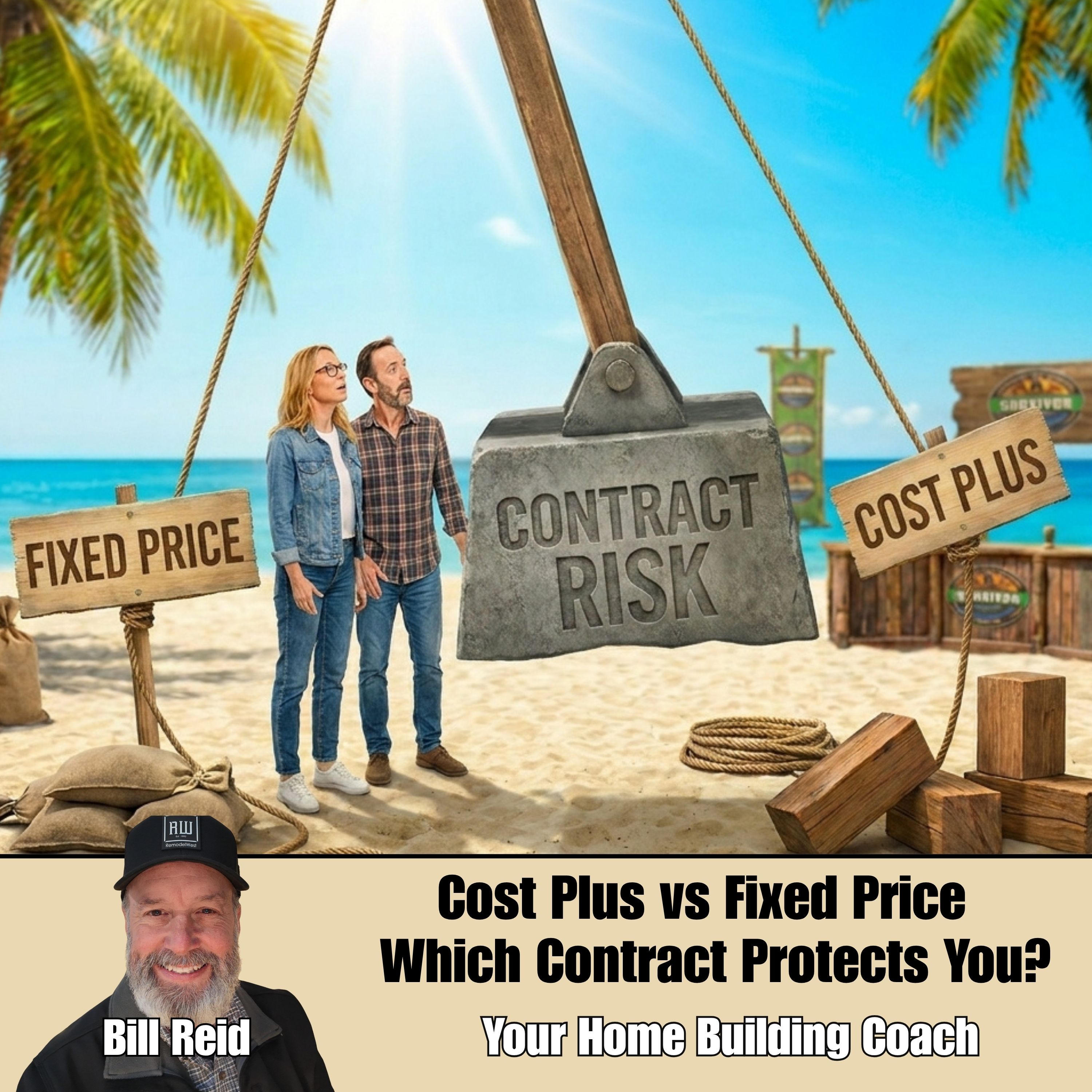
Cost Plus vs Fixed Price — Which Contract Protects You?
Description
Cost plus or fixed price? It's the question your contractor asks just before you sign — and most homeowners walk into the answer blind. Episode 55 launches a brand-new sub-series inside the World of Construction playlist: Contracting Methods. And this first episode lays the foundation everything else will build on.
Get Your Free Contract Decision Tool
In plain English, Bill Reid breaks down what cost plus actually means, what fixed price actually means, and why this conversation is really about risk — not price. You'll meet the risk pendulum, the visual model that explains where every contract method sits between you and your contractor. You'll learn the four components required to even get a fixed price contract — and notice that three out of four are about you and your design team, not the contractor. You'll recognize the five triggers that push homeowners into cost plus by default, sometimes without realizing it. And you'll work through a six-question framework that picks the right contracting method for your situation.
Bill also walks through one of the biggest mistakes homeowners make at the bid stage: comparing a cost plus initial estimate against a fixed price proposal as if they're the same kind of number. They aren't. One is a guess with no ceiling. The other is a commitment with contingency built in. On most well-documented residential projects, fixed price comes in at or below where cost plus would have landed at completion — not at the bid stage, but at the finish line. The cost plus number that looked cheaper at the start is almost never the number you actually pay at the end.
Whether you're planning a custom home build or a major remodel, this episode will give you the foundation to walk into your contract conversation with eyes wide open.
In This Episode You'll Discover
- What cost plus, time and materials, T&M, and cost plus fee all really mean (and why they're the same thing wearing different hats)
- What fixed price, lump sum, and stipulated sum really mean (also the same thing wearing different hats)
- The risk pendulum: how every contracting method positions risk between homeowner and contractor
- The five triggers that push homeowners into cost plus contracts by default — and how to recognize when three or more are true on your project
- Why the quality of your design documents — not your preference — decides the contract type you can actually get
- The four components required for a fixed price contract to even work
- The bid comparison trap: why looking at $800,000 vs $890,000 without knowing the contracting method is a mistake
- Three mitigation strategies that move a cost plus contract closer to fixed price territory: not-to-exceed clause, completion incentives, and third-party billing oversight
- Why the residential construction industry has shifted away from fixed price as the default since 2020 — and what it means for the homeowner who wants one
- The four hybrid contracts (cost plus with NTE, GMP, fixed price with allowances, cost plus fixed fee) that fit projects the two pure methods don't
Key Timestamps
00:00 — Cost plus or fixed price: the contract question that stops homeowners cold
04:32 — Why contracts are about risk, not just price (the risk pendulum)
12:48 — Cost plus contract explained in plain English
15:30 — The 5 triggers that push you into cost plus by default
17:45 — When cost plus is genuinely the right call
19:00 — 3 mitigation strategies if you land on cost plus
20:03 — Fixed price contract explained: lump sum, stipulated sum
23:15 — The 4 components required for a fixed price contract
26:30 — Why the cheaper cost plus bid almost never wins at the finish line
31:24 — The 6-question framework