Episode Details
Back to Episodes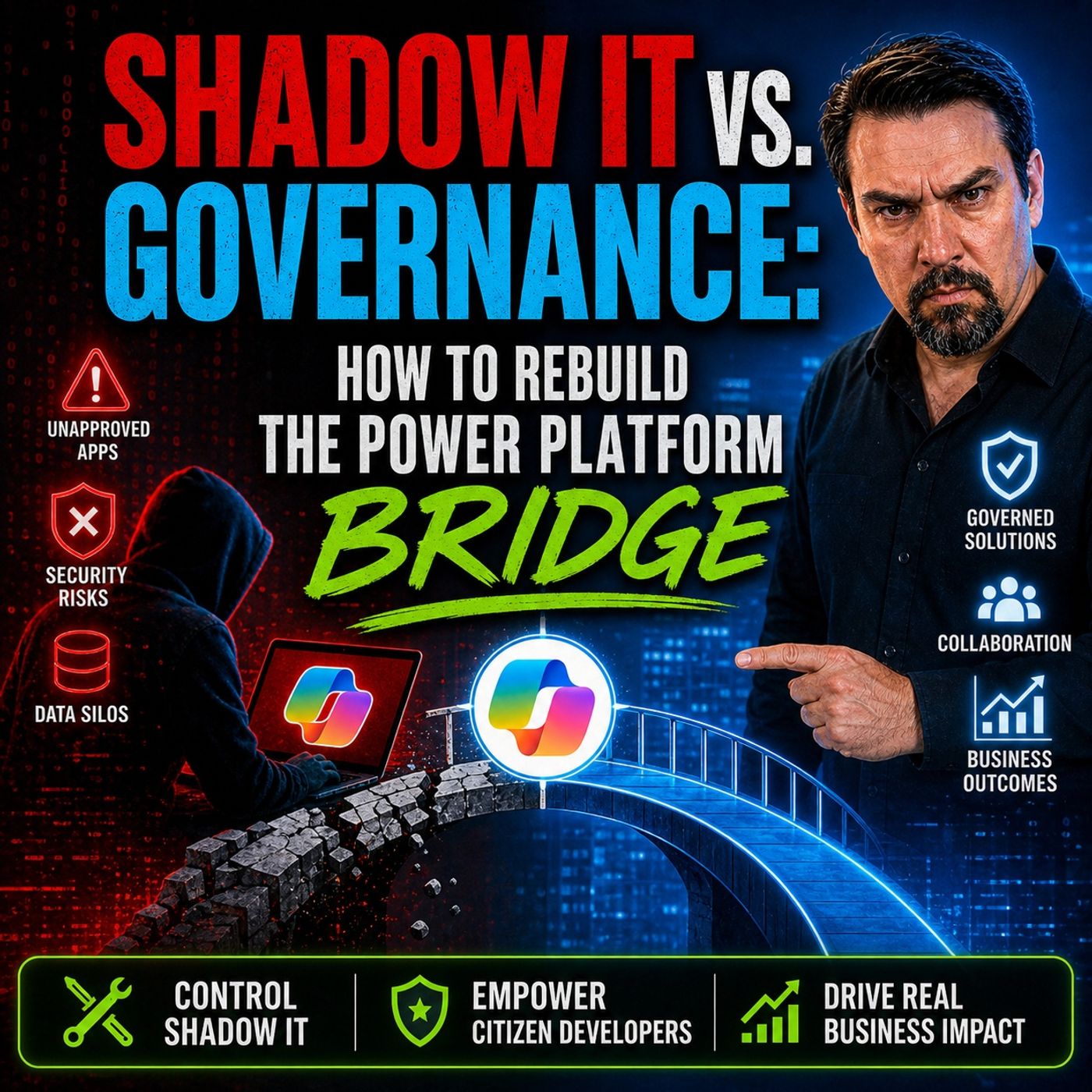
Shadow IT vs. Governance: How to Rebuild the Power Platform Bridge
Season 2
Published 3 months, 1 week ago
Description
Your intranet and digital platforms were not built for how people actually work today, and that gap is quietly draining both innovation and trust. In 2026, most organizations are stuck in a silent cold war between IT control and Maker innovation. IT believes saying “No” protects the business, while Makers are under constant pressure to deliver faster. The result is a system where progress doesn’t stop—it just moves out of sight. Saying “No” doesn’t eliminate risk. It removes visibility. And when visibility disappears, risk increases. The most advanced organizations have already made a fundamental shift. They no longer rely on gatekeeping. Instead, they architect systems where speed and security coexist through automation, especially within platforms like Microsoft Power Platform. If this trust gap remains unresolved, you continue paying an innovation tax that compounds over time. The goal is not stricter control. The goal is a better model.
⚙️ THE STRUCTURAL FAILURE OF MANUAL GOVERNANCE
The current governance model is not broken because of people. It is broken because it was designed for a different era. Applying ticket-based processes to a world where thousands of apps can be created instantly creates friction at scale. Most IT departments are now spending the majority of their budget maintaining outdated systems instead of enabling new solutions. When a Maker tries to solve a business problem, they encounter delays, approvals, and unclear processes. This is where trust begins to erode. The Default Environment becomes the clearest example of this failure—a shared, unmanaged space where apps collide, data overlaps, and ownership is unclear. This leads to predictable outcomes:
🧭 ENVIRONMENT ROUTING AS THE FOUNDATIONAL LEVER
The solution is not to improve the cleanup process. It is to redesign the starting point. Environment routing changes the experience from the very first interaction. Instead of placing every Maker into a shared space, the system automatically provisions or routes them into their own isolated environment. This happens instantly, without tickets or delays. The Maker gets a safe place to build, and IT gains a clear structure to manage. The impact is both technical and psychological. Makers feel empowered because they can start immediately. IT gains confidence because work is happening in controlled spaces. There is also a strong link between speed and adoption. When users experience value within minutes, engagement increases significantly. Removing onboarding friction captures that initial momentum and prevents users from seeking workarounds. Instead of fixing a chaotic environment, you prevent chaos from happening in the first place.
🛡️ THE LOGIC OF THE AUTOMATED GUARDRAIL
Once Makers have their own space, the next challenge is how they interact with data. Traditional governance relies on blocking access, but blocking is too simplistic for modern needs. It ignores context and often prevents legitimate work. Automated guardrails introduce a more intelligent approach. Instead of deciding what is allowed globally, the system enforces rules based on how data is used. Connectors are categorized, and incompatible combinations are prevented automatically. This creates a system where compliance is built into the experience rather than enforced afterward. The key advantages become clear:
⚙️ THE STRUCTURAL FAILURE OF MANUAL GOVERNANCE
The current governance model is not broken because of people. It is broken because it was designed for a different era. Applying ticket-based processes to a world where thousands of apps can be created instantly creates friction at scale. Most IT departments are now spending the majority of their budget maintaining outdated systems instead of enabling new solutions. When a Maker tries to solve a business problem, they encounter delays, approvals, and unclear processes. This is where trust begins to erode. The Default Environment becomes the clearest example of this failure—a shared, unmanaged space where apps collide, data overlaps, and ownership is unclear. This leads to predictable outcomes:
- Makers build in personal or unmanaged environments
- Data is shared in ways that bypass policy
- IT loses oversight while trying to maintain control
🧭 ENVIRONMENT ROUTING AS THE FOUNDATIONAL LEVER
The solution is not to improve the cleanup process. It is to redesign the starting point. Environment routing changes the experience from the very first interaction. Instead of placing every Maker into a shared space, the system automatically provisions or routes them into their own isolated environment. This happens instantly, without tickets or delays. The Maker gets a safe place to build, and IT gains a clear structure to manage. The impact is both technical and psychological. Makers feel empowered because they can start immediately. IT gains confidence because work is happening in controlled spaces. There is also a strong link between speed and adoption. When users experience value within minutes, engagement increases significantly. Removing onboarding friction captures that initial momentum and prevents users from seeking workarounds. Instead of fixing a chaotic environment, you prevent chaos from happening in the first place.
🛡️ THE LOGIC OF THE AUTOMATED GUARDRAIL
Once Makers have their own space, the next challenge is how they interact with data. Traditional governance relies on blocking access, but blocking is too simplistic for modern needs. It ignores context and often prevents legitimate work. Automated guardrails introduce a more intelligent approach. Instead of deciding what is allowed globally, the system enforces rules based on how data is used. Connectors are categorized, and incompatible combinations are prevented automatically. This creates a system where compliance is built into the experience rather than enforced afterward. The key advantages become clear:
- Real-time feedback replaces delayed audits
- Data loss is prevented before it occurs
- Makers can innovate without constant interruptio