Episode Details
Back to Episodes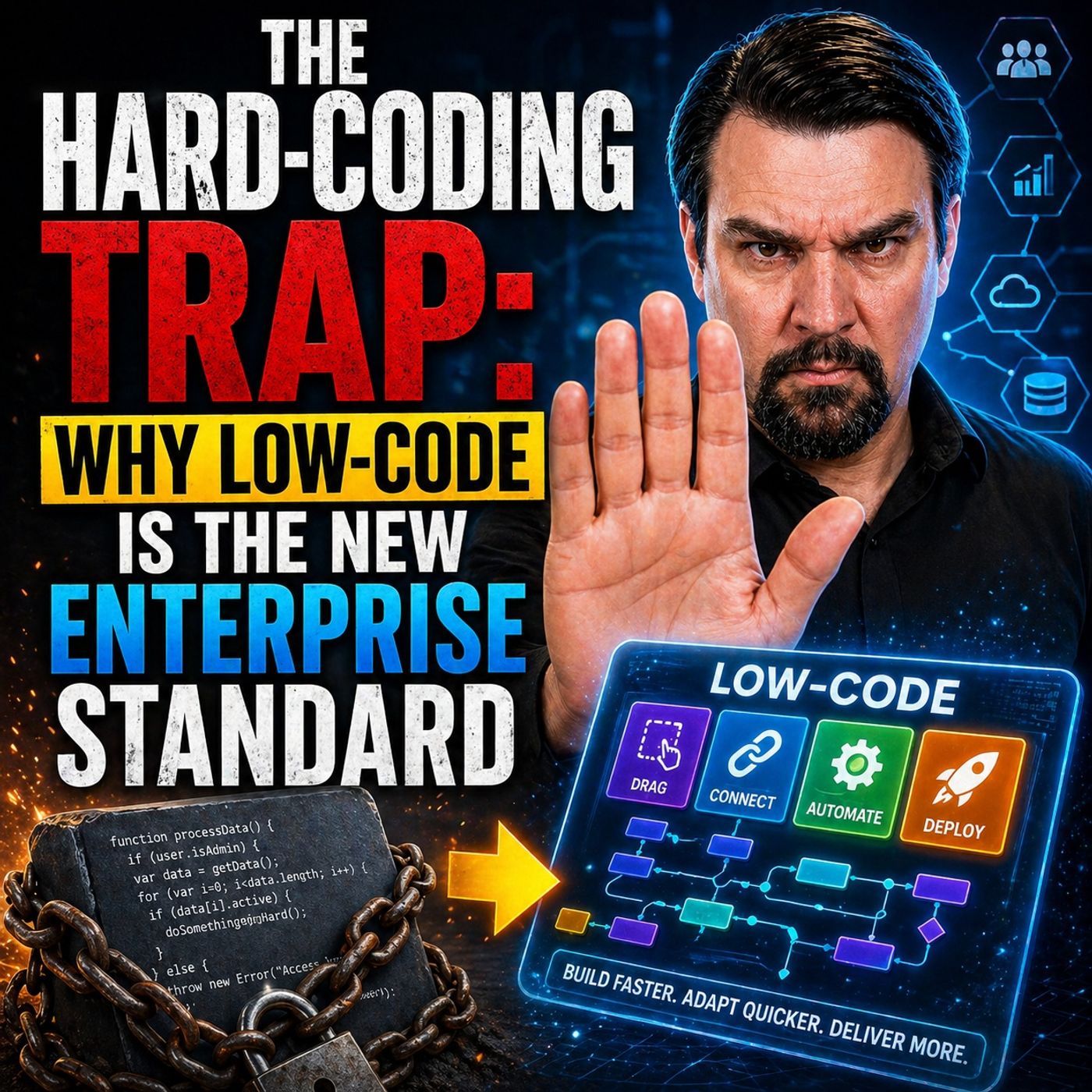
The Hard-Coding Trap: Why Low-Code Is the New Enterprise Standard
Season 2
Published 3 months, 1 week ago
Description
The eighteen-month development cycle isn’t just slow anymore—it’s a business liability. In today’s economy, waiting on IT isn’t neutral… it’s expensive. The traditional monolith—where every piece of logic is hard-coded, locked away, and dependent on long release cycles—is collapsing under its own weight. What used to be “enterprise-grade” is now enterprise friction. Organizations are still trying to fix this by hiring more developers. More code. More backlog. More complexity. But the top performers aren’t scaling code—they’re scaling capability. They’ve realized the bottleneck isn’t technology. It’s the governance model. This is the moment where low-code stops being an experiment and becomes the new enterprise standard.
💸 THE ECONOMIC COLLAPSE OF LEGACY DEVELOPMENT
The real cost of traditional development isn’t the software—it’s the waiting. If a broken process costs ten thousand dollars a month and sits in a backlog for over a year, the loss compounds silently. You’re not just paying for development—you’re paying for inaction. A typical enterprise custom build might start around eighty thousand dollars. A comparable low-code solution? Often a fraction of that. But the real advantage isn’t just cost—it’s speed and proximity. When business logic moves closer to the people doing the work, development becomes immediate instead of delayed. The deeper issue is technical debt. Every line of hard-coded logic becomes a future constraint. It locks your business into past assumptions and makes change expensive. In a world where priorities shift weekly, that rigidity becomes dangerous. You’re no longer agile—you’re dependent.
🧠 FROM CODERS TO CITIZEN ARCHITECTS
The biggest shift happening right now isn’t technical—it’s structural. For decades, value in software was tied to writing code. Today, value has moved to designing systems and orchestrating logic. This is the rise of the Citizen Architect. Instead of translating business needs through layers of IT, organizations are empowering the people closest to the problem to define and build their own solutions. Not by turning them into engineers—but by giving them tools that match how they already think: workflows, logic, outcomes. Professional developers don’t disappear in this model—they evolve. Their role shifts from writing applications to building secure frameworks, reusable components, and guardrails. They become force multipliers, enabling hundreds of solutions instead of delivering them one by one. The result is a fusion model where:
Speed without structure creates chaos—but too much control kills momentum. The answer isn’t restriction. It’s zoned governance. Instead of saying “no,” modern organizations design environments that guide innovation safely. Lightweight solutions can exist in flexible spaces, while critical systems are protected with stronger controls. This creates a balance where experimentation thrives without exposing the organization to unnecessary risk. The key shift is from manual oversight to automated enforcement. Policies are no longer static documents—they’re active systems. If something violates a rule, it’s stopped instantly. No waiting. No audits. Just real-time protection. This approach turns governance from a bottleneck into an enabler. It allows organizations to scale development without losing visibility or control.
🤖 THE POST-APPLICATION ERA: AGENTS OVER APPS
We are moving beyond traditional applications into a world of autonomous agents. Instead of clicking through interfaces, systems will increasingly act on intent—analyzing data, making decisions, and executing workflows across platforms. This changes everything. Hard-coded systems were built for predictable paths. A
💸 THE ECONOMIC COLLAPSE OF LEGACY DEVELOPMENT
The real cost of traditional development isn’t the software—it’s the waiting. If a broken process costs ten thousand dollars a month and sits in a backlog for over a year, the loss compounds silently. You’re not just paying for development—you’re paying for inaction. A typical enterprise custom build might start around eighty thousand dollars. A comparable low-code solution? Often a fraction of that. But the real advantage isn’t just cost—it’s speed and proximity. When business logic moves closer to the people doing the work, development becomes immediate instead of delayed. The deeper issue is technical debt. Every line of hard-coded logic becomes a future constraint. It locks your business into past assumptions and makes change expensive. In a world where priorities shift weekly, that rigidity becomes dangerous. You’re no longer agile—you’re dependent.
🧠 FROM CODERS TO CITIZEN ARCHITECTS
The biggest shift happening right now isn’t technical—it’s structural. For decades, value in software was tied to writing code. Today, value has moved to designing systems and orchestrating logic. This is the rise of the Citizen Architect. Instead of translating business needs through layers of IT, organizations are empowering the people closest to the problem to define and build their own solutions. Not by turning them into engineers—but by giving them tools that match how they already think: workflows, logic, outcomes. Professional developers don’t disappear in this model—they evolve. Their role shifts from writing applications to building secure frameworks, reusable components, and guardrails. They become force multipliers, enabling hundreds of solutions instead of delivering them one by one. The result is a fusion model where:
- Business defines the logic
- Architects secure and scale it
- The organization moves at the speed of context
Speed without structure creates chaos—but too much control kills momentum. The answer isn’t restriction. It’s zoned governance. Instead of saying “no,” modern organizations design environments that guide innovation safely. Lightweight solutions can exist in flexible spaces, while critical systems are protected with stronger controls. This creates a balance where experimentation thrives without exposing the organization to unnecessary risk. The key shift is from manual oversight to automated enforcement. Policies are no longer static documents—they’re active systems. If something violates a rule, it’s stopped instantly. No waiting. No audits. Just real-time protection. This approach turns governance from a bottleneck into an enabler. It allows organizations to scale development without losing visibility or control.
🤖 THE POST-APPLICATION ERA: AGENTS OVER APPS
We are moving beyond traditional applications into a world of autonomous agents. Instead of clicking through interfaces, systems will increasingly act on intent—analyzing data, making decisions, and executing workflows across platforms. This changes everything. Hard-coded systems were built for predictable paths. A