Episode Details
Back to Episodes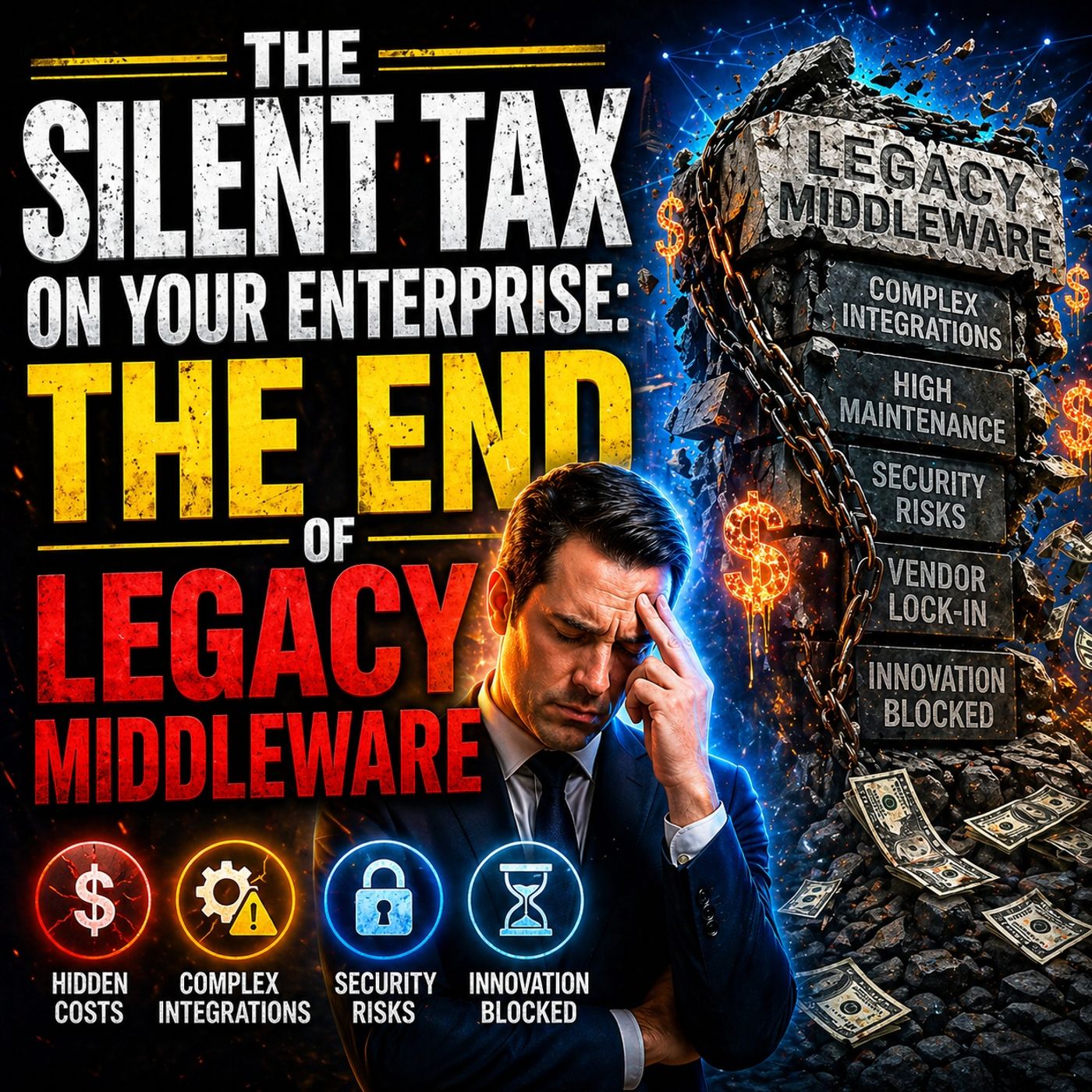
The Silent Tax on Your Enterprise: The End of Legacy Middleware
Season 2
Published 3 months, 1 week ago
Description
Middleware didn’t disappear—it became invisible. And that’s exactly why it has become one of the most expensive and overlooked problems in modern enterprises. In many organizations, systems appear fully connected and dashboards look real-time, but beneath the surface everything is slightly delayed. That delay is rarely questioned because it is normalized. Over time, however, it creates a hidden cost that spreads across every process, every team, and every decision.
THE COST OF “EVENTUALLY CORRECT” DATA
Most enterprises are still operating on what can be described as “eventually correct data.” Systems sync every few minutes, which sounds efficient but introduces a critical lag. Sales teams may quote outdated prices, operations may react too late to changes, and leadership may act on information that no longer reflects reality. These small gaps compound quickly, leading to missed opportunities, reduced trust in systems, and constant friction in day-to-day operations.
THE SILENT TAX ON YOUR OPERATIONS
Polling-based middleware is one of the biggest drivers of this inefficiency. Systems continuously check for updates, even when nothing has changed. This creates constant system activity that delivers no real value. You are effectively paying for infrastructure, compute, and processes that spend most of their time doing unnecessary work. This ongoing cost—without meaningful output—is what we call the silent tax.
LATENCY-TO-VALUE (LTV): THE METRIC THAT DEFINES PERFORMANCE
To understand the real impact, you need to look beyond traditional metrics like uptime or throughput. The metric that truly matters is Latency-to-Value, or LTV. It measures the time between when a business event occurs and when your organization takes action. Every second of delay reduces your ability to compete. In fast-moving markets, even small delays can mean lost revenue, slower responses, and weaker outcomes.
WHY YOUR AI IS UNDERPERFORMING
There is a direct connection between your integration layer and your AI results. AI systems rely on timely, accurate data. If your data is delayed, your AI is working with an outdated picture of reality. This leads to incorrect recommendations, reduced confidence, and lower return on investment. The issue is not the intelligence of the AI—it is the latency of the data feeding it.
THE SHIFT FROM PULL TO PUSH
Most legacy systems operate in a pull model, where they constantly ask if something has changed. Modern architectures shift to a push model, where systems are notified instantly when an event occurs. This eliminates unnecessary processing and removes delays between signal and action. It allows organizations to operate in real time rather than reacting to the past.
SECURITY AND GOVERNANCE RISKS
Delayed integrations don’t just impact performance—they create security risks. When identity or access changes take time to propagate, users may retain permissions longer than they should. This leads to over-permissioning and increased exposure. Traditional governance models rely on periodic reviews, but those approaches cannot keep up with real-time environments. Control must become continuous and embedded directly into the system.
THE FINANCIAL WEIGHT OF LEGACY SYSTEMS
Legacy middleware represents a growing form of technical debt. Organizations spend a significant portion of their IT budgets maintaining systems that do not drive innovation. These systems are always running, always consuming resources, and rarely improving business outcomes. Instead of enabling progress, they act as a constant drag on performance and efficiency.
A NEW APPROACH: REAL-TIME, EVENT-DRIVEN ARCHITECTURE
The solution is not to replace one middleware platform with another. The real shift is toward event-driven architectur
THE COST OF “EVENTUALLY CORRECT” DATA
Most enterprises are still operating on what can be described as “eventually correct data.” Systems sync every few minutes, which sounds efficient but introduces a critical lag. Sales teams may quote outdated prices, operations may react too late to changes, and leadership may act on information that no longer reflects reality. These small gaps compound quickly, leading to missed opportunities, reduced trust in systems, and constant friction in day-to-day operations.
THE SILENT TAX ON YOUR OPERATIONS
Polling-based middleware is one of the biggest drivers of this inefficiency. Systems continuously check for updates, even when nothing has changed. This creates constant system activity that delivers no real value. You are effectively paying for infrastructure, compute, and processes that spend most of their time doing unnecessary work. This ongoing cost—without meaningful output—is what we call the silent tax.
LATENCY-TO-VALUE (LTV): THE METRIC THAT DEFINES PERFORMANCE
To understand the real impact, you need to look beyond traditional metrics like uptime or throughput. The metric that truly matters is Latency-to-Value, or LTV. It measures the time between when a business event occurs and when your organization takes action. Every second of delay reduces your ability to compete. In fast-moving markets, even small delays can mean lost revenue, slower responses, and weaker outcomes.
WHY YOUR AI IS UNDERPERFORMING
There is a direct connection between your integration layer and your AI results. AI systems rely on timely, accurate data. If your data is delayed, your AI is working with an outdated picture of reality. This leads to incorrect recommendations, reduced confidence, and lower return on investment. The issue is not the intelligence of the AI—it is the latency of the data feeding it.
THE SHIFT FROM PULL TO PUSH
Most legacy systems operate in a pull model, where they constantly ask if something has changed. Modern architectures shift to a push model, where systems are notified instantly when an event occurs. This eliminates unnecessary processing and removes delays between signal and action. It allows organizations to operate in real time rather than reacting to the past.
SECURITY AND GOVERNANCE RISKS
Delayed integrations don’t just impact performance—they create security risks. When identity or access changes take time to propagate, users may retain permissions longer than they should. This leads to over-permissioning and increased exposure. Traditional governance models rely on periodic reviews, but those approaches cannot keep up with real-time environments. Control must become continuous and embedded directly into the system.
THE FINANCIAL WEIGHT OF LEGACY SYSTEMS
Legacy middleware represents a growing form of technical debt. Organizations spend a significant portion of their IT budgets maintaining systems that do not drive innovation. These systems are always running, always consuming resources, and rarely improving business outcomes. Instead of enabling progress, they act as a constant drag on performance and efficiency.
A NEW APPROACH: REAL-TIME, EVENT-DRIVEN ARCHITECTURE
The solution is not to replace one middleware platform with another. The real shift is toward event-driven architectur