Episode Details
Back to Episodes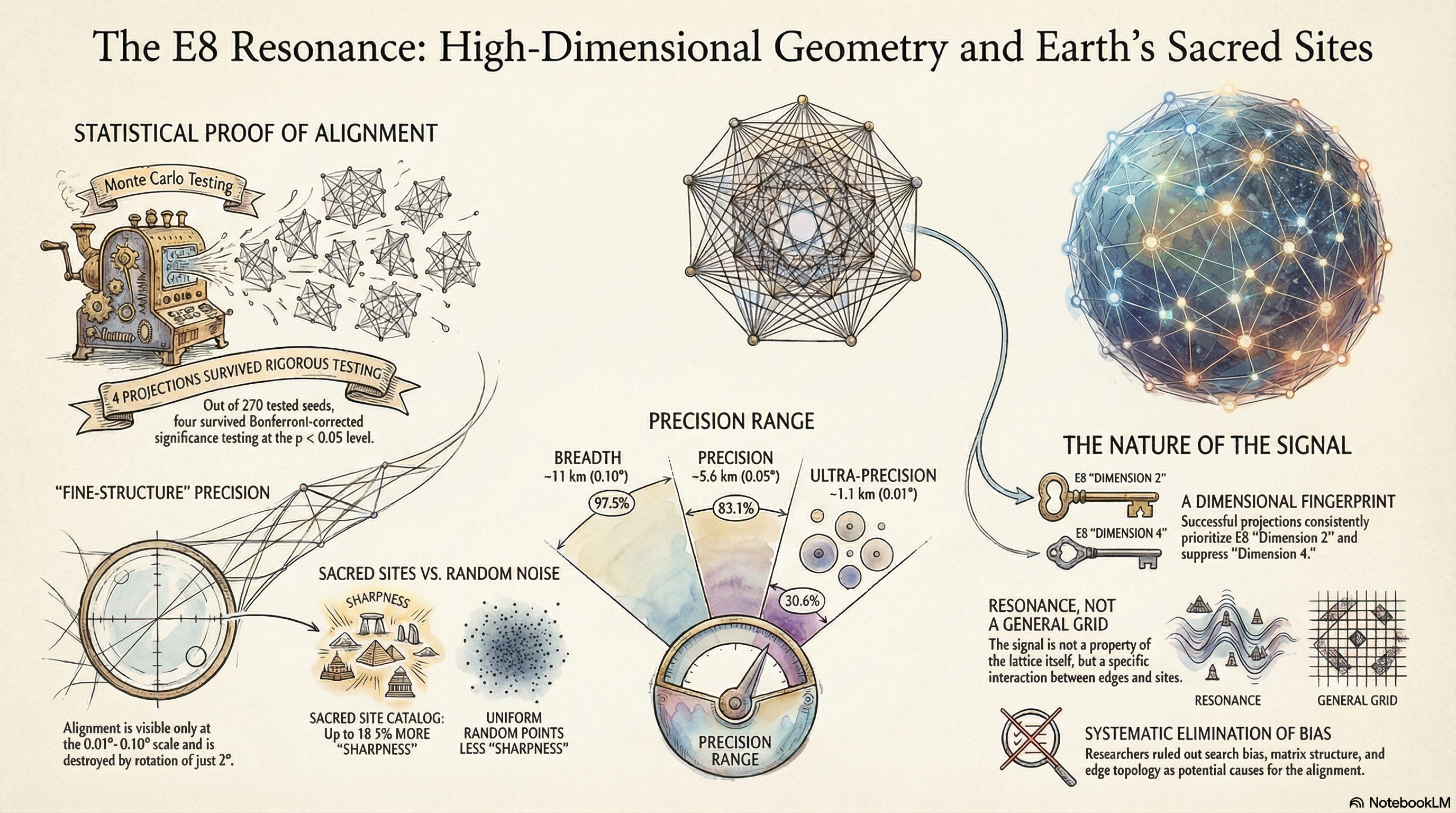
The E8 Alignment Anomaly
Description
The core problem I tackle is this: standard statistical tests are vulnerable to the “Texas sharpshooter” illusion. If you search a large space and only show the best hits, ordinary p‑values can make random patterns look meaningful. I use a best‑of‑search Monte Carlo null model to fix this, so the tests correctly account for how hard we looked before declaring a result “significant.”
The study runs a kind of tournament. I test 270 different projections of the E8 structure and compare them against a catalog of 160 site patterns. Out of all of these, only four projections survive strict statistical screening, even after applying a Bonferroni correction to keep the overall false‑positive rate below 0.05.
These surviving patterns show three distinct kinds of “signatures”: breadth, precision, and ultra‑precision. Each operates over a different distance range, so together they cover complementary bands of the data.
The results sit on a razor’s edge. A perturbation analysis shows that the apparent alignments collapse if we nudge the system by only 2–3 degrees. This instability is 4 to 7 standard deviations sharper than anything produced by chance in the Monte Carlo simulations.
I then go through a process of elimination. I rule out several conventional explanations: stochastic noise, search bias, metric bias, generic‑point effects, and preferred overall direction. None of these can account for the observed signals.
Yet there is a genuine mystery. Machine learning classifiers cannot reliably distinguish the confirmed “seed” patterns from failures; their performance is barely above random guessing (AUC = 0.52). The network of edges connecting sites also looks the same between confirmed seeds and failures.
One striking fingerprint does appear. In all five confirmed seeds, the second dimension of E8 is systematically boosted, and the fourth dimension is systematically suppressed. The probability of this combination happening by chance is about 0.0074, based on a combinatorial calculation.
There is also cross‑catalog confirmation. Seed 89 was discovered independently in a different catalog that used only 62 sites, yet it produces both the strongest overall signal and the strongest fingerprint in the entire study.
Despite all of this, key questions remain open. Possible sources of bias include how the sites were selected, subtle hidden spatial structure in the data, and over‑emphasis or “inflation” of E8‑related symmetry. Most importantly, there is still no known physical mechanism capable of producing these patterns. For now, we have robust statistical oddities without a clear explanation.
The paper and all data are available on Zenodo: DOI: 10.5281/zenodo.19047661
Below is the full briefing document accompanying today’s video presentation. While the video walks you through the conceptual framework and key visual results, this document provides the complete methodological detail; including the exact tournament pipeline stages, the four confirmed projection seeds with their performance metrics, perturbation stability z-scores, dimension fingerprinting analysis ($p = 0.0074$), and the cross-catalog transfer results. It is written in a standard research document format (LaTeX) for those who want to examine the statistical rigor up close. Whether you are a researcher, a curious reader, or someone replicating the analysis, this briefing serves as a permanent, citable reference that stands alongside the video. I recommend watching the presentation first for intuition, then diving into the document for the numbers and methodology.
E8 Sacred Sites Alignment: Statistical Briefing Document
A few important scientific definitions:
Best-of-search null model: Each random trial gets the same freedom to search for its best orientation as the real data did — so we're not com