Episode Details
Back to Episodes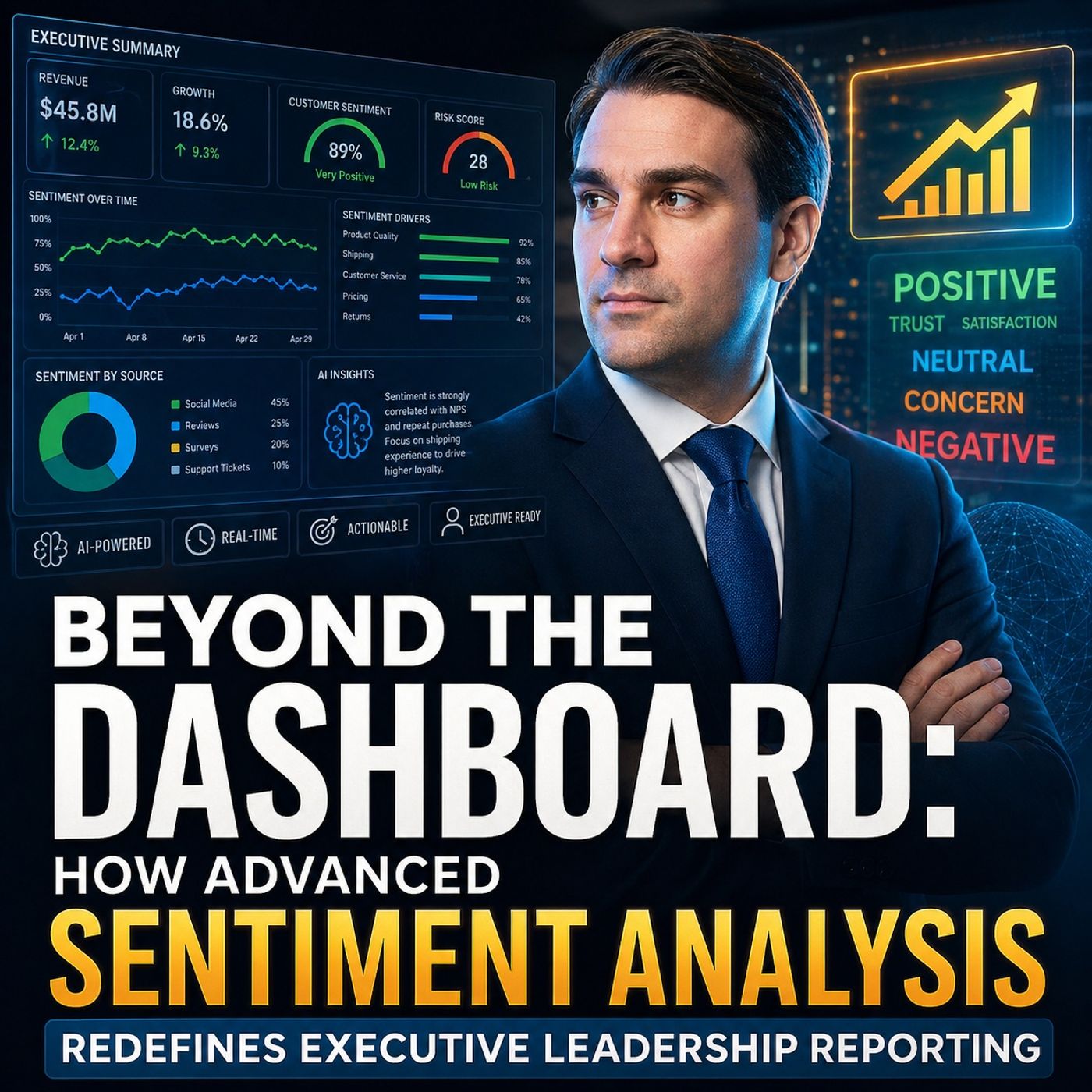
Beyond The Dashboard: How Advanced Sentiment Analysis Redefines Executive Leadership Reporting
Season 2
Published 3 months, 1 week ago
Description
Most executive dashboards don’t reflect reality—they reflect what’s easy to measure. In boardrooms, everything looks perfect: green charts, rising adoption, high completion rates. But step outside the slide deck, and a different story emerges. Employees are frustrated, confused, and often working around the very systems leaders believe are succeeding. This is the Green Dashboard trap—where activity is mistaken for progress, and comfort replaces truth. The core issue is simple: we measure what’s clean, not what’s meaningful. Logins, clicks, and usage stats create the illusion of success, but they fail to capture the human experience behind the data. A project can appear “on track” while being culturally broken. This disconnect creates a hidden Behavioral Gap—the space between what dashboards report and what people actually feel.
THE STRUCTURAL FLAW IN EXECUTIVE REPORTING
Traditional reporting models are built on flawed assumptions. They equate participation with success and rely heavily on activity-based metrics that look impressive but lack depth. These metrics—logins, completion rates, click-throughs—are easy to quantify but often meaningless in terms of real impact. Data aggregation further distorts reality. By the time insights reach leadership, nuance is gone. Frustration becomes a percentage. Resistance becomes a trendline. The “why” disappears entirely. This creates a sanitized version of truth—one that protects leadership from discomfort but also blinds them to risk. The result? Leaders are making high-stakes decisions based on incomplete, filtered data. And in a fast-moving, AI-driven world, that’s not just inefficient—it’s dangerous.
THE UNTAPPED GOLDMINE: UNSTRUCTURED DATA
The real pulse of an organization doesn’t live in dashboards—it lives in conversations. Microsoft 365 environments are filled with rich, unstructured data: Teams chats, meeting transcripts, collaborative edits. This is where the truth exists. Until recently, this data was too complex to analyze at scale. But with AI and tools like Copilot, we can now detect linguistic patterns that reveal sentiment, confidence, and friction in real time. This isn’t about reading private messages—it’s about identifying patterns in how people communicate. Language shifts when organizations struggle. Words become more passive. Confidence turns into hesitation. Frustration surfaces subtly before it becomes visible in traditional metrics. These are leading indicators—signals that allow leaders to act before problems escalate.
TRUST IS THE FOUNDATION, NOT A FEATURE
There’s a critical constraint: trust. If sentiment analysis is perceived as surveillance, it fails immediately. Employees will self-censor, and the data becomes meaningless. The solution is a privacy-first model built on aggregation and anonymization. Leaders don’t need to know who is frustrated—they need to understand what is broken. This shifts the mindset from monitoring individuals to diagnosing systems. Think of it as a public health model for organizations: you’re tracking patterns, not people. When trust is preserved, the data remains authentic—and that’s where real insight lives.
THE COPILOT ADOPTION TRAP
AI rollouts like Microsoft Copilot highlight the limitations of traditional dashboards. High adoption rates and usage metrics may suggest success, but they often hide underlying friction. Employees can use tools they don’t trust. They can complete training without understanding it. They can generate activity that looks like engagement but actually signals inefficiency. This is where a new metric emerges: the Adoption-to-Trust Ratio. It compares usage with sentiment. Are employees confident in the tool—or quietly struggling with it? Without this context, organizations risk scaling frustration instead of productivity.
FROM DASHBOARDS TO EXECUTIVE SIGNALS
T
THE STRUCTURAL FLAW IN EXECUTIVE REPORTING
Traditional reporting models are built on flawed assumptions. They equate participation with success and rely heavily on activity-based metrics that look impressive but lack depth. These metrics—logins, completion rates, click-throughs—are easy to quantify but often meaningless in terms of real impact. Data aggregation further distorts reality. By the time insights reach leadership, nuance is gone. Frustration becomes a percentage. Resistance becomes a trendline. The “why” disappears entirely. This creates a sanitized version of truth—one that protects leadership from discomfort but also blinds them to risk. The result? Leaders are making high-stakes decisions based on incomplete, filtered data. And in a fast-moving, AI-driven world, that’s not just inefficient—it’s dangerous.
THE UNTAPPED GOLDMINE: UNSTRUCTURED DATA
The real pulse of an organization doesn’t live in dashboards—it lives in conversations. Microsoft 365 environments are filled with rich, unstructured data: Teams chats, meeting transcripts, collaborative edits. This is where the truth exists. Until recently, this data was too complex to analyze at scale. But with AI and tools like Copilot, we can now detect linguistic patterns that reveal sentiment, confidence, and friction in real time. This isn’t about reading private messages—it’s about identifying patterns in how people communicate. Language shifts when organizations struggle. Words become more passive. Confidence turns into hesitation. Frustration surfaces subtly before it becomes visible in traditional metrics. These are leading indicators—signals that allow leaders to act before problems escalate.
TRUST IS THE FOUNDATION, NOT A FEATURE
There’s a critical constraint: trust. If sentiment analysis is perceived as surveillance, it fails immediately. Employees will self-censor, and the data becomes meaningless. The solution is a privacy-first model built on aggregation and anonymization. Leaders don’t need to know who is frustrated—they need to understand what is broken. This shifts the mindset from monitoring individuals to diagnosing systems. Think of it as a public health model for organizations: you’re tracking patterns, not people. When trust is preserved, the data remains authentic—and that’s where real insight lives.
THE COPILOT ADOPTION TRAP
AI rollouts like Microsoft Copilot highlight the limitations of traditional dashboards. High adoption rates and usage metrics may suggest success, but they often hide underlying friction. Employees can use tools they don’t trust. They can complete training without understanding it. They can generate activity that looks like engagement but actually signals inefficiency. This is where a new metric emerges: the Adoption-to-Trust Ratio. It compares usage with sentiment. Are employees confident in the tool—or quietly struggling with it? Without this context, organizations risk scaling frustration instead of productivity.
FROM DASHBOARDS TO EXECUTIVE SIGNALS
T