Episode Details
Back to Episodes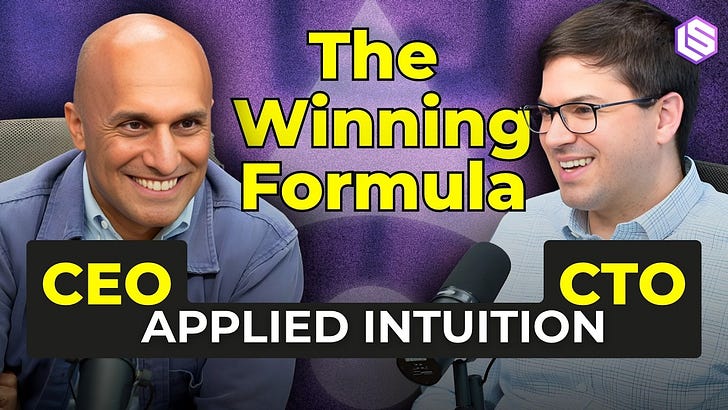
Physical AI that Moves the World — Qasar Younis & Peter Ludwig, Applied Intuition
Description
From building Applied Intuition from YC-era autonomy tooling into a $15B physical AI company, Qasar Younis and Peter Ludwig have spent the last decade living through the full arc of autonomy: from simulation and data infrastructure for robotaxi companies, to operating systems for safety-critical machines, to deploying AI onto cars, trucks, mining equipment, construction vehicles, agriculture, defense systems, and driverless L4 trucks running in Japan today. They join us to explain why “physical AI” is not just LLMs on wheels, why the real bottleneck is no longer model intelligence but deployment onto constrained hardware, and why the future of autonomy may look less like one-off demos and more like Android for every moving machine.
We discuss:
* Applied Intuition’s mission: building physical AI for a safer, more prosperous world, powering cars, trucks, construction and mining equipment, agriculture, defense, and other moving machines
* Why physical AI is different from screen-based AI: learned systems can make mistakes in chat or coding, but safety-critical machines like driverless trucks, autonomous vehicles, and robots need much higher reliability
* The evolution from autonomy tooling to a broad physical AI platform: starting with simulation and data infrastructure for robotaxi companies, then expanding into 30+ products across simulation, operating systems, autonomy, and AI models
* Why tooling companies came back into fashion: Qasar on why developer tooling looked unfashionable in 2016, why Applied Intuition still bet on it, and how the AI boom made workflows and tools central again
* The three core buckets of Applied Intuition’s technology: simulation and RL infrastructure, true operating systems for vehicles and machines, and fundamental AI models for autonomy and world understanding
* Why vehicles need a real AI operating system: real-time control, sensor streaming, latency, memory management, fail-safes, reliable updates, and why “bricking a car” is much worse than bricking an iPad
* Physical machines as “phones before Android and iOS”: Peter explains why today’s vehicle and machine software stack is fragmented across many operating systems, and why Applied Intuition wants to consolidate the platform layer
* Coding agents inside Applied Intuition: Cursor, Claude Code, internal adoption leaderboards, and how AI tools are changing engineering workflows even in embedded systems and safety-critical software
* Verification and validation for physical AI: why evals get harder as models improve, how end-to-end autonomy changes simulation requirements, and why neural simulation has to be fast and cheap enough to make RL practical
* From deterministic tests to statistical safety: why autonomy validation is shifting from binary pass/fail requirements toward “how many nines” of reliability and mean time between failures
* Cruise, Waymo, and public trust: Qasar and Peter discuss why autonomy failures are not just technical issues, how companies interact with regulators, and why Waymo is setting a high bar for the industry
* Simulation vs. reality: why no simulator perfectly represents the real world, how sim-to-real validation works, and why real-world testing will never disappear
* World models for physical AI: hydroplaning, construction equipment, visual cues, cause-and-effect learning, and where world models h