Episode Details
Back to Episodes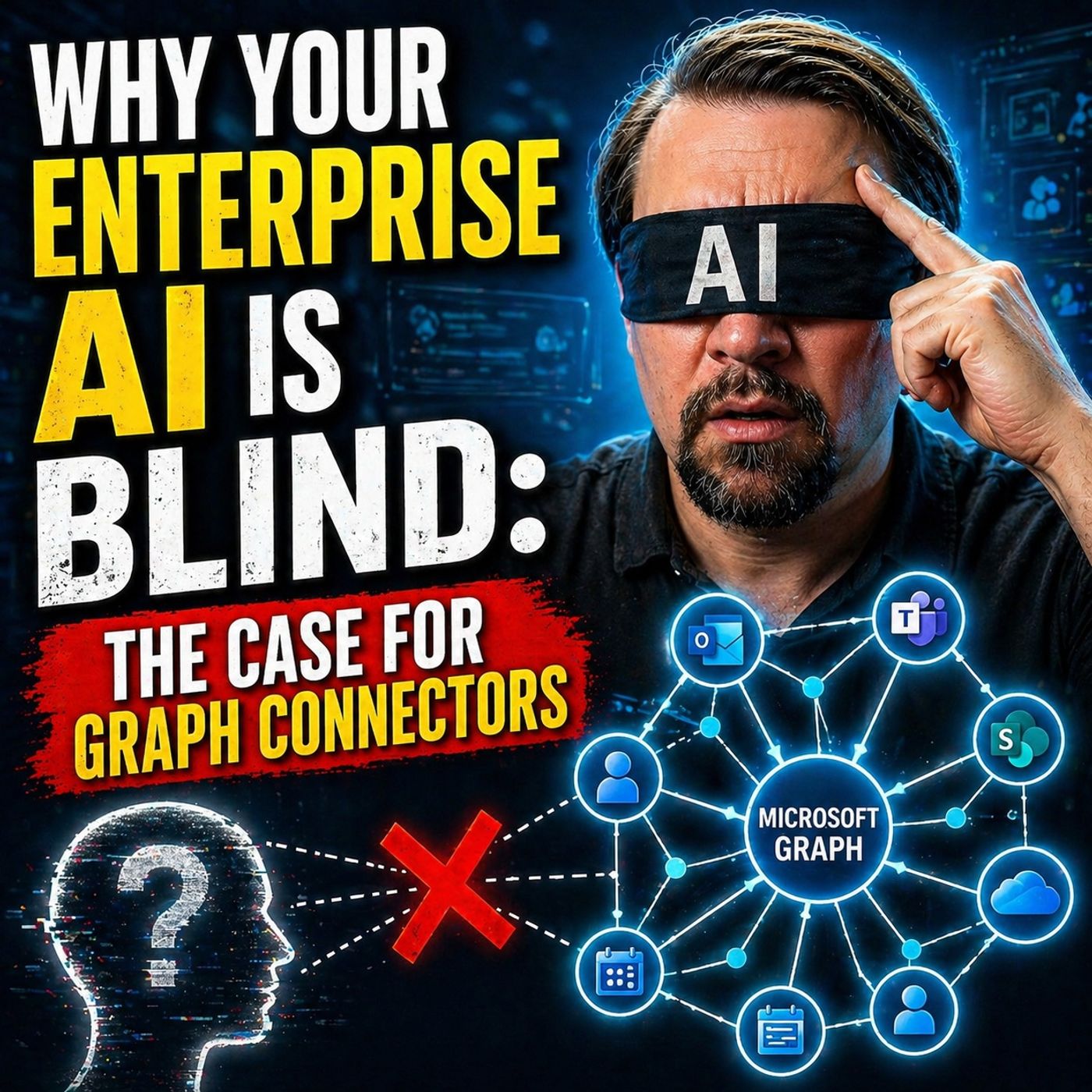
Why Your Enterprise AI is Blind: The Case for Graph Connectors
Season 2
Published 3 months, 2 weeks ago
Description
Your enterprise AI isn’t failing because the model is bad.
It’s failing because it can’t see. Most organizations think they’ve “enabled AI” by connecting Copilot to SharePoint and OneDrive. They clean up documents, organize folders, and assume the job is done. But that’s only a fraction of the actual business reality. The majority of critical context lives outside that world. It’s in ticketing systems, ERPs, CRMs, approval tools, and legacy databases. If that data isn’t indexed into the Microsoft Graph, your AI doesn’t know it exists. So when you ask for insights, summaries, or recommendations, the AI responds with confidence—but without the full picture. It produces answers that look right, sound right, and are completely disconnected from real-time business conditions. That’s not intelligence. That’s a liability. In this episode, we break down why most enterprise AI is fundamentally blind and how Graph connectors are the missing layer that turns isolated data into real awareness.
WHAT’S REALLY HAPPENING
Right now, most AI implementations rely on static knowledge. Documents, PDFs, and stored content act as the source of truth. But business doesn’t run on static files. It runs on live systems, changing states, and real-time signals.
THE THREE MAJOR BLIND SPOTS
Across organizations, the same visibility gaps keep appearing. The first is approvals. Decisions that control money, deployments, or contracts often live in external systems or email threads. If the AI can’t see approval status, it assumes everything is ready to proceed. The second is the customer journey. Sales, support, and delivery data are split across different platforms. Without a unified view, the AI might recommend a sales action while the customer is actively dealing with a critical issue. The third is risk and exceptions. The real guardrails of a business—waivers, audit notes, special conditions—are rarely stored in standard document libraries. Without access to these, AI recommends the “standard” path, even when it shouldn’t. In all three cases, the issue isn’t logic. It’s missing context.
WHY CONNECTORS CHANGE EVERYTHING
Graph connectors solve a very specific problem. They don’t just move data. They make that data visible and usable for AI reasoning. By bringing external systems into the Microsoft Graph, you give the AI access to:
THE SHIFT FROM STATIC TO LIVE INTELLIGENCE
We are moving away from a model where AI searches for answers in files.
We are moving toward a model where AI continuously understands what is happening. That requires a different architecture. Instead of periodic uploads and manual indexing, you need event-driven ingestion. When something changes in your systems, that change needs to be reflected immediately. Identity, permissions, and data structure all need to align so the AI can interpret and secure that information correctly. This is no longer about storing knowledge. It’s about streaming reality.
GOVERNANCE IS THE DIFFERENTIATOR
As soon as AI has access to more data, trust becomes the critical factor. If users aren’t confident that permissions are respected, adoption slows down. If sensitive data
It’s failing because it can’t see. Most organizations think they’ve “enabled AI” by connecting Copilot to SharePoint and OneDrive. They clean up documents, organize folders, and assume the job is done. But that’s only a fraction of the actual business reality. The majority of critical context lives outside that world. It’s in ticketing systems, ERPs, CRMs, approval tools, and legacy databases. If that data isn’t indexed into the Microsoft Graph, your AI doesn’t know it exists. So when you ask for insights, summaries, or recommendations, the AI responds with confidence—but without the full picture. It produces answers that look right, sound right, and are completely disconnected from real-time business conditions. That’s not intelligence. That’s a liability. In this episode, we break down why most enterprise AI is fundamentally blind and how Graph connectors are the missing layer that turns isolated data into real awareness.
WHAT’S REALLY HAPPENING
Right now, most AI implementations rely on static knowledge. Documents, PDFs, and stored content act as the source of truth. But business doesn’t run on static files. It runs on live systems, changing states, and real-time signals.
- AI is trained on snapshots, not reality
- Critical updates happen outside its field of view
- Decisions are made on outdated or incomplete data
THE THREE MAJOR BLIND SPOTS
Across organizations, the same visibility gaps keep appearing. The first is approvals. Decisions that control money, deployments, or contracts often live in external systems or email threads. If the AI can’t see approval status, it assumes everything is ready to proceed. The second is the customer journey. Sales, support, and delivery data are split across different platforms. Without a unified view, the AI might recommend a sales action while the customer is actively dealing with a critical issue. The third is risk and exceptions. The real guardrails of a business—waivers, audit notes, special conditions—are rarely stored in standard document libraries. Without access to these, AI recommends the “standard” path, even when it shouldn’t. In all three cases, the issue isn’t logic. It’s missing context.
WHY CONNECTORS CHANGE EVERYTHING
Graph connectors solve a very specific problem. They don’t just move data. They make that data visible and usable for AI reasoning. By bringing external systems into the Microsoft Graph, you give the AI access to:
- Live status instead of static documents
- Process signals like approvals and exceptions
- End-to-end context across systems
THE SHIFT FROM STATIC TO LIVE INTELLIGENCE
We are moving away from a model where AI searches for answers in files.
We are moving toward a model where AI continuously understands what is happening. That requires a different architecture. Instead of periodic uploads and manual indexing, you need event-driven ingestion. When something changes in your systems, that change needs to be reflected immediately. Identity, permissions, and data structure all need to align so the AI can interpret and secure that information correctly. This is no longer about storing knowledge. It’s about streaming reality.
GOVERNANCE IS THE DIFFERENTIATOR
As soon as AI has access to more data, trust becomes the critical factor. If users aren’t confident that permissions are respected, adoption slows down. If sensitive data