Episode Details
Back to Episodes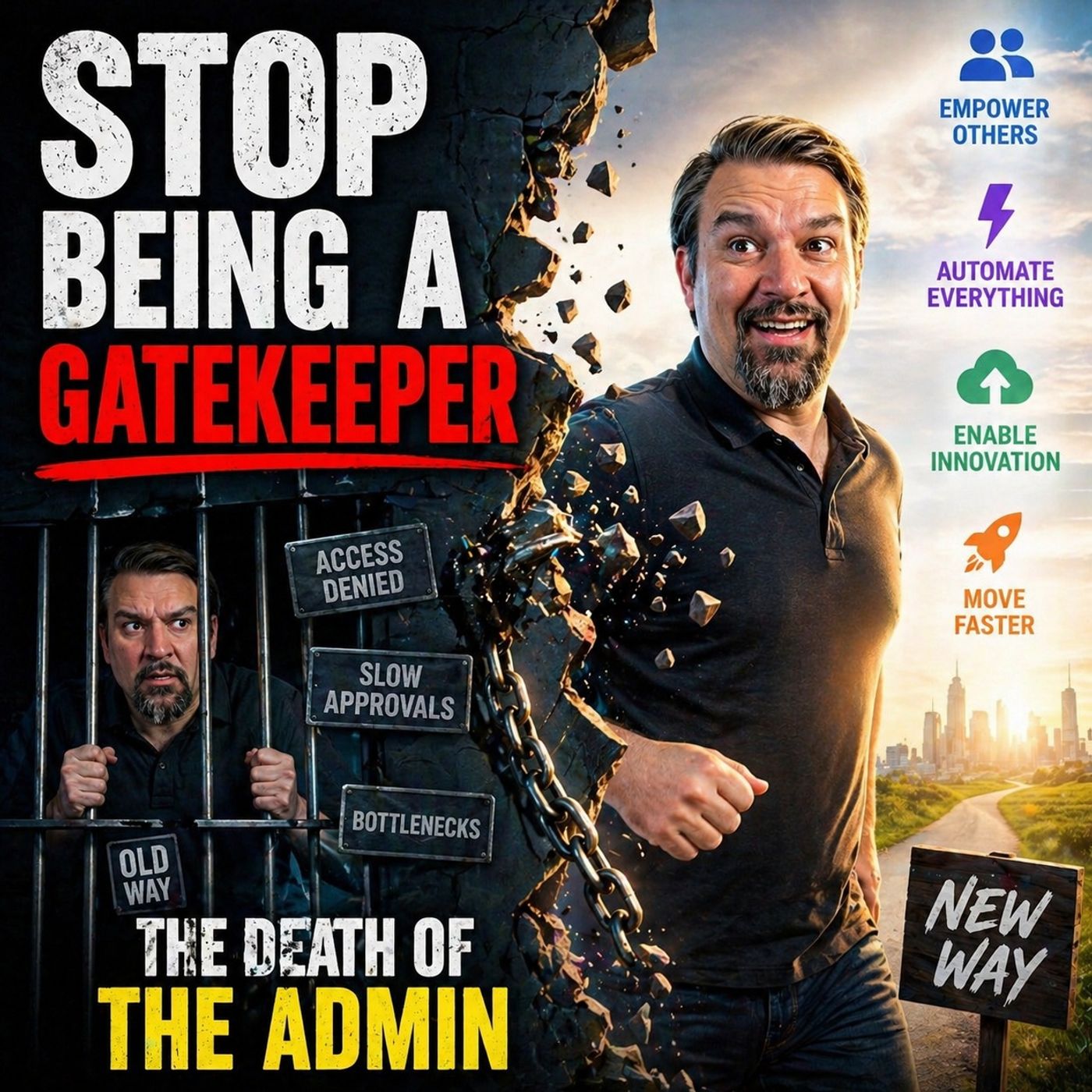
Stop Being a Gatekeeper: The Death of the Admin
Season 2
Published 3 months, 2 weeks ago
Description
The traditional admin role is already obsolete—most organizations just haven’t admitted it yet. In this episode of the M365FM Podcast, we break down a fundamental shift happening across Microsoft 365 and beyond: the transition from gatekeeper to architect. Your job is no longer to approve access, review tickets, or act as a bottleneck. Your job is to design systems where approvals are no longer needed. The old model was built on control, scarcity, and the word “No.” The new model operates on a Default Yes—within engineered guardrails. If you don’t evolve into this new role, the business won’t wait. It will bypass you entirely using Shadow IT and Shadow AI. And when that happens, you don’t just lose control—you lose relevance.
⚠️ THE STRUCTURAL FAILURE OF MANUAL GOVERNANCE
Most organizations still treat governance like a physical checkpoint: request → wait → approve. But this model is fundamentally broken in a world of SaaS, automation, and AI. Manual governance doesn’t create control—it creates delay. And delay is exactly what drives users toward risky workarounds. When teams wait weeks for approvals, they don’t stop working—they go around the system:
🔄 FROM GATEKEEPER TO ARCHITECT: A FUNDAMENTAL SHIFT
Gatekeepers operate in a linear model—limited by time, capacity, and human attention. Architects operate in an exponential model—where policies enforce decisions automatically across the entire environment. This is the shift from:
👉 “Under what conditions is this safe—and how do I enforce that automatically?” This is where the concept of the “Green Zone” comes in: a pre-engineered environment where users can build, automate, and innovate without needing permission, because safety is already built into the system. The goal is simple—but powerful:
👉 Make the secure path the fastest path
🧠 ENGINEERING FRICTIONLESS GOVERNANCE WITH MICROSOFT 365
This transformation isn’t theoretical—it’s built on real capabilities inside the Microsoft ecosystem. Moving to an architectural model means replacing human decisions with programmable logic. Key building blocks include:
📊 THE NEW KPIs: FROM ACTIVITY TO VELOCITY
To truly evolve, you must also change how success is measured. Traditional
⚠️ THE STRUCTURAL FAILURE OF MANUAL GOVERNANCE
Most organizations still treat governance like a physical checkpoint: request → wait → approve. But this model is fundamentally broken in a world of SaaS, automation, and AI. Manual governance doesn’t create control—it creates delay. And delay is exactly what drives users toward risky workarounds. When teams wait weeks for approvals, they don’t stop working—they go around the system:
- Using personal accounts or unsanctioned tools
- Exporting sensitive data into unmanaged formats (CSV, Excel)
- Building shadow automations outside IT visibility
- Introducing security and compliance risks unintentionally
- Approval queues grow longer
- Exception-based rules multiply
- Auditability disappears
- Admins default to blocking everything—or approving everything
🔄 FROM GATEKEEPER TO ARCHITECT: A FUNDAMENTAL SHIFT
Gatekeepers operate in a linear model—limited by time, capacity, and human attention. Architects operate in an exponential model—where policies enforce decisions automatically across the entire environment. This is the shift from:
- Request–Response → Policy-Driven Architecture
- Manual approvals → Automated guardrails
- Perimeter security → Data-centric governance
👉 “Under what conditions is this safe—and how do I enforce that automatically?” This is where the concept of the “Green Zone” comes in: a pre-engineered environment where users can build, automate, and innovate without needing permission, because safety is already built into the system. The goal is simple—but powerful:
👉 Make the secure path the fastest path
🧠 ENGINEERING FRICTIONLESS GOVERNANCE WITH MICROSOFT 365
This transformation isn’t theoretical—it’s built on real capabilities inside the Microsoft ecosystem. Moving to an architectural model means replacing human decisions with programmable logic. Key building blocks include:
- Environment Routing → Automatically place users into governed, pre-configured environments
- Solution Checkers → Real-time quality and compliance validation during development
- Purview DLP Policies → Data-level protection that works across connectors and flows
- Entra ID Entitlement Management → Automated access lifecycle with expiration and reviews
- Sensitivity Labels → Persistent, portable data protection across files and systems
- Shadow Mode for AI → Test and validate AI agents before granting autonomy
📊 THE NEW KPIs: FROM ACTIVITY TO VELOCITY
To truly evolve, you must also change how success is measured. Traditional