Episode Details
Back to Episodes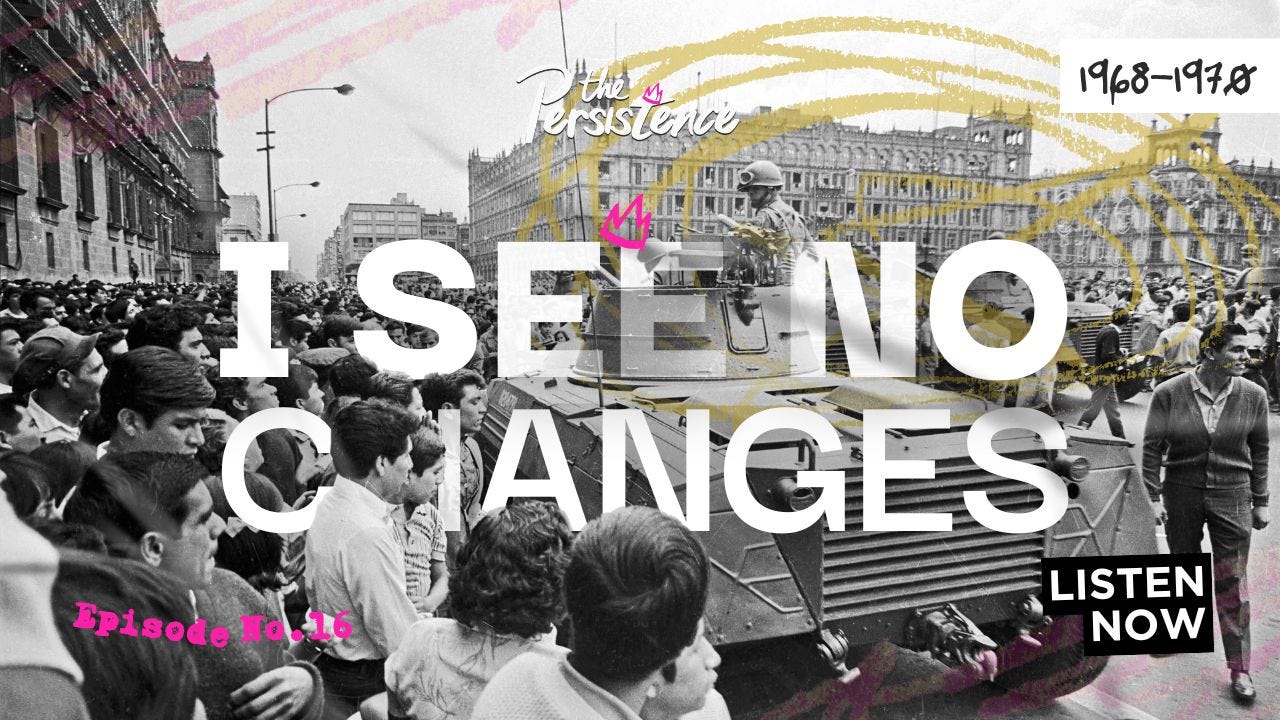
Episode 16: I See No Changes
Description
The late 1960s were supposed to be proof that things were working.
Civil rights legislation had passed. The language of progress was everywhere. On paper, it looked like the system had responded.
But on the ground?
That story didn’t hold.
This episode explores the turning point of the 1960s civil rights movement, where protests, policing, and public trust in American institutions began to shift.
From the Watts uprising to the assassination of Martin Luther King Jr., from student protests and occupations at Columbia University to the Chicano walkouts across the Southwest, from the American Indian Movement and the occupation of Alcatraz to the Stonewall uprising, this wasn’t a series of isolated events.
It was people adjusting.
Figuring out what to do when the rules they were told to follow stopped producing the outcomes they were promised.
And as that shift took hold, something else changed too.
Protest started getting framed as disruption.Rights became “security.”And policing and state response to dissent began to evolve in real time.
By the time we get to 1968 and the years just beyond it, what looks like chaos starts to read differently.
Not as breakdown.
As recognition.
This episode covers the history of civil rights, 1960s protest movements, policing in America, and the evolution of state surveillance and counterintelligence.
This episode was written by and produced by Angélica Cordero, with a little help from ChatGPT.
Our theme song is Don’t Kid Yourself Baby by Fold, used with their blessings. Podcast artwork for The Persistence features Mexican-American activist Jovita Idar and was created by Tamra Collins of Sunroot Studio.
Resources For Fellow Wascally Wabbits
Books
A People’s History of the United States by Howard Zinn
“Chale No, We Won’t Go!” The Chicano Moratorium Committee in “Mi raza primero!” (My People First!): Nationalism, Identity, and Insurgency in the Chicano Movement in Los Angeles, 1966-1978 by Ernesto Chávez
Massacre in Mexico by Elena Poniatowska (New York , Viking Press, 1975)
¡Raza Sí! ¡Guerra No!: The Chicano Movement from South Vietnam to the American Southwest by Dillon Otto, University of Colorado Honors Journal
Seventies: The Great Shift in American Culture, Society, and Politics by Bruce J. Schulman
Links
“1970: National Chicano Moratorium,” (A Latinx Resource Guide: Civil Rights Cases and Events in the United States, Hispanic, Research Guides, Library of Congress)
“The Chicano Moratorium: 50 Years Later,” (Los Angeles Times, Aug 2020)
“Exhibits,” Stonewall 50: A Guide Honoring the 50th Anniversary of the Stonewall Riots and LGBTQ Hi