Episode Details
Back to Episodes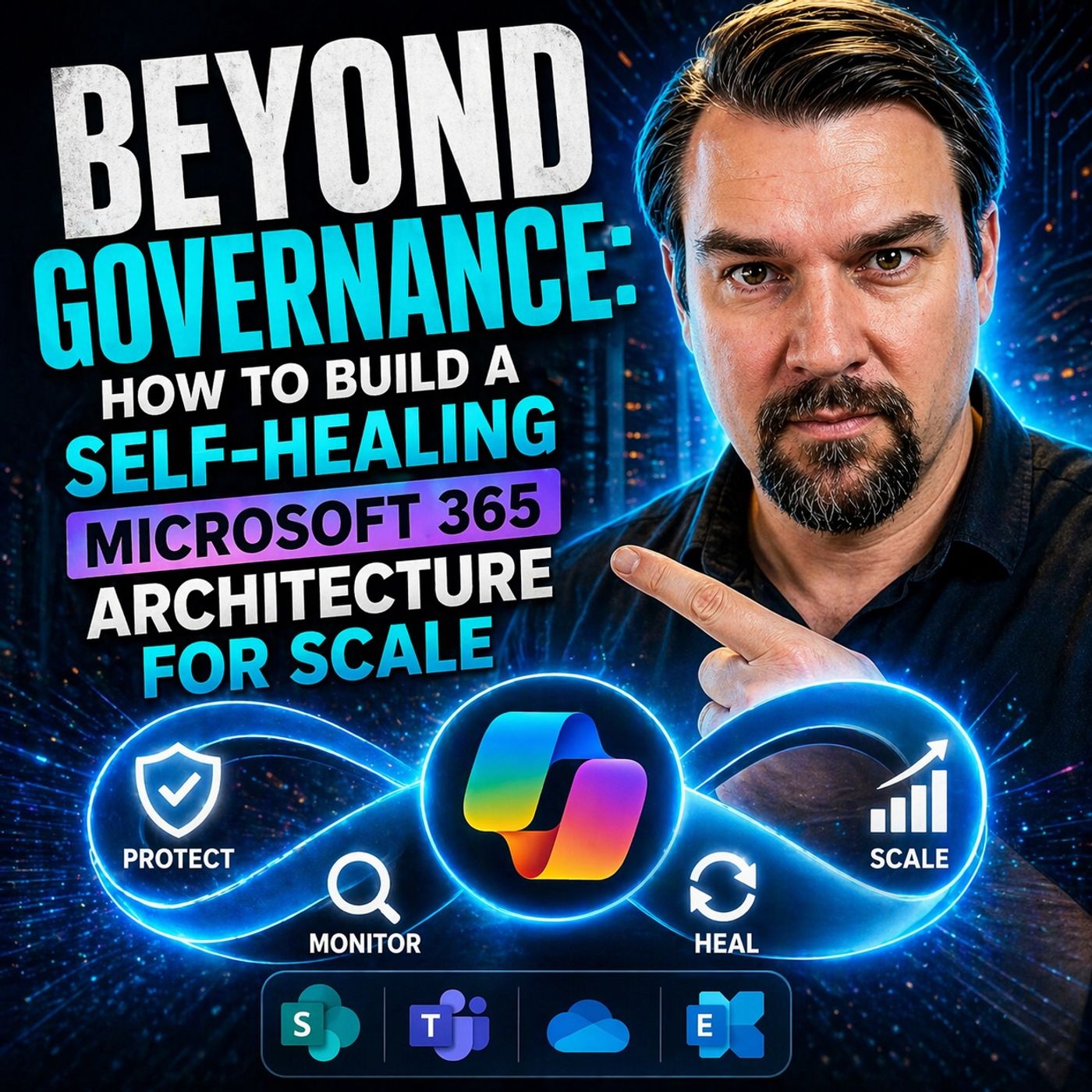
Beyond Governance: How To Build A Self-Healing Microsoft 365 Architecture For Scale
Season 2
Published 3 months, 2 weeks ago
Description
Your Microsoft 365 tenant is growing faster than your governance model can keep up. The first thing that breaks isn’t security tooling — it’s the assumption that people can review everything manually. You write policies. You define standards. You build governance frameworks. And then the tenant changes anyway. That’s the core problem. Governance, as most organizations implement it, doesn’t operate in real time. It reacts after the fact. And by the time reviews happen, drift has already spread. Prevention still matters. You need it. But prevention only defines what “good” looks like. Self-healing is what keeps the tenant alive.
⚠️ GOVERNANCE HAS BECOME ARCHITECTURE DEBT
Most governance models were built like documentation projects. They describe an ideal environment, but they don’t enforce reality. That gap is where risk grows. In modern Microsoft 365 tenants, change is constant. Teams are created daily. Private channels multiply. SharePoint permissions evolve. External sharing expands. Ownership becomes unclear. What starts as a small inconsistency doesn’t explode immediately. It sits quietly, accumulating exposure until it becomes a real issue. This is what governance debt looks like in practice:
🔄 THE SHIFT: FROM MANUAL GOVERNANCE TO RUNTIME SYSTEMS
The solution isn’t better documentation or more reviews. It’s a different model entirely. A self-healing Microsoft 365 architecture operates as a continuous loop:
Desired State → Detection → Decision → Remediation
Instead of describing the environment, the system actively maintains it. That shift changes everything. Governance stops being a static layer around the platform and becomes part of the runtime itself.
🧠 HOW A SELF-HEALING MICROSOFT 365 SYSTEM WORKS
A working model separates responsibilities into clear layers, each with a specific role. The system starts with signals — the events that indicate something has changed. That might be a missing owner, broken inheritance, a removed sensitivity label, or unusual access patterns tied to AI usage. It then compares that signal against a defined state. This is the machine-readable definition of what “correct” looks like. It can come from tools like M365 DSC, emerging capabilities like UTCM, or custom Graph-based logic. From there, orchestration takes over. Logic Apps or similar workflows evaluate the situation and decide what kind of response is appropriate. Not every issue should be treated the same. Some require notification. Others require immediate containment. Finally, enforcement applies the fix. Permissions are corrected, labels restored, sharing restricted, or ownership reassigned. And every action is logged for audit and trust.
📉 THE METRICS THAT ACTUALLY MATTER
Most organizations still measure governance maturity based on documentation or policy coverage. That doesn’t reflect reality. What matters instead are operational metrics:
🤫 FAILURE MODE #1: COPILOT EXPOSING HIDDEN DRIFT
Copilot doesn’t create risk. It accelerates visibility. A user asks a simple question and gets an answer built from content they technically had access to — but shouldn’t have been able to discover so easily. Nothing breaks. No alert fires. But the
⚠️ GOVERNANCE HAS BECOME ARCHITECTURE DEBT
Most governance models were built like documentation projects. They describe an ideal environment, but they don’t enforce reality. That gap is where risk grows. In modern Microsoft 365 tenants, change is constant. Teams are created daily. Private channels multiply. SharePoint permissions evolve. External sharing expands. Ownership becomes unclear. What starts as a small inconsistency doesn’t explode immediately. It sits quietly, accumulating exposure until it becomes a real issue. This is what governance debt looks like in practice:
- A Team gets created for a project
- Private channels are added later
- Permissions drift from the original intent
- External sharing remains open too long
- Owners leave and nobody replaces them
🔄 THE SHIFT: FROM MANUAL GOVERNANCE TO RUNTIME SYSTEMS
The solution isn’t better documentation or more reviews. It’s a different model entirely. A self-healing Microsoft 365 architecture operates as a continuous loop:
Desired State → Detection → Decision → Remediation
Instead of describing the environment, the system actively maintains it. That shift changes everything. Governance stops being a static layer around the platform and becomes part of the runtime itself.
🧠 HOW A SELF-HEALING MICROSOFT 365 SYSTEM WORKS
A working model separates responsibilities into clear layers, each with a specific role. The system starts with signals — the events that indicate something has changed. That might be a missing owner, broken inheritance, a removed sensitivity label, or unusual access patterns tied to AI usage. It then compares that signal against a defined state. This is the machine-readable definition of what “correct” looks like. It can come from tools like M365 DSC, emerging capabilities like UTCM, or custom Graph-based logic. From there, orchestration takes over. Logic Apps or similar workflows evaluate the situation and decide what kind of response is appropriate. Not every issue should be treated the same. Some require notification. Others require immediate containment. Finally, enforcement applies the fix. Permissions are corrected, labels restored, sharing restricted, or ownership reassigned. And every action is logged for audit and trust.
📉 THE METRICS THAT ACTUALLY MATTER
Most organizations still measure governance maturity based on documentation or policy coverage. That doesn’t reflect reality. What matters instead are operational metrics:
- MTTR for drift
How long does it take to detect and fix permission or configuration issues? - Copilot-safe coverage
What percentage of your content is properly secured and ready for AI access?
🤫 FAILURE MODE #1: COPILOT EXPOSING HIDDEN DRIFT
Copilot doesn’t create risk. It accelerates visibility. A user asks a simple question and gets an answer built from content they technically had access to — but shouldn’t have been able to discover so easily. Nothing breaks. No alert fires. But the