Episode Details
Back to Episodes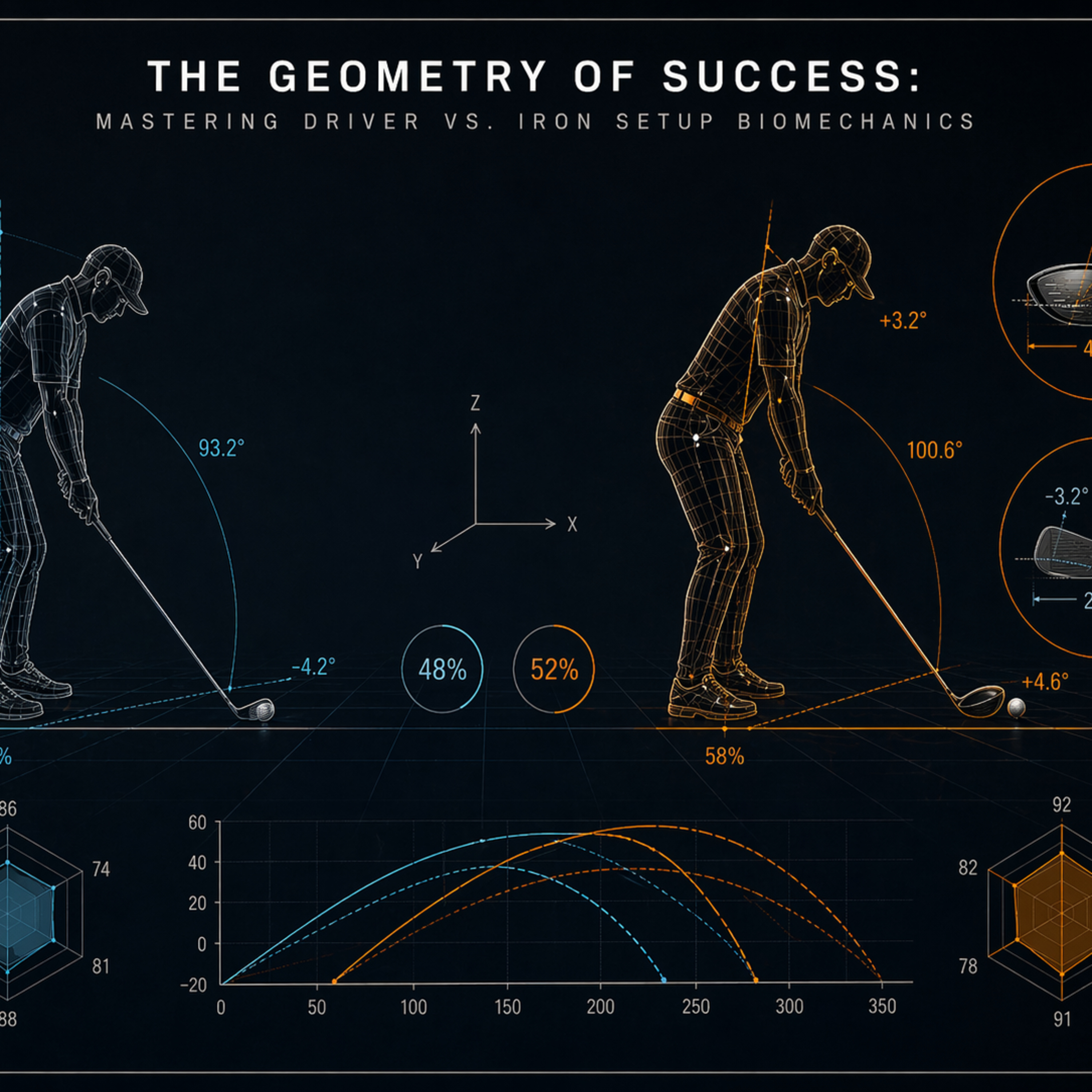
#566 The Geometry of Success: Mastering Driver vs. Iron Setup Biomechanics
Description
In advanced golf biomechanics, the swing is not a series of isolated positions but an integrated system. The setup represents the system’s “Zero Position,” defining how the body and club will move throughout the swing. Any structural error at address forces compensations later. Setup geometry directly influences sway, lift, thrust, and rotation. A correct setup pre-programs efficient movement; a poor one creates instability and inconsistency. Importantly, setup is task-specific—iron play requires downward compression, while the driver demands speed and upward strike.
Modern coaching moves beyond 2D video into 3D measurement using 6 Degrees of Freedom (6 DOF). This tracks movement through translation (sway, lift, thrust) and rotation (turn, side bend, flexion/extension). Without this system, coaches rely on visual estimation, often distorted by camera angle, lens effects, and alignment errors. Objective measurement defines the true “Zero Position” and eliminates guesswork.
For irons, the primary objective is low-point control and downward compression. This requires a stable, “stacked” structure. The ball is positioned near the sternum, ensuring contact before the low point. The thorax and pelvis remain vertically aligned with minimal side bend, promoting a descending strike. Weight is balanced or slightly lead-side to stabilize the center of rotation and reduce sway. The iron setup prioritizes control, precision, and consistency.
The driver requires a fundamentally different geometry. Here, the goal is maximum speed and upward angle of attack. The ball is positioned forward, near the lead heel, shifting the swing’s low point behind the ball. The thorax tilts away from the target, creating side bend that supports an ascending strike. This also alters the rotational axis, allowing efficient rotation without losing speed. A wider stance increases stability and enables greater ground force and vertical thrust.
Comparing both setups highlights their task-based differences. Iron setup places the low point in front of the ball, uses a centered ball position, and maintains a neutral structure for control. Driver setup shifts the low point behind the ball, moves the ball forward, and introduces side bend to optimize power. The iron prioritizes stability and minimizes sway; the driver maximizes thrust and energy transfer.
Ultimately, setup defines the kinematic chain—the sequence of energy transfer from ground to club. A correct, data-driven setup allows efficient sequencing, eliminates compensations, and creates repeatable performance. This transforms the golf swing from a subjective feel-based action into a precise, measurable system.