Episode Details
Back to Episodes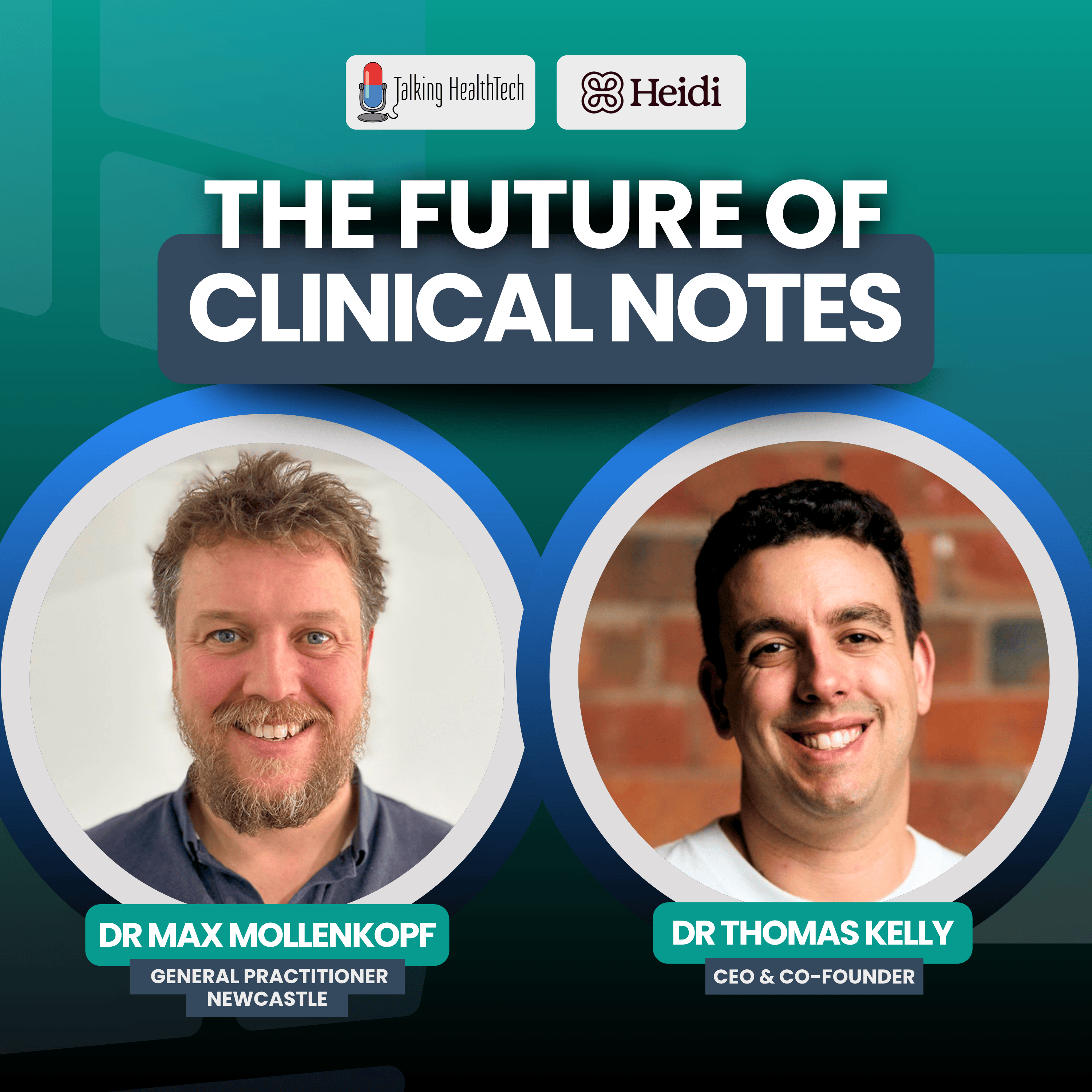
600 - Clinical Evidence at Your Fingertips: AI, Scribes, and the Future of Medical Documentation
Description
In this episode of Talking HealthTech, Dr Max Mollenkopf is joined by Dr Tom Kelly to unpack the evolution of Heidi, an AI-powered clinical documentation tool, from its early experimentation in general practice to its growing presence across health systems globally.
The conversation traces the realities of building in digital health, including early missteps, product pivots, and the challenge of finding meaningful product-market fit in a complex and highly regulated environment.
The discussion goes beyond surface-level AI hype to examine how tools like Heidi are being shaped by real clinical workflows.
It explores the practical challenges of integrating with existing practice management systems, navigating regulatory frameworks across different regions, and competing in an increasingly crowded international market.
There is also a focus on the rise of AI-powered clinical scribing, the role of large language models, and how these technologies are changing the day-to-day experience of clinicians.
Alongside the technical and commercial considerations, the episode reflects on broader questions facing the sector, including safety, interoperability, and the cost of scaling AI in healthcare.
It also looks ahead to emerging use cases such as real-time evidence retrieval and patient-facing applications, offering a grounded perspective on where AI is delivering value today and where it may have the greatest impact in the future.
Key Takeaways
✨ Product evolution and lessons learned Heidi started as a triage and workflow automation tool and shifted focus to clinical AI scribing in response to market needs and advancements in AI models.
💬 Integration and interoperability challenges Integrating with practice management systems remains complex and highly dependent on regional vendors and technical standards, highlighting the ongoing struggle for efficient interoperability in healthcare.
🌍 Global competition and expansion Heidi's growth strategy and competition vary by country, with different primary competitors in Australia, the UK, and North America, and a keen focus on clinician-centric product development.
🛠️ Regulation and medical device territory AI-based clinical tools like Heidi must constantly reassess their compliance with evolving software as a medical device rules, which differ across international markets.
🤝 Feedback-driven design Heidi’s freemium model enabled rapid feedback loops from clinicians, shaping product features and spurring adoption in both individual practices and enterprise hospital deals.
Timestamps
00:00 Heidi’s origins and early pivots
03:37 Traction and barriers to product adoption
09:01 Pivot to AI-powered scribing
14:11 Drivers of Heidi’s growth and market position
18:56 Competitors in each market
22:45 Evidence product launch and vision
29:17 Software as a medical device, regulatory lines
37:37 Relationships with PMS providers
44:16 Interoperability barriers and national health records
52:13 The cost of AI in clinical tools
54:40 Expanding to communications and voice products
57:32 Consumer-facing applications and future directions
59:59 Will AI replace clinicians?
--------
Want to keep the conversation going?
The full article and extended show notes for this episode are available inside the THT+ Community here: View Full Article Here
In the THT+ Community, our members keep the discussion going, share perspectives, and unpack what this episode actually mean