Episode Details
Back to Episodes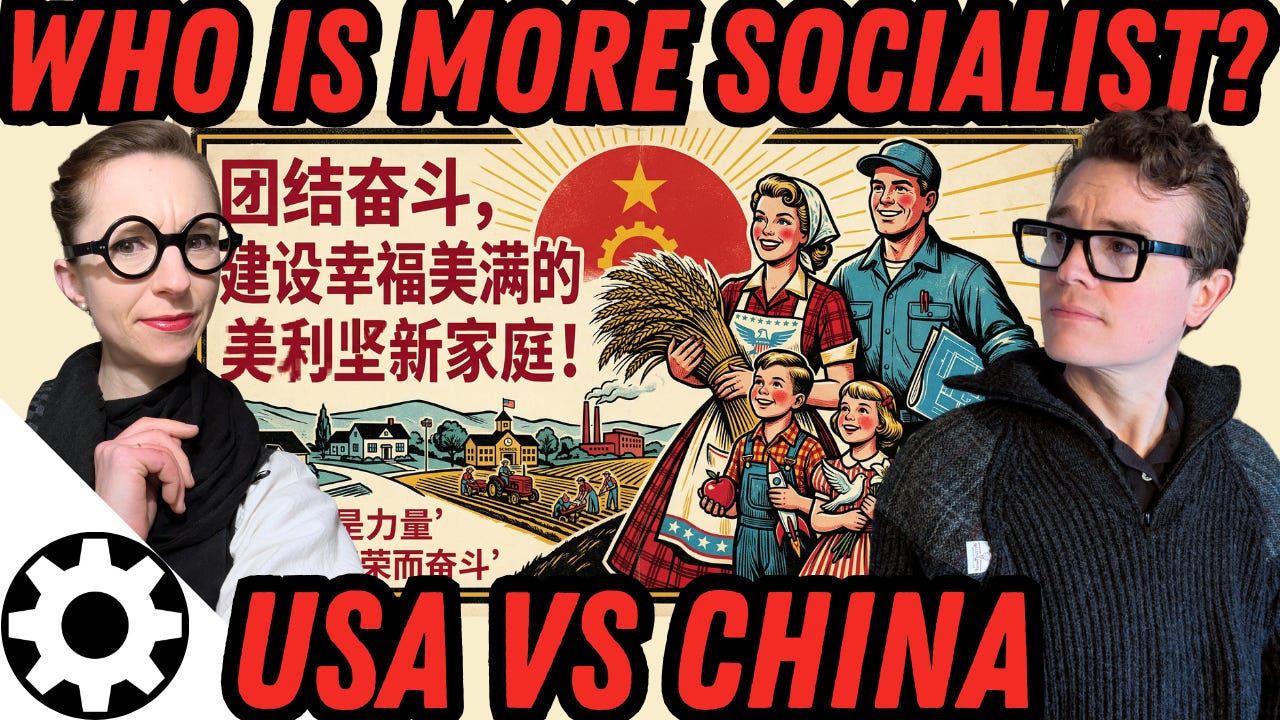
Who is REALLY More Socialist: The US or China (2026)?
Description
Having been given the impression as young Americans that China was “socialist,” providing abundant services and safety nets for its citizens, while the US was “capitalist,” leaving its citizens to fend for themselves, we were in for a surprise when we discovered that, relatively speaking, the United States is a socialist utopia.
Today on Based Camp, we explore the United States’ (admittedly unsustainable) socialist utopia Americans enjoy and the (put diplomatically) bare bones support provided to citizens—especially rural citizens—by the CCP.
If you’re a parent in the US looking to avail themselves of more of the United States generous services oriented around families, please refer to Pronatalist.org’s summaries of and links to State resources for parents.
Show Notes
I grew up thinking the USA was a land of pure capitalism, where people are on the hook for everything. Turns out that’s only the case if you’re middle class.
If you’re poor in the USA, you’re arguably living in the best communist world imaginable, because you’re enjoying socialist-style support (for food, childcare, healthcare, etc.) but getting capitalism-style goods and services (e.g. going to the same private hospitals that rich people go to; going to the same grocery stores that rich people go to, etc.)
Case in point: State resources for parents (We created detailed guides for Pronatalist.org)
If “communism” means “this country has a significant social safety net”, then the USA is more communist than China.
Even China has disparities in its benefits: urban formal workers receive significantly better protection than migrants and rural residents.
Old-Age Income
* USA: Social security
* Going to stop working
* Based on what you contribute as a worker… sort of
* For a typical retiree claiming at full retirement age, Social Security is designed to replace around 40 percent of pre‑retirement earnings, with replacement rates higher for low earners (roughly 60–80 percent) and lower for high earners.
* The Social Security Administration indexes each year of your past earnings to national wage growth and takes your 35 highest‑earning years to compute your Average Indexed Monthly Earnings (AIME)
* For people first eligible in 2025, the formula replaces 90 percent of the first slice of AIME, 32 percent of the middle slice, and 15 percent of the top slice (with “bend points” around 1,226 and 7,391 dollars of AIME), so lower earners get a higher share of their prior income replaced
* The USA covers most seniors and low‑income households through Social Security, Medicare, and Medicaid, but non‑elderly adults without stable jobs or employer plans can still fall through gaps, especially as enhanced ACA subsidies expire.
* China:
* China now has a “three‑pillar” setup: a basic public pension (still the main source), employer/occupational plans, and voluntary private pensions with tax incentives.
* Resident pensions are low; national minimums have risen from 55 yuan per month at the program’s launch to around 143 yuan in 2025, with local governments often topping this up, but even average rural pensions of about 246 yuan per month in 2024 are only a modest supplement to other family or work income. Beijing, for example, set basic resident pensions for new claimants around 998 yuan per month in 2025, much higher than the national floor but still far below urban wages.
<