Episode Details
Back to Episodes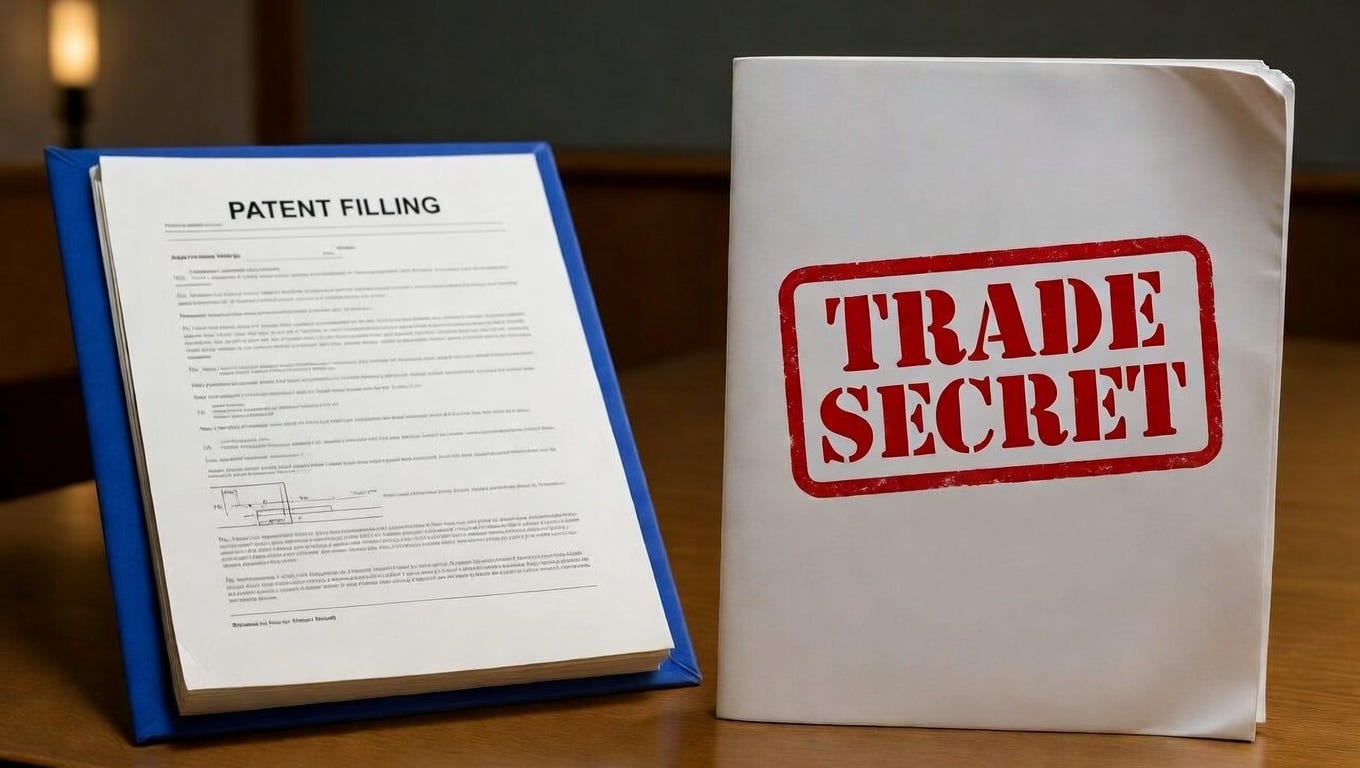
Patents versus Trade Secrets
Description
A Legal and Strategic Analysis Prepared by The Innovation Attorney
Executive Summary
Patents and trade secrets are the two principal legal regimes by which a startup converts proprietary technology into a defensible commercial asset. Patents are federal statutory rights granted under Title 35 of the United States Code in exchange for public disclosure, lasting twenty years from the earliest effective filing date, enforceable against independent inventors. Trade secrets are protected under the federal Defend Trade Secrets Act of 2016 and the state Uniform Trade Secrets Act adopted in forty eight states, last as long as the information remains secret and derives economic value from that secrecy, and are enforceable only against misappropriation. For a startup, the choice is rarely binary. It is a portfolio decision driven by the speed of reverse engineering, the capital intensity of enforcement, the posture of investors and acquirers, the rate of technology change, and the subject matter eligibility framework that has narrowed the patentability of software and diagnostic methods since 2012.
The most important findings are as follows. First, patent subject matter eligibility has contracted since the Supreme Court’s decisions in 2012 and 2014, leaving many software and diagnostic inventions outside the patent system and pushing startups in those fields toward trade secret protection as the default. Second, the Defend Trade Secrets Act has federalized trade secret litigation, added exemplary damages up to two times compensatory damages, authorized attorneys fees, and created a limited ex parte seizure remedy, which has materially strengthened the trade secret option. Third, inter partes review has become a meaningful counterweight to asserted patents, invalidating claims at a rate that sophisticated acquirers now price into diligence. Fourth, for a startup with a sub forty million dollar enterprise value, a blended strategy, a small set of carefully prosecuted patents surrounded by a disciplined trade secret program, typically produces the best risk adjusted return.
Detailed Findings
1. The Statutory Architecture
Patents are created by Congress under Article I, Section 8, Clause 8 of the Constitution and codified in Title 35 of the United States Code. A utility patent requires that the claimed invention fall within eligible subject matter under 35 U.S.C. 101, be novel under 35 U.S.C. 102, be nonobvious under 35 U.S.C. 103, and be supported by a written description that enables a person of ordinary skill to make and use the invention under 35 U.S.C. 112. The term is twenty years from the earliest nonprovisional filing date under 35 U.S.C. 154.
Trade secrets are protected by a parallel state and federal regime. The Defend Trade Secrets Act of 2016, codified at 18 U.S.C. 1831 through 1839, created a federal civil cause of action for misappropriation of a trade secret related to a product or service used in interstate commerce. Forty eight states have adopted some version of the Uniform Trade Secrets Act, and the Restatement of Unfair Competition supplies a parallel common law framework in the remaining jurisdictions. A trade secret requires information that derives independent economic value from not being generally known and that is the subject of reasonable measures to maintain secrecy.
2. The Disclosure Bargain
The patent system is built on a disclosure bargain. In exchange for a time limited exclusive right, the inventor publishes a specification that teaches the public how to practice the invention. A United States patent application publishes eighteen months after the earliest filing date under 35 U.S.C. 122, unless the applicant certifies that no foreign counterpart will be filed. Once published, the technology is permanently in the public domain after the patent expires.
Trade secret prote