Episode Details
Back to Episodes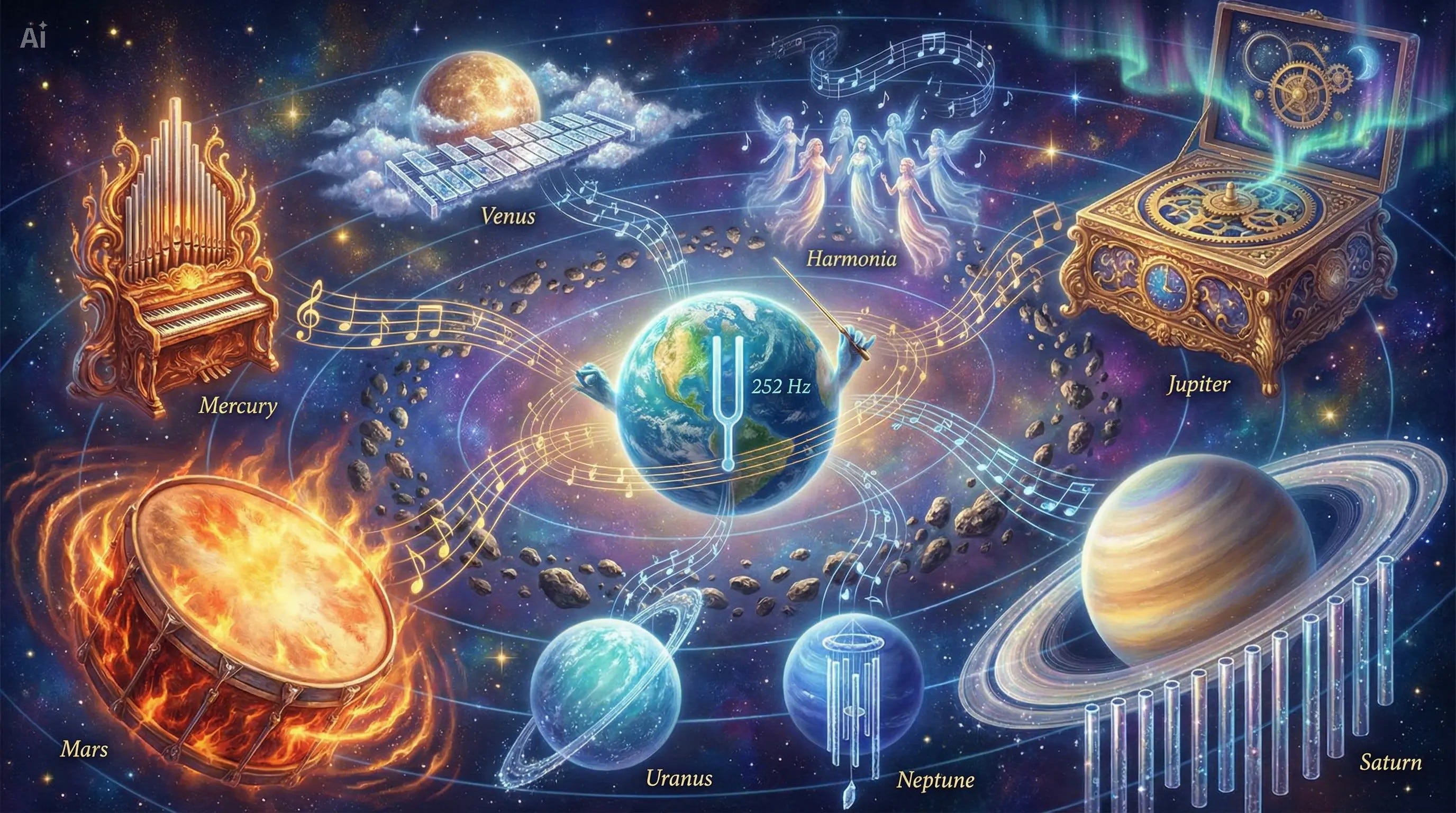
When the Solar System Became an Orchestra
Description
Something unexpected happened after I published Harmonia — The Missing Note in the Solar Symphony.
I had written about the planets as a musical scale, Mercury at a Major 9th below Earth, Mars at the dissonant Tritone, Harmonia at the missing Major 7th, Jupiter anchoring two full octaves above. I had included a Python script that generated the Solar chord as pure sine-wave tones, with mathematically exact frequencies derived from the Silver Ratio Harmonic Framework, Earth tuned to 252 Hz, and every planetary frequency reducing to a digit sum of 9.
It was, I thought, a complete realisation of the idea. Pure mathematics expressed as pure sound.
Then Michiel read the article. And he asked a question I had not thought to ask.
Can I make those tones into instruments?
The Same Frequencies. Different Voices.
The frequencies in the Silver Ratio Harmonic Framework are mathematically fixed. Mercury at 90 Hz. Venus at 180 Hz. Earth at 252 Hz — the tonic. Mars at 396 Hz — the Tritone, the diabolus in musica. Harmonia at 540 Hz — the leading tone, the Major 7th, the note that never resolves. Jupiter at 1305 Hz. Saturn, Uranus, Neptune, Pluto ascending outward to 9972 Hz.
These numbers are not arbitrary. They emerge from the same geometric construction — the Celtic Cross, the 3×3 grid, the concentric circles — that predicts planetary orbital distances to within 0.72% mean error. The frequencies are the mathematics heard as sound.
What Michiel realised is that the same frequency can be voiced through different instruments, and that each instrument gives the planet a different character, a different personality, a different emotional register, while preserving the mathematical identity exactly.
So he built an instrument orchestration system.
Eight Presets. One Solar System.
Using FluidSynth and the Arachno SoundFont, a rich library of General MIDI instrument voices, Michiel created eight distinct orchestrations of the Solar chord. Each preset assigns a different instrument to each planet. The frequencies never change. But the character of each planet shifts dramatically depending on its voice.
Here are the eight presets he created:
Each preset builds the Solar chord planet by planet — Mercury enters first, then Venus, then Earth, then Mars, and so on outward to Pluto. Then the full chord sustains in resonance before fading to silence. The structure mirrors the original solar_chord_buildup.wav — but now with instrumental voices rather than pure sine waves.
Mars Always Drums. Harmonia Always Sings.
Two design decisions in Michiel’s script stand out as musically and symbolically perfect.
Mars at 396 Hz is permanently assigned a drumbeat — alternating between a Taiko Drum and a Melodic Tom, beating steadily throughout every preset at its Tritone frequency. The diabolus in musica as a relentless pulse. The most dissonant planet is the rhythmic engine driving the entire composition forward. It is impossible to listen to Mars drumming at 396 Hz without feeling the tension it creates — exactly as the Tritone has always functioned in Western harmony, pushing urgently toward resolution.
Harmonia at 540 Hz sings as a Choir voice. In every preset, when Harmonia’s frequency enters the chord, it arrives as a human voice — warm, sustained, slightly ethereal. The leading tone is the most human-sounding available in the instrument library. The missing planet is voiced as a choir that sings, never quite resolving.
Mars drums. Harmonia sings. The asteroid belt is the silence between them.
What the Script Does
The script is interactive; you run it, choose a preset, and listen as the Solar chord assembles itself instrument by instrument. A menu displays the eight options. You select one. The planets enter on