Episode Details
Back to Episodes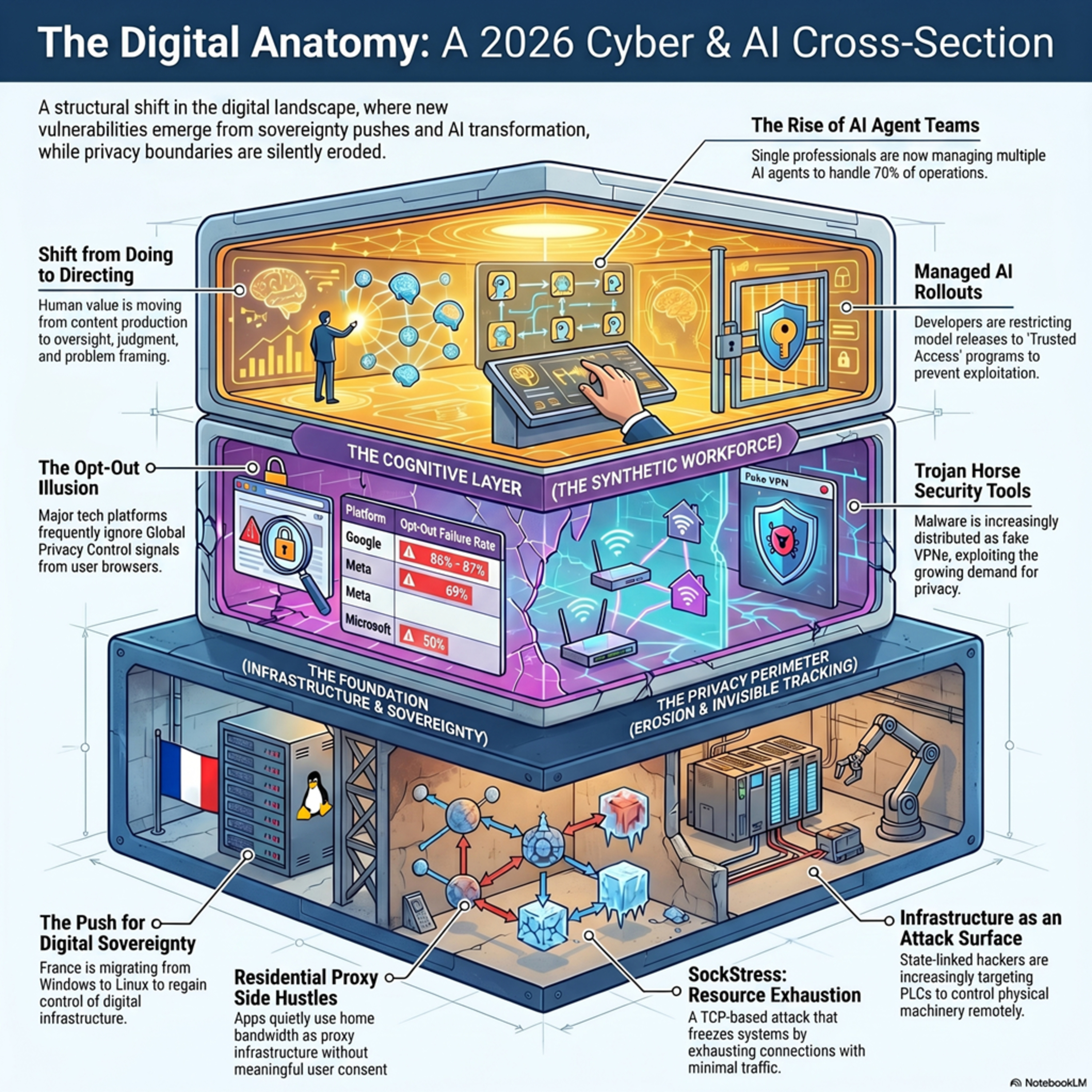
Episode 287.5. Deep Dive. Taxing. The AI, Privacy, and Security Weekly Update for the Week ending April 14th 2026
Description
Cybersecurity is entering an “invisibility crisis,” where threats are no longer loud, external attacks but subtle abuses of normal system behavior. Techniques like SockStress exploit TCP assumptions to drain resources, residential proxy networks turn everyday users into unwitting infrastructure, and fake VPNs weaponize trust to exfiltrate data. Even ransomware response processes are being hijacked, transforming incident response into an attack surface. At the same time, transparency mechanisms are failing—Google, Meta, and Microsoft frequently ignore user opt-outs—highlighting a systemic breakdown in consent and accelerating calls for digital sovereignty.
This shift feeds directly into geopolitics. Nations increasingly view reliance on foreign technology as a strategic risk, pushing “digital sovereignty” agendas. France, for example, is migrating government systems to domestic or open-source alternatives like Linux and Jitsi, and relocating sensitive health data infrastructure. Meanwhile, advanced AI proliferation introduces a paradox: companies restrict powerful models to prevent misuse, yet real-world breaches—such as the Tianjin Supercomputer incident, where attackers exfiltrated 10 petabytes via a compromised VPN—demonstrate how stealthy, persistent threats can evade detection at scale.
Critical infrastructure remains especially vulnerable. Iran-linked actors have targeted industrial control systems (PLCs), showing how cyber intrusions can translate into physical manipulation. The message is clear: internet-connected industrial systems must adopt stronger controls, including multifactor authentication and continuous monitoring, particularly across energy and water sectors.
Alongside these risks, the workforce itself is transforming. AI is shifting human roles from execution to oversight—people increasingly “direct” rather than “do.” However, this creates a paradox: while AI boosts productivity, it also increases complexity, oversight demands, and cognitive load. Managers now supervise fleets of AI agents, and professionals often refine AI outputs instead of producing original work. Despite widespread tech layoffs, judgment, accountability, and problem framing are becoming the most valuable—and scarce—skills.
The broader theme is one of diminishing visibility and control. Whether in cybersecurity, geopolitics, or labor, systems are becoming more opaque, automated, and interdependent. Even efforts to uncover foundational truths—like identifying Satoshi Nakamoto—remain inconclusive despite advanced analysis. In this environment, the key differentiator is no longer technical capability alone, but human judgment: the ability to question assumptions, verify continuously, and navigate a world where the greatest risks are hidden in plain sight.