Episode Details
Back to Episodes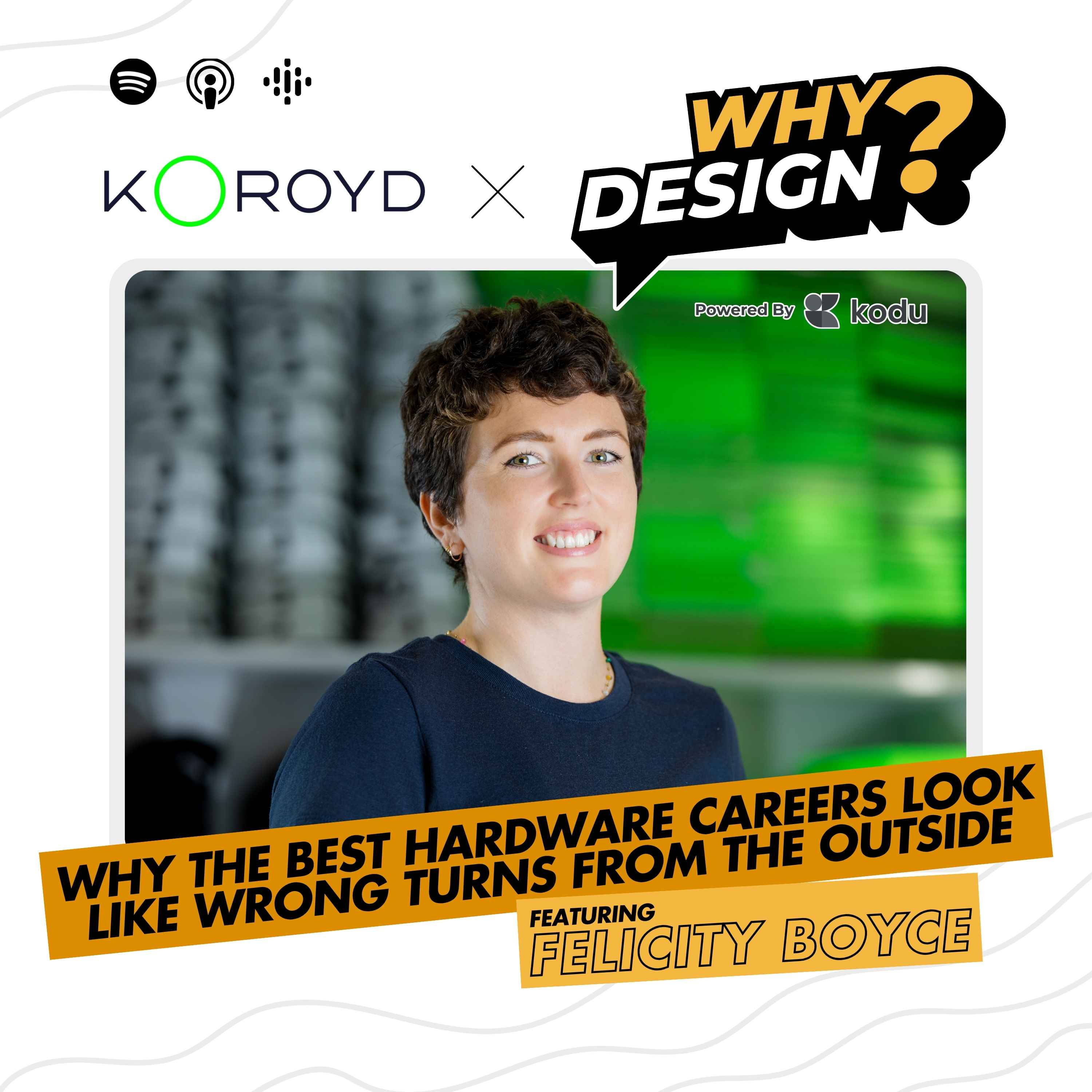
Why the best hardware careers look like wrong turns from the outside | Felicity Boyce
Description
What do you do when the work you're best at starts to feel like the problem?
In this episode of Why Design, Felicity Boyce shares the belief that sits at the heart of her work: that understanding how something is made, at factory scale, under pressure, with the wrong release agent and a cycle time that doesn't add up, is more valuable than any theory you carry out of university.
As Head of Material Innovation at Koroyd, she leads the development of the tubular core technology that is now inside helmets and body protection products used across sports, industrial, motorsport, and defence markets, inside a company just acquired by MIPS for 40 million euros.
Rather than following a planned career trajectory, Felicity built her expertise through saying yes: to factory trips others declined, to project responsibility that appeared during redundancy rounds, to a year inside a nappy recycling facility learning waste streams and polymer chemistry from the ground up, and eventually to a job offer in Monaco from a team she already trusted. That sequence of decisions led her to one of the more interesting material science roles in European hardware.
This conversation isn't about impact protection materials.
It's about what you learn by being physically present when things go wrong in a factory.
This conversation isn't about sustainability credentials.
It's about the weight of making things at volume, and what you do when that weight becomes a reason to change direction.
This conversation isn't about relocating for work.
It's about what it looks like to build a career without a map, and why gut instinct and a good team around you turn out to be the main navigational tools.
Join the Why Design community: teamkodu.com/whydesign
What You'll Learn
- 🔩 Why the best material science careers are built in factories, not labs, and what that means for how you read a CV.
- 🌍 How sustainability shifts from an interest to an obligation when you have spent years watching what gets made at scale.
- 🏗️ What Koroyd's tubular core technology actually does, where it came from, and why the MIPS acquisition is a science story as much as a business one.
- 🧪 Why a year recycling nappies turned out to be one of the most valuable things Felicity did for her career, and what it taught her about the gap between lab-scale proof and real-world implementation.
- 👥 What attitude actually looks like in an interview when you are hiring for a technical team in a company that is evolving faster than its org chart.
- 🏔️ What it genuinely costs and feels like to relocate to Monaco for work, beyond the sunshine, the sea, and the scenery.
Memorable Quotes
"I think I was just at a point of my life and my career where it felt like a bit of an adventure. Sometimes you just have to go with your gut and it just felt like a good move."
"I think I've always just seen challenge as something positive rather than something too scary. You've got to be comfortable being a bit uncomfortable."
"Being in a factory, trying to troubleshoot exactly why you're having trouble running a new material or a new product, you can't get it to mould or demould, that was really where I felt I started to thrive."
"It's okay not to know what the future holds and where the path's going, as long as you've got a good support network and you feel well supported. You'll find your way."
"It's not quite as simple as just getting rid of all plastics and that's going to be the solution to all our problems. It's a much more complex topic than that."
Resources