Episode Details
Back to Episodes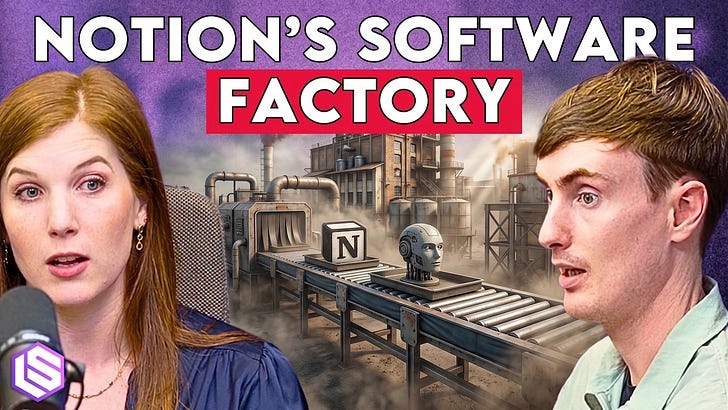
Notion’s Token Town: 5 Rebuilds, 100+ Tools, MCP vs CLIs and the Software Factory Future — Simon Last & Sarah Sachs of Notion
Description
For all those who missed out on London, see you in Miami next week!
Notion, the knowledge work decacorn, has been building AI tooling since before ChatGPT, with many hits from Q&A in 2023 and unified AI in 2024 and Meeting Notes in 2025. At the end of their last Make user conference, Ryan Nystrom teased Notion 3.0’s Custom Agents - and they are finally embracing the Agent Lab playbook!
Sarah Sachs and Simon Last of Notion join us for a deep dive into how Notion built Custom Agents, why it took years and multiple rebuilds to get right, and what it means to turn a productivity tool into an agent-native system of record for enterprise work.
We go inside the product, engineering, evals, pricing, and org design decisions behind one of the most ambitious AI product efforts in software today — from early failed tool-calling experiments in 2022 to agent harnesses, progressive tool disclosure, meeting notes as data capture, and the long-term vision for software factories and agentic work.
We discuss:
* Sarah and Simon’s path to launching Notion Custom Agents, and why the feature was rebuilt four or five times before it was ready for production
* Why early agent attempts failed: no tool-calling standard, short context windows, unreliable models, and too much complexity exposed to the model
* The “Agent Lab” thesis: not just wrapping a model, but understanding how people collaborate and building the right product system around frontier capabilities
* How Notion thinks about roadmap timing: not swimming upstream against model limitations, but also building early enough that the product is ready when the models are
* Why coding agents feel like the kernel of AGI, and how Notion is thinking about “software factories” made up of agents that spec, code, test, debug, review, and maintain codebases together
* How Sarah runs AI engineering at Notion (“notes from Token Town”): objective-setting over idea ownership, low-ego teams comfortable deleting their own work, and a culture designed to swarm around fast-changing opportunities
* The “Simon Vortex,” company hackathons, and why security gets pulled in early rather than late
* How Notion organizes AI: core AI capabilities and infrastructure, product packaging teams, and a broader company mandate that every product surface must increasingly work for both humans and agents
* Why prototypes have become much easier to build internally, and how “demos over memos” changes product development inside a tool the whole company already uses every day
* Notion’s eval philosophy: regression tests, launch-quality evals, and “frontier/headroom” evals that intentionally only pass ~30% of the time so the company can see where model capabilities are going
* What a “Model Behavior Engineer” is, and