Episode Details
Back to Episodes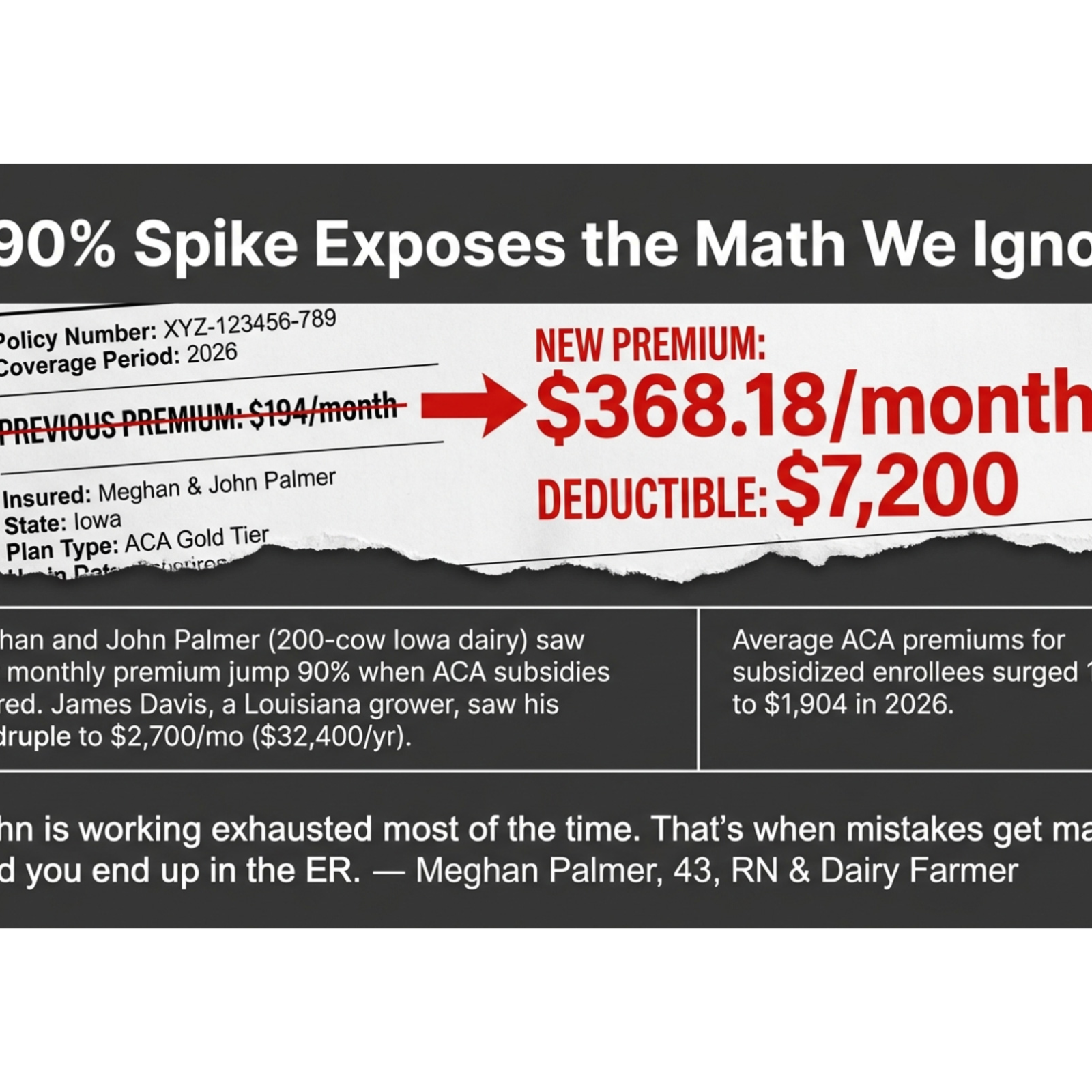
E537 $368 Insurance, −$1,830 from Farming: What Actually Keeps One Iowa Dairy Alive
Description
USDA says the median U.S. farm household lost $1,830 farming in 2024 — and earned $86,900 off the farm. When enhanced ACA subsidies expired in December 2025, families like Meghan Palmer's in northeastern Iowa watched their monthly health insurance bill nearly double, exposing a financial reality the dairy industry rarely talks about openly: on most operations, the spouse's town job isn't supplemental income. It's the operating margin. This episode breaks down the barn math, the governance gap, and four concrete decision paths every dual-income dairy household should evaluate now.
KEY TAKEAWAYS
- Why USDA's 2024 farm household income data ($102,748 median total — but negative $1,830 from farming) should change how you think about your farm's real financial structure.
- The hidden math behind a $55,000 off-farm salary: how employer health insurance, retirement matches, and benefits push total compensation to $65,000–$77,000 — and why that number often exceeds your net farm income.
- What a 200-cow herd shipping 75 lbs/day at $20.50/cwt actually nets after costs run $23.56/cwt — and where the off-farm paycheck fits in that equation.
- The governance gap: why the person funding your dairy's real margin probably isn't on your loan documents, bank accounts, or succession plan — and what that means if they get hurt, burn out, or leave.
- How ACA premium hikes (114% projected increase per KFF) and a 40%+ uninsured rate among dairy farmers are compounding an already razor-thin margin environment.
- Four decision paths — from formalizing the town job in your business plan to planning an intentional exit — with a 30-day action you can take with last year's tax return and a W-2.
This episode puts real numbers behind something most dairy families live but never quantify. Using USDA Economic Research Service data, KFF Health News reporting, and Bullvine analysis, the discussion walks through what a spouse's off-farm job actually contributes — not just the paycheck, but the $7,500 to $19,300 in annual employer health insurance contributions, the retirement match, and the stability that no milk check can replicate.
The conversation goes beyond economics into farm governance: if your operation depends on a single off-farm income stream, is the person generating it actually part of your business structure? For most dairy families, the answer is no — and that's a concentration risk nobody's managing.
You'll hear the real story of Meghan Palmer, a registered nurse on a northeastern Iowa dairy whose $368 monthly insurance bill became the catalyst for rethinking her family's entire financial structure. Her experience, sourced from KFF Health News, mirrors what thousands of dairy households are navigating right now as ACA subsidy loss collides with production costs that averaged $23.56/cwt in 2024.
Whether you're running 80 cows or 800, this episode gives you a framework to answer one question: does your farm's business plan actually account for the income that's keeping it alive?
The full article — with sourced data, a side-by-side comparison table, and all four decision paths — is available at https://www.thebullvine.com/news/368-insurance-%E2%88%921830-from-farming-what-actually-keeps-one-iowa-dairy-alive/.
Subscribe to The Bullvine Podcast on Apple Podcasts, Spotify, or wherever you listen — and sign up for The Bullvine Weekly newsletter at thebullvine.com for upcoming economics features on production-cost breakevens by herd size and region.