Episode Details
Back to Episodes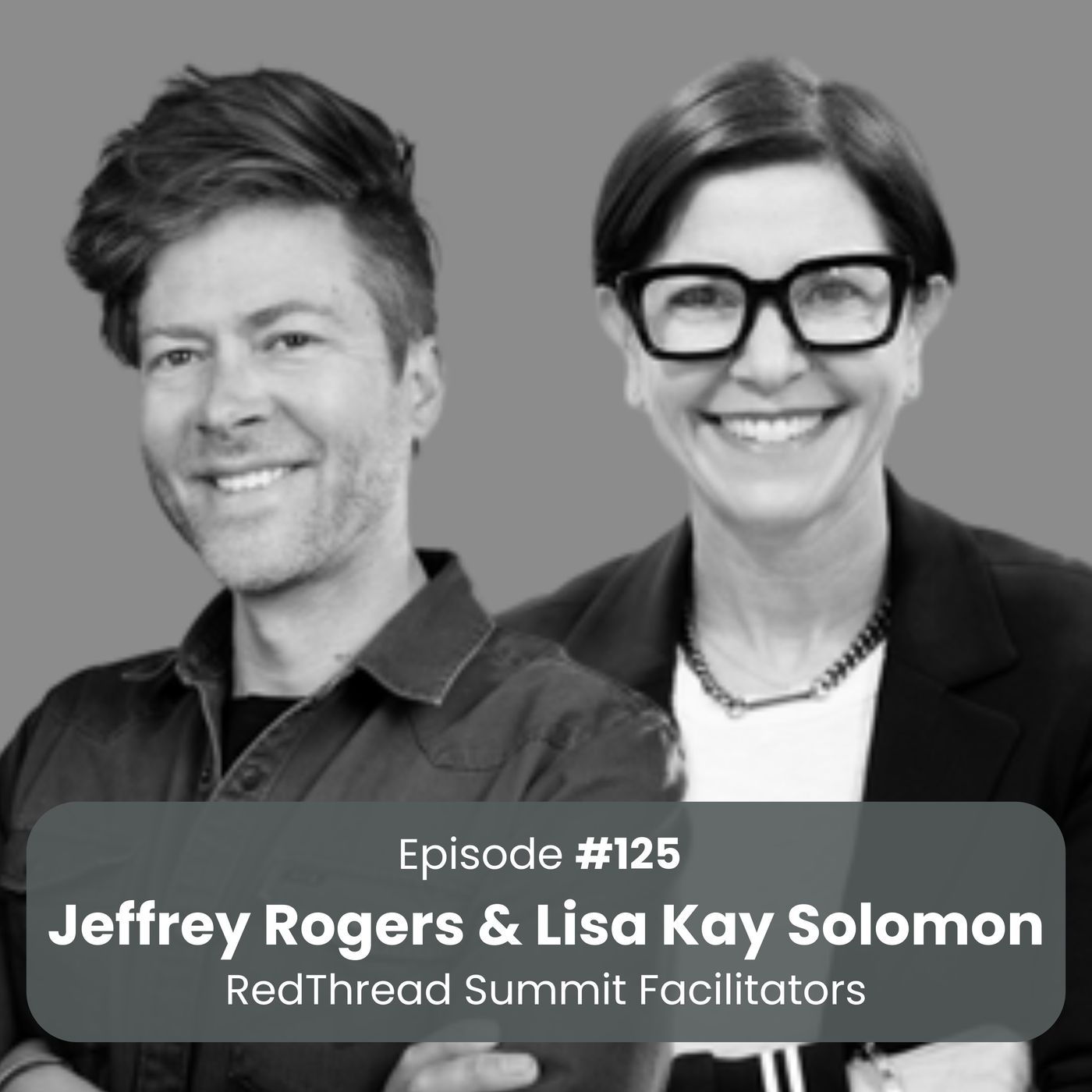
Designing Future Narratives in a Changing Workplace: Lisa Kay Solomon and Jeffrey Rogers
Episode 125
Published 5 months ago
Description
In this episode, we welcome Lisa Kay Solomon, designer-in-residence at Stanford's d.school and host of the "How We Future" podcast, and Jeffrey Rogers, principal of Learning and Facilitation at Radical and co-founder of Projectory. We discuss why foresight—the ability to anticipate and design the futures we want—is everybody's job, not just the domain of senior leaders or specialized futurists. They challenge the idea that organizations operate on an "official future" built from unexamined assumptions, and explore how narrative shapes both our approach to work and our readiness for rapid change, especially in the face of AI disruption.
You will want to hear this episode if you are interested in...
The Leadership Muscle We Forget to Use
One of the most powerful ideas to emerge from the conversation is that of foresight as a "leadership muscle." Most leaders are trained and incentivized to focus on quarterly results and annual plans. The urgent often squeezes out the important, leaving little room for the kind of long-term, strategic thinking that anticipates disruption rather than simply reacts to it.
Foresight isn't someone else’s job—it's every leader's job. Yet, most organizations have let this muscle atrophy. Through scenario planning and immersive exercises like those facilitated at last year’s Summit, the hosts argue that HR and organizational leaders can rediscover the collective ability to inquire, imagine, and influence the future, rather than endure it.
Challenging the "Official Future" and the Power of Narrative
Every organization operates on an "official future," a set of unspoken assumptions about what tomorrow holds. In stable times, these guiding narratives are rarely questioned. But when the world is in flux, from technological disruptions like AI to geopolitical shocks, such narratives become vulnerabilities.
Leaders, especially in HR, have a responsibility to both recognize and challenge prevailing stories about the future. Wherever there’s a narrative, there’s also the possibility for a counter-narrative, and organizations need to cultivate the skill of holding multiple possible futures in mind, letting diverse perspectives inform strategic choices rather than defaulting to inherited assumptions.
Building Organizational Foresight: Tools, Skills, and Community
The value of events like the Red Thread Summit lies in three core takeaways: the experience of stepping back to envision the future, a toolkit of practices that can be applied immediately, and the creation of a community dedicated to learning and experimentation.
There are three critical skills:
Perhaps nowhere is the need for foresight and narrative-shaping more acute than in the realm of AI and automation. Today’s leaders are under immense pressure to adopt and justify new technologies, to navigate uncertainty, and to avoid being blindsided by change.
A k
You will want to hear this episode if you are interested in...
- [00:00] Rethinking future-focused leadership
- [03:39] HR's evolving role in shaping the future
- [07:18] Understanding contested narratives and the potential to challenge them
- [21:50] The importance of adopting futures thinking through broad learning across multiple perspectives
- [25:47] Strategic foresight and future practices
- [35:13] Rethinking knowledge and learning priorities
- [39:21] Reflecting on AI adoption barriers
- [47:08] Helping leaders develop future-oriented skills
- [51:14] Looking ahead to the future
The Leadership Muscle We Forget to Use
One of the most powerful ideas to emerge from the conversation is that of foresight as a "leadership muscle." Most leaders are trained and incentivized to focus on quarterly results and annual plans. The urgent often squeezes out the important, leaving little room for the kind of long-term, strategic thinking that anticipates disruption rather than simply reacts to it.
Foresight isn't someone else’s job—it's every leader's job. Yet, most organizations have let this muscle atrophy. Through scenario planning and immersive exercises like those facilitated at last year’s Summit, the hosts argue that HR and organizational leaders can rediscover the collective ability to inquire, imagine, and influence the future, rather than endure it.
Challenging the "Official Future" and the Power of Narrative
Every organization operates on an "official future," a set of unspoken assumptions about what tomorrow holds. In stable times, these guiding narratives are rarely questioned. But when the world is in flux, from technological disruptions like AI to geopolitical shocks, such narratives become vulnerabilities.
Leaders, especially in HR, have a responsibility to both recognize and challenge prevailing stories about the future. Wherever there’s a narrative, there’s also the possibility for a counter-narrative, and organizations need to cultivate the skill of holding multiple possible futures in mind, letting diverse perspectives inform strategic choices rather than defaulting to inherited assumptions.
Building Organizational Foresight: Tools, Skills, and Community
The value of events like the Red Thread Summit lies in three core takeaways: the experience of stepping back to envision the future, a toolkit of practices that can be applied immediately, and the creation of a community dedicated to learning and experimentation.
There are three critical skills:
- Recognizing the narrative: Are you taking assumptions as fact, or seeing them as just one possible story?
- Crafting your own narratives: Are you able to articulate clear, alternative futures?
- Communicating vision: Can you equip others to see and believe in those visions?
Perhaps nowhere is the need for foresight and narrative-shaping more acute than in the realm of AI and automation. Today’s leaders are under immense pressure to adopt and justify new technologies, to navigate uncertainty, and to avoid being blindsided by change.
A k