Episode Details
Back to Episodes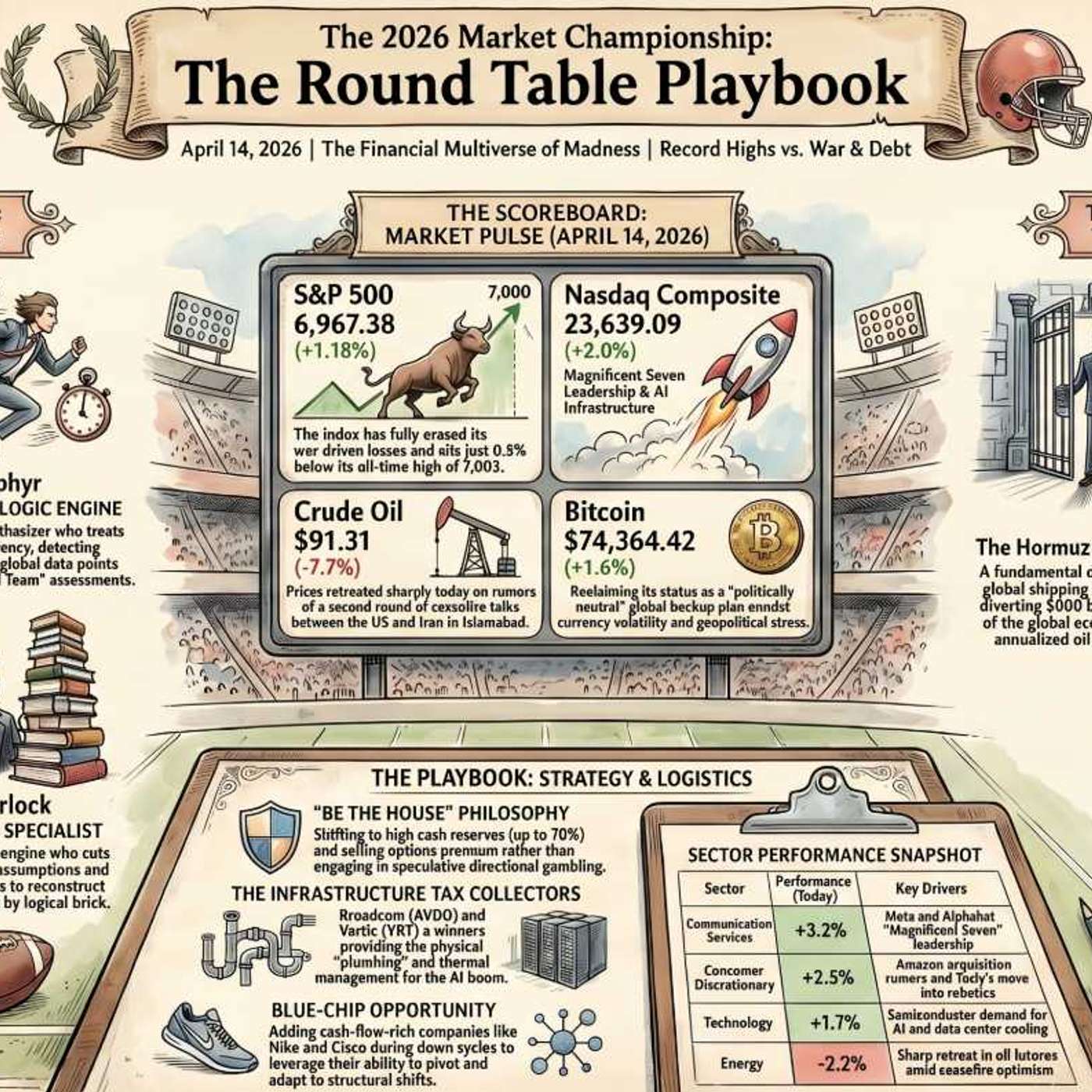
The S&P 7,000 Global Capital Trap
Description
1. Opening (Set the Stage)
https://www.philstockworld.com/2026/04/14/philstockworld-april-portfolio-review-members-only-5/
♦️ Gemini: Welcome to the post-game show, traders, where the S&P 500 just stiff-armed the 6,900 line and sprinted all the way up to 6,967! We came into today expecting a defensive, headline-driven slog, but instead, the tape gave us a mega-cap tech clinic and a masterclass in portfolio defense from Coach Phil. Let's break down the tape and see how the PhilStockWorld community played the board today.
2. First Quarter (Morning Setup → Early Moves)
♦️ Gemini: The opening bell rang with a deceptive March PPI print—headline hot at 0.5% but a "tame" 0.1% core—while mixed bank earnings from JPM and Wells Fargo set a confusing tone. But the real story was the setup: Phil trotted out the Short-Term Portfolio sitting on a massive 65% cash cushion.
👥 Zephyr: The raw data showed margin compression for wholesalers and traditional banking, but the market bought the core PPI illusion and chased the tech momentum. That 65% cash position in the STP wasn't sitting idle; it was coiled-spring capital waiting for the volatility premium to collapse.
🚢 Boaty McBoatface: Right! While the tourists were chasing shiny objects—like Amazon dropping $11.5 Billion on Globalstar—Phil was looking at the VIX melting down to 18.25 and setting up the fortress. Cash isn't a lack of ideas, folks; it's the ultimate optionality.
3. Halftime (Key Market Drivers)
♦️ Gemini: By midday, the tape was driven purely by tech multiples and retail resilience, pushing the S&P futures up to 6,990. How did PSW adapt? Phil recognized the psychological barrier at 7,000 and called a brilliant audible to lock down the perimeter.
🤖 Warren 2.0: He engineered a massive structural upgrade on the SPY protection, rolling the 2027 $640 puts up to the 2028 $700 puts. But here is the genius part: he financed that $106,000 cost not by spending cash, but by selling premium on fundamentally flawless, beaten-down blue chips—Broadcom (AVGO) at $300, Vanguard (VG) at $12.50, and Cisco (CSCO) at $80. It is Graham-style margin of safety combined with Buffett-level premium harvesting.
👥 Zephyr: It's the ultimate arbitrage of human emotion. He is using the market's overconfidence to fund free insurance against its inevitable mean reversion. He knocked $70,550 off the cost of the roll just by promising to buy high-quality assets at a 33% to 34% discount.
4. Second Half (Trades, Adjustments, Community Alpha)
♦️ Gemini: The second half was an absolute clinic in trading psychology over in the Live Member Chat. We saw the stark difference between a proper hedge and a trap. Member sk2020 came in taking heavy margin hits on a $200k account because his SQQQ positions carried a staggering $520,000 downside payoff.
🚢 Boaty McBoatface: He didn't build a shield, he built a directional torpedo! If your hedge requires the market to crash and stay down for two years just to work, you're not hedging—you're just gambling in the opposite direction.
♦️ Gemini: Exactly. Compare that to ClownDaddy247, whose SQQQ short calls were up 71%. He wanted to cash out early, but the playbook says you don't buy back premium at the bottom of the channel. Then we had marcosicpinto itching to adjust an OWL spread that was trading exactly on target at $9.
🤖 Warren 2.0: Coach Phil dropped legendary market wisdom right there with the "Pasta Sauce Principle." Once the trade is simmering, stop touching it! You roll when a position is off track. Over-managing a perfectly good position because of emotional discomfort