Episode Details
Back to Episodes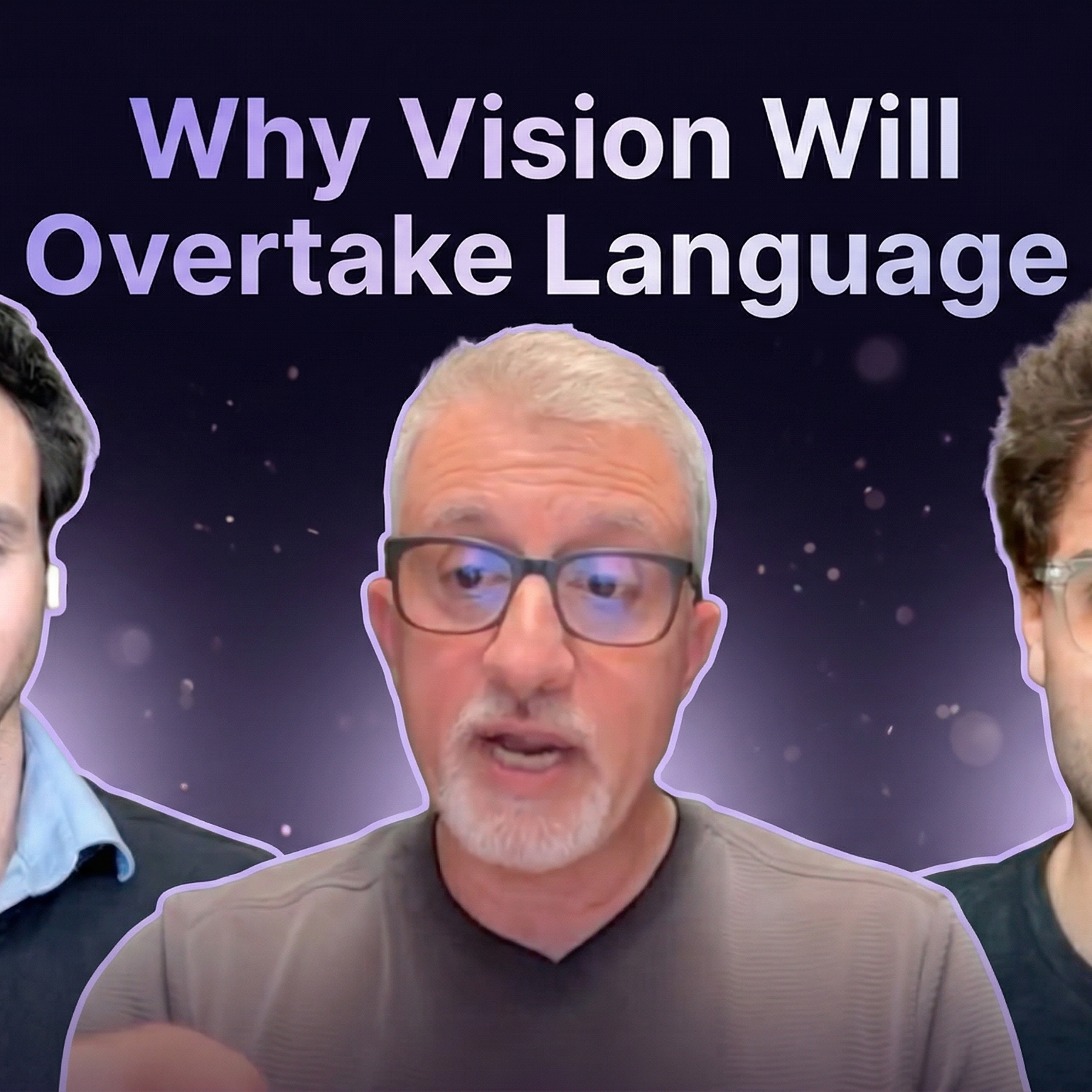
How to Build the Smartest Camera in Your Pocket - with Peyman Milanfar (Google)
Description
In this episode, we sit down with Peyman Milanfar, Distinguished Scientist at Google, where he leads the Computational Imaging team. Peyman is a member of the National Academy of Engineering, an IEEE Fellow, and one of the key minds behind the imaging pipeline in Google Pixel phones. Before joining Google, he was a professor of Electrical Engineering at UC Santa Cruz for 15 years, and he helped develop the imaging pipeline for Google Glass during his time at Google X. With over 35,000 citations and decades of work at the intersection of image processing and AI, Peyman makes a compelling case that denoising, long dismissed as a "digital janitor" task, is actually one of the most fundamental operations in modern machine learning, on par with SGD and backpropagation.
We trace the full arc from classical denoising algorithms to modern diffusion models. Peyman explains how early denoisers implicitly learned from image patches, how the "Is Denoising Dead?" paper in 2010 led him to ask what else denoisers could do beyond cleaning up noise, and how that question opened the door to regularization by denoising and, eventually, to the diffusion models powering image generation today.
We also dig into the practical side, including how Peyman's team shipped a one-step diffusion model on the Pixel phone for 100x ProRes Zoom, the challenges of controlling hallucinations in generative models for consumer products, and why understanding physics and the image formation process still matters in the age of large models.
The conversation wraps with a big-picture debate: why has language dominated the AI spotlight while vision lags behind? Peyman argues that visual intelligence is coming next, and that, unlike language, vision requires grounding in the physical world through robotics, world models, and continuous learning. He also reflects on his journey from professor to industry researcher and why he wouldn't trade the ability to take ideas from theory to millions of users.
Timeline
0:13 Intro
1:42 Why denoising matters
3:20 History of denoising
5:57 How denoisers work
9:39 Why phones need denoising
12:54 Tesla's vision-only bet
14:14 BM3D's dominance
16:58 "Is Denoising Dead?"
18:21 Regularization by Denoising (RED)
24:26 RED looks like diffusion
26:19 Denoising & manifolds
28:42 Energy-based vs. diffusion models
33:46 Blind denoisers
40:30 Diffusion for text
45:44 Perception-distortion tradeoff
53:05 Denoising vs. editing
57:01 ComfyUI & democratization
58:51 One-step diffusion on Pixel
59:51 Coding agents & domain expertise
1:02:45 Diffusion for music
1:06:53 World models & continuous learning
1:15:01 Why vision will overtake language
1:21:12 Professor vs. Google
1:25:08 Wrap-up
Music:
- "Kid Kodi" - Blue Dot Sessions - via Free Music Archive - CC BY-NC 4.0.
- "Palms Down" - Blue Dot Sessions - via Free Music Archive - CC BY-NC 4.0.
- Changes: trimmed
About: The Information Bottleneck is hosted by Ravid Shwartz-Ziv and Allen Roush, featuring in-depth conversations with leading AI researchers about the ideas shaping the future of machine learning.