Episode Details
Back to Episodes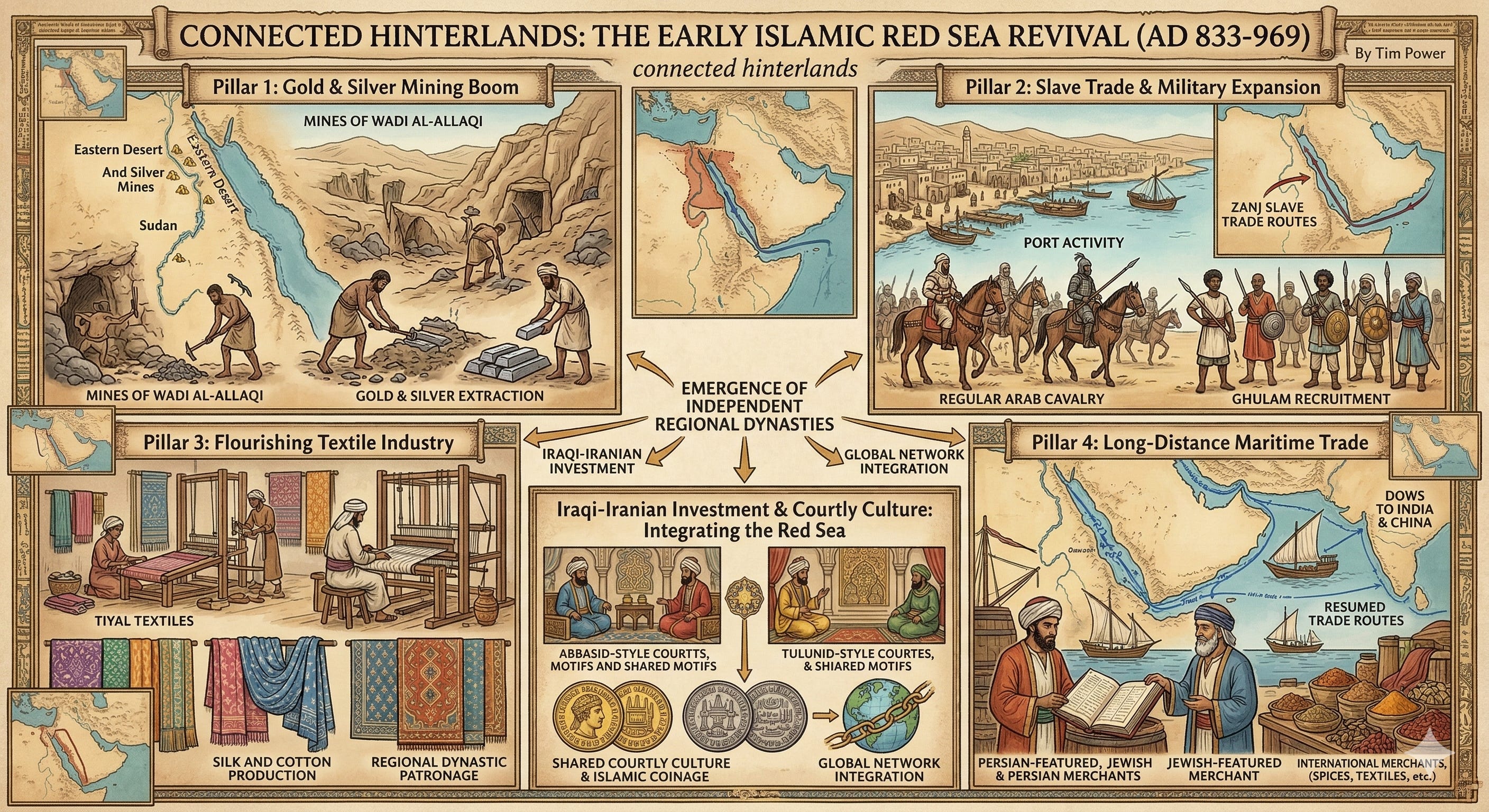
The Red Sea Renaissance: Unearthing the Pre-Fatimid Commercial Boom
Description
The scholarly discourse surrounding the Red Sea region has long been dominated by the narrative of Fatimid primacy, suggesting that significant economic prosperity and sophisticated trade networks only truly flourished under their rule from the late 10th century onwards. However, a compelling and meticulously researched article by Tim Power, published within the proceedings collection Connected Hinterlands, powerfully challenges this established view. Power presents persuasive evidence for a dramatic commercial growth that occurred much earlier, specifically between AD 833 and 969, an era that can be rightfully characterized as a “Red Sea Renaissance.”
This paper seeks to expand upon the core arguments presented in Power’s work, delving deeper into the historical context and the specific catalysts that propelled this remarkable, albeit long-overlooked, economic revival. By moving beyond the Fatimid-centric model, we can gain a more nuanced and accurate understanding of the dynamics that shaped the Red Sea as a critical maritime and economic artery in the early medieval period.
Follow the story along here.
A Revisionist History: Beyond the Fatimid Shade
For decades, the dominant historical narrative relegated the pre-Fatimid era in the Red Sea to a period of relative stagnation or, at best, a fragmented precursor to the ‘golden age’ that was to come. Power’s work is part of a broader revisionist movement that actively seeks to reclaim and illuminate the significance of earlier centuries. He argues that this focus on the Fatimids has inadvertently obscured a vibrant period of commercial activity and regional integration that was not dependent on their subsequent empire-building.
The time frame under consideration, AD 833-969, corresponds to a period of decentralization within the wider Islamic world. The unified Abbasid Caliphate, centered in Baghdad, was facing internal fragmentation and the rise of autonomous regional powers. While this may have weakened the absolute control of the Caliphs, Power suggests that it paradoxically created the space and impetus for a different kind of growth: one driven by localized ambition and independent Muslim states.
The Catalysts of Growth: Paving the Way for Revival
This Red Sea Renaissance was not a monolithic event but rather the culmination of several interrelated factors, many of which can be traced back to the proactive policies and economic interests of these newly independent Muslim dynasties, particularly in Egypt and Yemen. These dynasties, though potentially rivaling each other, found a common interest in securing and capitalizing on the Red Sea trade routes.
Several key developments were instrumental in fueling this pre-Fatimid boom:
A Resurgent Mining Industry: The Foundations of Wealth
A crucial pillar of this early economic revival was a resurgent mining industry, which provided the essential resources for coin production and further commercial activity. Power points to a deliberate and concerted effort by these regional states to restart or expand mining operations. The procurement of precious metals, particularly gold and silver, was paramount, as it formed the basis of the currency that facilitated increasingly large-scale and long-distance transactions.
This wasn’t just a haphazard resurgence; it involved significant investment in infrastructure and technology. The reopening of old mines, likely dating back to the Roman or even Pharaonic periods, and the exploration for new deposits required substantial state support. This organized approach speaks volumes about the strategic importance placed on securing a steady supply of bullion, and it provides a concrete example of the active state involvement that underpinned this commercial growth.
The Expansion of the Slave Trade: A Commercial Engine,