Episode Details
Back to Episodes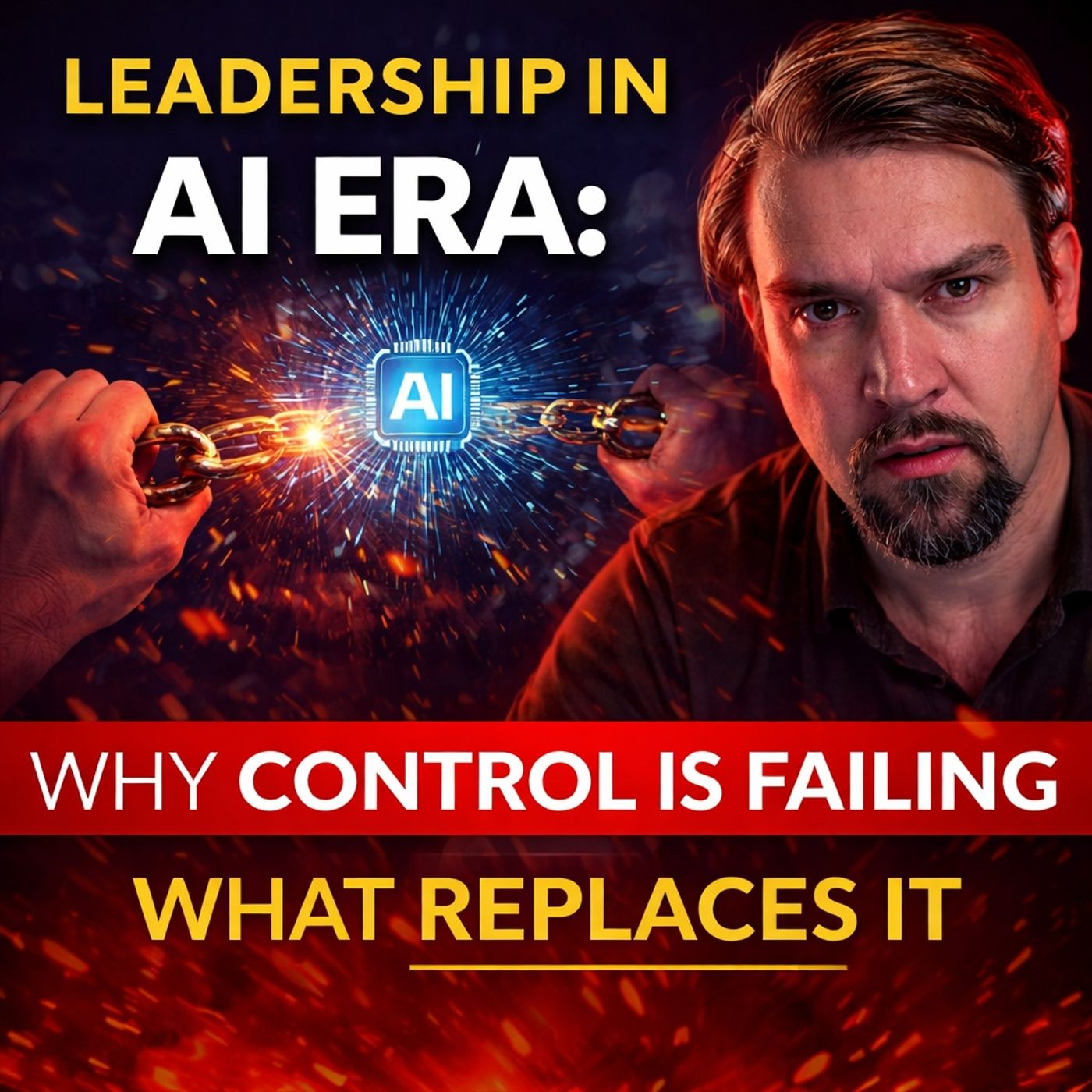
Why Leadership Control Fails in the Age of AI (And What Replaces It in Microsoft 365)
Season 1
Published 4 months, 1 week ago
Description
In this episode of m365.fm, Mirko Peters explains why leadership models built on control are failing in the age of AI — not because leaders are ineffective, but because control itself does not scale in systems that require speed, autonomy, and clarity.
As organizations deploy AI across Microsoft 365 environments, a fundamental shift becomes visible: leadership can no longer function as the coordination layer. AI accelerates decision-making, exposes structural dependencies, and removes the tolerance for human bottlenecks. The issue is not leadership quality — it is the operating model behind it.
AI is not just a technology shift. It is a structural stress test for how decisions are made, how ownership is defined, and how systems operate under pressure. This episode breaks down why control-based leadership models collapse under AI — and what replaces them.
WHAT YOU WILL LEARN
Most organizations believe leadership is required to maintain control as complexity increases. AI proves the opposite. The more your system depends on leaders to make decisions, resolve conflicts, and coordinate work, the more fragile it becomes under speed and scale. AI does not remove leadership. It removes the need for leadership as a control mechanism. What replaces it is architecture — systems that define decisions, enforce constraints, and enable execution without constant human intervention.
WHY LEADERSHIP CONTROL FAILS IN AI ENVIRONMENTS
Mirko Peters is a Microsoft 365 expert, architect, and host of m365.fm. He works with organizations ranging from small businesses to large enterprises, focusing on Microsoft 365 architecture, governance design, AI integration, and scalable operating models. His work centers on designing systems that reduce complexity, enable autonomous execution, and create sustainable performance in modern organizations.
Become a supporter of this podcast:
As organizations deploy AI across Microsoft 365 environments, a fundamental shift becomes visible: leadership can no longer function as the coordination layer. AI accelerates decision-making, exposes structural dependencies, and removes the tolerance for human bottlenecks. The issue is not leadership quality — it is the operating model behind it.
AI is not just a technology shift. It is a structural stress test for how decisions are made, how ownership is defined, and how systems operate under pressure. This episode breaks down why control-based leadership models collapse under AI — and what replaces them.
WHAT YOU WILL LEARN
- Why leadership models based on control fail in AI-driven environments
- How AI exposes decision bottlenecks in Microsoft 365 organizations
- Why coordination through leaders does not scale with increasing complexity
- What replaces leadership as the primary control layer in modern systems
- How operating models must change to support AI-driven execution
- What autonomy actually requires at a structural level
Most organizations believe leadership is required to maintain control as complexity increases. AI proves the opposite. The more your system depends on leaders to make decisions, resolve conflicts, and coordinate work, the more fragile it becomes under speed and scale. AI does not remove leadership. It removes the need for leadership as a control mechanism. What replaces it is architecture — systems that define decisions, enforce constraints, and enable execution without constant human intervention.
WHY LEADERSHIP CONTROL FAILS IN AI ENVIRONMENTS
- Decisions routed through leaders create systemic delays
- AI accelerates execution beyond human coordination capacity
- Control introduces dependency instead of enabling autonomy
- Governance relies on interpretation instead of enforcement
- Decision ownership is unclear or inconsistently applied
- Leaders become bottlenecks in high-speed environments
- AI exposes leadership dependency as a structural weakness
- Control does not scale — it creates fragility under pressure
- Leadership must shift from control to system design
- Governance must be embedded, not manually enforced
- Scalable organizations reduce decision needs instead of managing them
- The future of leadership is architectural, not operational
- CIOs and IT leaders navigating AI adoption in Microsoft 365
- Microsoft 365 architects designing governance and operating models
- Transformation leaders dealing with increasing system complexity
- Organizations struggling with decision bottlenecks and coordination overload
- Leadership in the Age of AI
- Microsoft 365 Governance & Operating Models
- AI and Organizational Design
- Decision Architecture & Autonomy
- Structural Readiness for AI
Mirko Peters is a Microsoft 365 expert, architect, and host of m365.fm. He works with organizations ranging from small businesses to large enterprises, focusing on Microsoft 365 architecture, governance design, AI integration, and scalable operating models. His work centers on designing systems that reduce complexity, enable autonomous execution, and create sustainable performance in modern organizations.
Become a supporter of this podcast:
Listen Now
Love PodBriefly?
If you like Podbriefly.com, please consider donating to support the ongoing development.
Support Us