Episode Details
Back to Episodes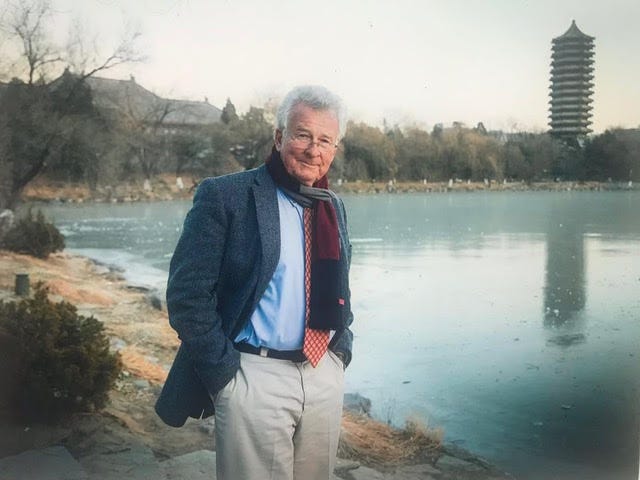
Interview | Roger T. Ames: Bringing Chinese Philosophy Onto The Stage of The Modern World
Description
In 2011, Confucian Role Ethics: A Vocabulary was published by the University of Hawai‘i Press and the Chinese University of Hong Kong Press. In this work, “Confucian Role Ethics” was for the first time systematically and comprehensively articulated, presenting Confucian ethics as a distinctive ethical system centred on “relational being” and “role-bearing persons”. This framework distinguishes itself from dominant Western traditions such as deontology, utilitarianism, and virtue ethics in its conventional form.
The concept has received widespread acclaim in the international academic community. It has been praised for its holistic, narrative, and practical character, revitalising Confucianism as a living moral tradition transmitted across generations and endowed with universal philosophical significance. While some scholars, such as Stephen Angle, have raised critical questions, they nonetheless acknowledge its core insights — particularly its relational conception of the person — as both compelling and illuminating. Today, “Confucian Role Ethics” has become a recognized term within contemporary ethical discourse. The author of this work is Roger T. Ames, widely regarded as “one of the most distinguished interpreters of Chinese philosophy in the Western world.”
Roger T. Ames was born in 1947 in Toronto, Canada, and grew up in the United Kingdom and Vancouver. As a young man, he developed a strong interest in poetry and literature. Around 1966, he left Canada to study liberal arts at the University of Redlands in California, later transferring to the University of British Columbia (UBC), where he majored in philosophy and Chinese language and obtained his bachelor’s degree. During this period, he spent a year as an exchange student at the Chinese University of Hong Kong, marking his first deep engagement with Chinese culture. There, he was profoundly influenced by scholars such as Lao Sze-Kwang and Tang Junyi.
After completing his undergraduate studies, Ames pursued a master’s degree at National Taiwan University (1970–1972) under the tutorial supervision of Yang Youwei, earning an MA in philosophy. In 1975, he moved to the United Kingdom to study at the School of Oriental and African Studies (SOAS), University of London, under the renowned sinologist D. C. Lau, and completed his PhD in 1978. His doctoral dissertation, titled The “Chu Shu” chapter of the Huai-Nan-Tzu: The sources and orientation of its political thought, laid a solid foundation for his mastery of classical Chinese and his cross-cultural comparative perspective.
After receiving his PhD in 1978, Ames joined the Department of Philosophy at the University of Hawai‘i at Mānoa as an assistant professor. He remained there for 38 years (1978–2016), later serving as associate professor, full professor, and director of the Center for Chinese Studies. He is an important heir to the University of Hawai‘i’s tradition of comparative philosophy, a tradition that can be traced back to scholars such as Charles A. Moore. After retiring as Professor Emeritus in 2016, Ames relocated to China. He currently serves as Humanities Chair Professor at Peking University and Academic Director to Berggruen Institute China.
Over the years, Ames has consistently reinterpreted classical Chinese thought through the lenses of process philosophy and relationality. He has articulated Confucian ethics as a distinctive ethical system grounded in concrete social roles and dynamic relational practices, offering a compelling East Asian alternative to contemporary global ethical dilemmas. In addition, he has long promoted dialogue between pragmatism and Chinese philosophy, systematically developing a distinctive “vocabulary” for Chinese thought that emphasizes its processual, contextual, and narrative dimensions. His work has had a profound impact on comparative philosophy, the contemporary revival of Confucianism, and cross-cultural ethical studies. It